






Apple iOS 27 Privacy Changes Put AdTech Tracking At Risk

Apple iOS 27 privacy changes are creating fresh concerns across the digital advertising industry. Advertising technology companies are facing restrictions on certain domains used for audience identification, cross-site tracking, and ad delivery. The issue has become important for advertisers, publishers, and data providers that depend on these systems to run and measure campaigns.
The latest development is not a completely new announcement from Apple. Instead, the industry is responding to the effects of the iOS 27 update released in September, along with changes reported in the newer iOS 27.2 beta. However, the wider issue involving advertising identity and data companies remains unresolved.
For advertisers, the concern goes beyond cookies. If a browser blocks a domain that an advertising platform needs to identify audiences or deliver an ad, the impact can reach several parts of a campaign. It may affect targeting, reporting, and the way publishers earn money from their online content.
What The Apple iOS 27 Privacy Changes Mean For AdTech
The Apple iOS 27 privacy changes involve WebKit, the browser engine used by Safari and by browsers running on Apple's iOS devices. A public WebKit bug report, filed by an engineer at The Trade Desk on September 21, documents requests to the company's adsrvr.org domain being blocked on iOS 27.
The report identified several domains associated with advertising identity and data services. These included domains linked to The Trade Desk's Unified ID 2.0 initiative, ID5, LiveRamp, Permutive, and Audigent. The report also explained that adsrvr.org was used for core ad requests and delivery, not just identity matching.
This distinction matters because blocking a tracking identifier and blocking an ad-serving domain are not the same thing. When an identifier becomes unavailable, advertisers may lose one way of recognizing users across websites. When a domain needed for ad delivery is blocked, the problem can extend to whether an ad request reaches its destination at all. Business Insider also reported on October 7 that the changes had created uncertainty for companies that depend on advertising identifiers and other post-cookie technologies.
The Trade Desk Gets Some Relief In The iOS 27.2 Beta
One of the most important recent developments involves The Trade Desk, a major demand-side platform used by advertisers to buy digital advertising. Its advertising technology helps brands purchase inventory across websites and other digital channels.
The company's engineering team reported that Safari on iOS 27 was blocking requests to adsrvr.org. Because the domain plays a central role in the company's ad-serving operations, the restriction raised concerns about delivering advertisements to affected Apple-device users. The public WebKit bug report records a response from WebKit engineer John Wilander on October 5 asking the reporter to test a new iOS 27.2 beta. The Trade Desk's engineer acknowledged seeing the changes in that beta build.
AdExchanger subsequently reported on October 8 that the beta had removed adsrvr.org from the blocklist. Its October 9 coverage also discussed the wider consequences for programmatic advertising.
This is a positive development for The Trade Desk, but it does not mean that every issue has been resolved. The change was reported in a beta version, and the same restrictions may continue to affect users running earlier versions until a relevant update reaches them. There is also a wider question about the other companies and domains that may be affected. A change addressing one advertising platform does not automatically restore every identity, analytics, or measurement service used across the open web.
Why Apple iOS 27 Privacy Changes Could Affect Audience Targeting
Digital advertising companies use different methods to help advertisers reach relevant audiences. Some services use first-party information supplied by a publisher or advertiser. Others help connect data from different websites, devices, and advertising environments. These connections can help marketers understand whether the same audience has interacted with a campaign across multiple channels. They can also support frequency management, audience segmentation, and campaign measurement.
The Apple iOS 27 privacy changes could make some of these activities more difficult when the browser blocks a domain used by an identity or data provider. An advertising platform may receive less information about a user or may be unable to use a particular identifier in the usual way.
For example, a brand might run a campaign across a publisher's website and a connected-TV service. Identity matching can help the advertiser understand how those separate interactions relate to one another. If a required identity service becomes unavailable, the advertiser may have a less complete view of the campaign.
This does not mean that all audience targeting will stop working on Apple devices. Advertising platforms use different technologies, and not every campaign depends on the same identifiers or domains. The actual effect will depend on the service involved, the browser environment, and the way the campaign is configured. Advertisers should therefore avoid assuming that every campaign has been affected equally. They need to check their own delivery and measurement data before making major changes to their advertising strategy.
What The Changes Could Mean For Publishers And Advertisers
Publishers are also watching the situation because advertising revenue depends partly on how effectively they can offer inventory to buyers. If an advertiser cannot use its usual targeting or measurement tools, it may value certain placements differently.
In some cases, limited audience information could make it harder to demonstrate the value of a campaign. This may create additional pressure on publishers that rely heavily on programmatic advertising revenue. Advertisers could face similar challenges. If their campaigns lose access to certain identity signals, they may find it harder to compare performance across channels or understand how different touchpoints contribute to conversions. There is also a measurement concern. Advertising reports may show that an impression was purchased even when the ad did not render as expected.
Such discrepancies need to be investigated carefully. A blocked domain does not automatically mean that every recorded impression is invalid, and advertisers should not assume that all campaign spending has been wasted. They should compare auction records, delivery logs, and available publisher-side reporting to determine what happened.
For businesses already working to improve native ads attribution, this situation is another reminder that campaign measurement depends on more than the numbers displayed in a single advertising dashboard. The quality and availability of the underlying data matter too.
Apple Has Not Publicly Explained The Full Scope Of The Blocklist
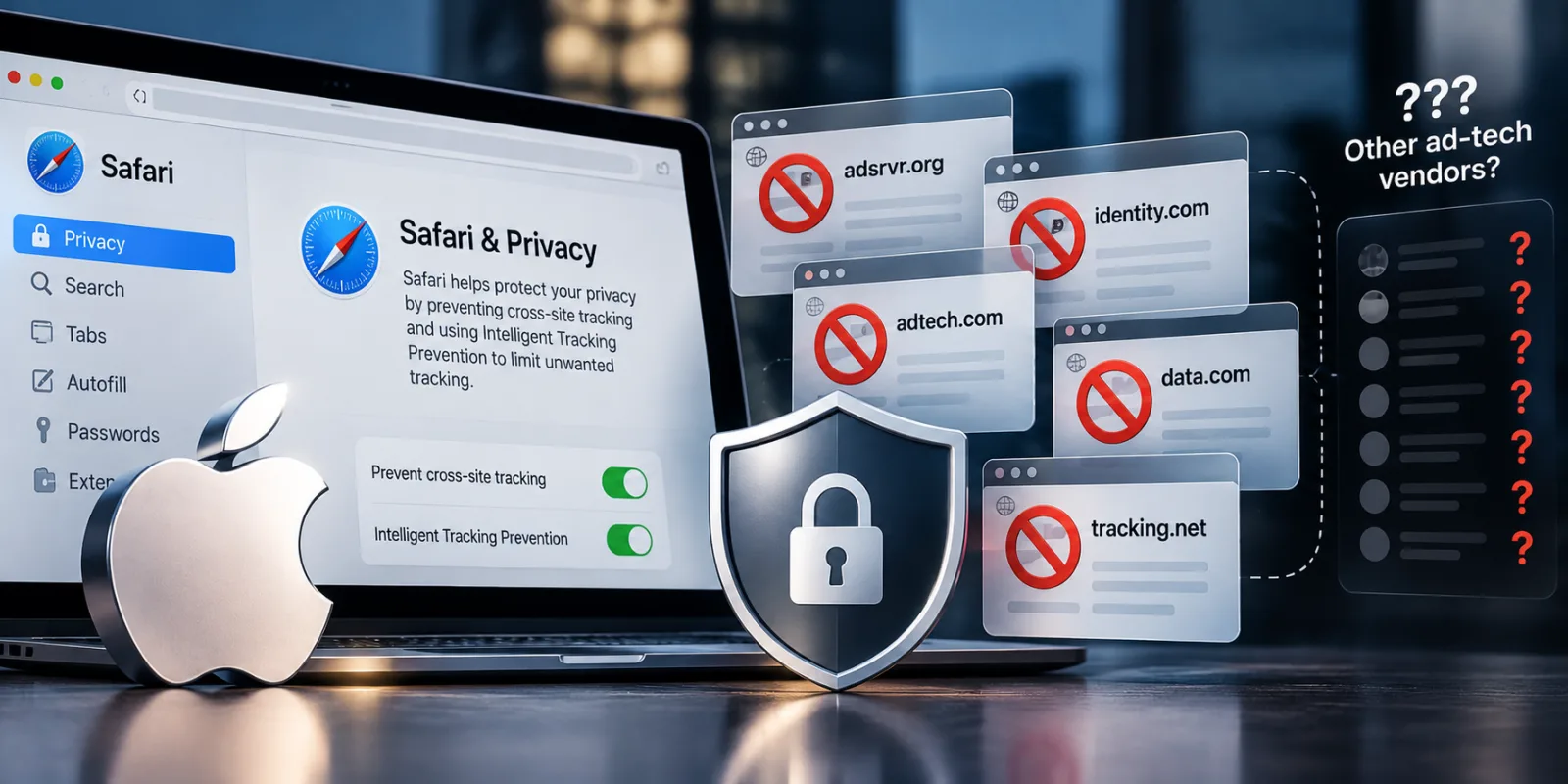
Apple has long promoted privacy protections in Safari. Its official Safari and Privacy documentation describes features such as preventing cross-site tracking and using Intelligent Tracking Prevention to limit unwanted tracking. However, the current dispute raises a separate question: which advertising and data domains are blocked, what criteria determine inclusion, and how might that list change?
AdExchanger reported on October 2, citing sources familiar with WebKit's plans, that the potential blocklist could extend to hundreds of ad-tech, marketing technology, and identity vendors. Its October 8 coverage continued to examine the possible wider effects.
That reported scale should be treated carefully. It is not the same as a publicly confirmed list of hundreds of companies that have all experienced measurable advertising disruption. Apple has not publicly explained the complete scope and selection criteria in the sources reviewed for this article. The distinction is important for accurate reporting. The public WebKit issue provides direct technical evidence of the adsrvr.org problem, while the wider claims about a much larger list come from industry reporting based on sources familiar with the situation. The latest developments therefore raise legitimate questions, but they do not establish that every advertising technology company is currently blocked or that all ads on Safari have stopped working.
What Advertisers Should Do Next
Advertisers do not need to stop their campaigns simply because of the iOS 27 issue. A better approach is to check whether their own advertising systems rely on affected domains and whether campaign performance has changed. Marketing teams should review delivery reports, conversion data, and browser-specific performance. If a campaign shows an unexpected decline in impressions or conversions among Apple-device users, the team should investigate before assuming that audience demand or creative quality is responsible.
It is also worth checking with advertising platforms, analytics providers, and publishers about any known delivery or measurement limitations. This can help separate a technical problem from normal campaign fluctuations. Businesses should review how much they depend on third-party identity providers and whether their measurement setup has reliable alternatives. First-party data, collected with appropriate permission, can support audience understanding without relying entirely on cross-site identifiers. Server-side measurement may also help in some cases, although it is not a universal workaround for every browser restriction and must still respect applicable privacy requirements.
Advertisers should not try to bypass privacy protections through fingerprinting or other methods designed to identify people without appropriate consent. Instead, they should focus on transparent data practices, reliable measurement, and systems that can operate when individual identifiers are unavailable.
What Happens Next For Apple iOS 27 Privacy Changes?
The next important milestone is the wider release of iOS 27.2 and any further changes to WebKit's blocking behavior. The beta update reported by AdExchanger offers some relief for The Trade Desk, but the situation involving other data and identity providers remains uncertain.
Advertisers and publishers will also be watching for clearer information about which domains are affected and how the changes influence ad delivery. Any confirmed update from Apple or WebKit could help companies decide whether they need to change their technical setup or reporting processes. For now, the main lesson is that browser-level privacy decisions can affect more than user tracking. They can also influence how advertising requests are processed, how campaigns are measured, and how publishers sell their inventory.
The Apple iOS 27 privacy changes are therefore worth watching closely, especially for businesses that depend on programmatic advertising and cross-channel measurement. But the industry should distinguish confirmed technical findings from broader predictions while the situation continues to develop. As new information becomes available, the most useful response for advertisers will be to test their own systems, check the quality of their data, and prepare for a digital advertising environment in which access to user identifiers cannot be taken for granted.
Agency ad accounts, without the wait.
Buy and top up Google, Meta, native, and more from one dashboard.
Get started


No comments yet. Be the first to comment.
Comments are open to registered AdScaleLab clients.
Sign in to comment