





The Top Native Advertising Networks in the World in 2026
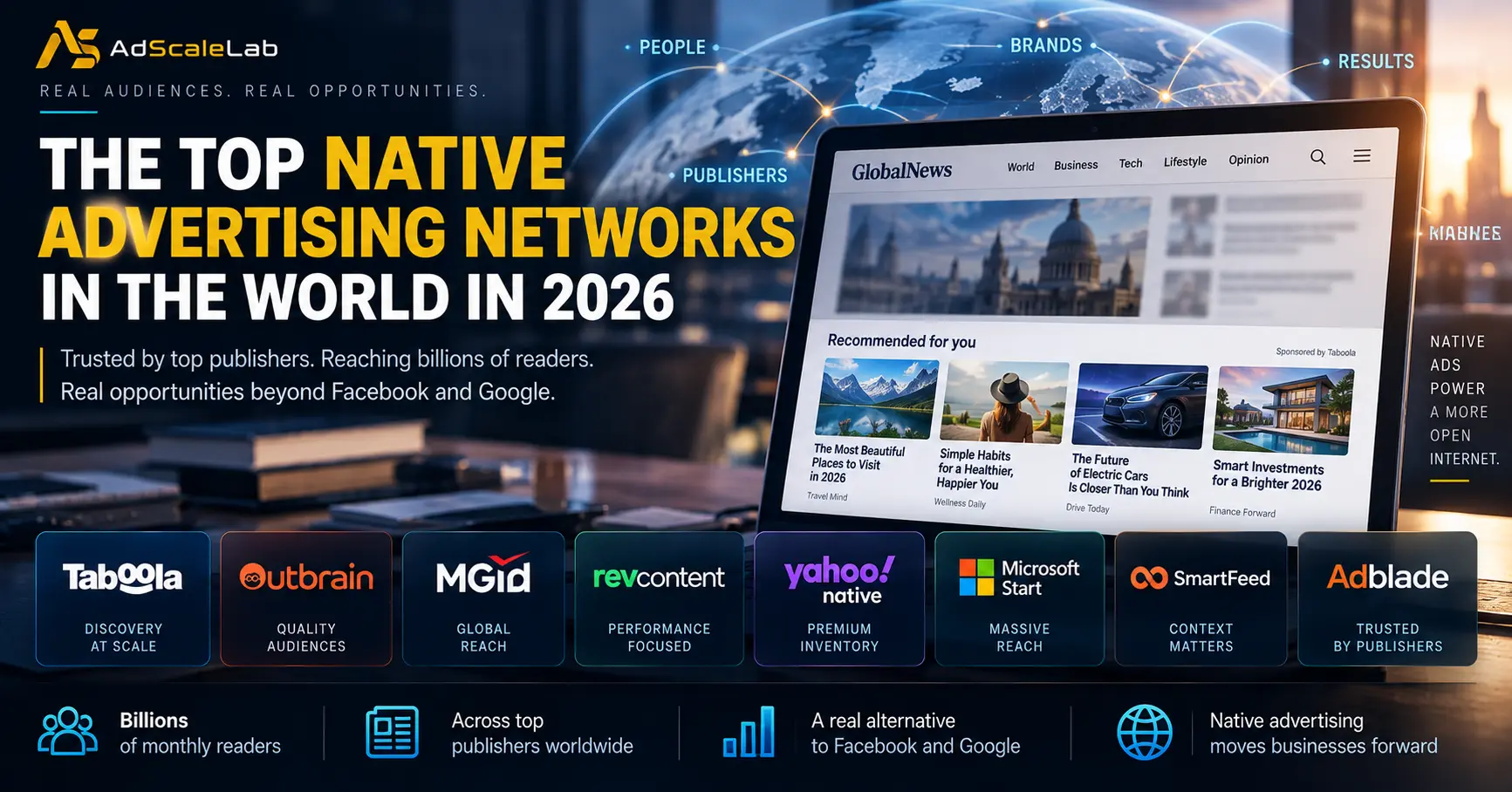
Native advertising networks put their ads at the bottom of almost every news article online: a row of headlines with small pictures, usually four or six across. Some of those headlines are more articles from the same site. Some are ads placed by businesses, and most readers cannot tell which is which at a glance.
That row is native advertising, and it is one of the biggest advertising formats on the internet that most people could not name. It reaches billions of readers a month, it runs on nearly every major publisher in the world, and it is where a growing number of businesses go once Facebook and Google become too expensive.
A handful of native advertising networks control most of it. Here they are, ranked roughly by reach and influence, with what each one does and who it tends to work for.
1. Taboola
Taboola is the largest native advertising network in the world and has been for most of the last decade. It reaches around 1.4 billion people a month across roughly 9,000 publisher properties, with exclusive placements on NBC News, the USA Today network and Microsoft's MSN.
In 2025 it rebuilt its advertiser platform under a new name, Realize, with automated bidding that adjusts what an advertiser pays for a click depending on how likely that particular reader is to buy. It also introduced Taboola Select and Taboola Ad Agency Account, a tier made up of its top 15 percent of US publishers, including Yahoo, Business Insider, the Associated Press, CNBC and the BBC, for advertisers who want the premium end of the network only. Get taboola Ads agency account here

The most interesting development is DeeperDive, Taboola's AI answer engine. It sits on publisher websites and lets a reader ask questions about an article and get a conversational reply. Ads appear inside those answers, and the company's chief executive has said they convert better than anything else Taboola runs. If that holds, it is one of the first pieces of evidence that an AI answer is a good place to sell something.
Best for: direct-response advertisers, businesses with a story to tell, and anyone who needs scale.
2. Teads (formerly Outbrain)
For most of native advertising's history this entry would have said Outbrain, Taboola's closest rival. In February 2025 Outbrain bought Teads, a French video advertising company, for roughly $900 million, and by June it had renamed the whole business Teads.
The combined company reports 2.2 billion monthly consumers and direct relationships with more than 10,000 publishers in 36 countries, with an editorial roster that skews premium: CNN, The Washington Post, The Guardian. The recommendation widgets on publisher pages still mostly say "Outbrain," and the underlying advertising system did not change. What the merger added was video and connected-TV inventory, which is now the company's growth priority. Get outbrain ads agency account here
Best for: brand advertisers, anyone with a video asset, and businesses that care where their ads appear.
3. MediaGo
MediaGo is the international native advertising platform of Baidu Also known as MediaGo Ads, the Chinese search company, and it has become the fastest-growing name on this list in the United States and Europe.
Its advantage is data. Baidu's search business gives MediaGo intent signals that content-recommendation networks do not usually have, and its pitch to advertisers is that it can find a likely buyer among a publisher's readers without relying on personal tracking, which has become harder to do in Europe under privacy rules. It runs across a large network of publisher sites and partner apps, mostly in Tier 1 markets.
The traffic behaves like native traffic everywhere: readers, not scrollers. Long-form articles, listicles, comparison pages and product stories do well. Ads that look like a headline with a thumbnail do well. Polished brand creative does not. Get mediago ads agency account here

Best for: advertisers already running native who want a second source, and businesses whose product benefits from a page of explanation before the sale.
4. Microsoft Audience Network
Most people do not think of Microsoft as a native advertising company, but its Audience Network places native ads across MSN, Outlook.com, Microsoft Edge and a spread of partner sites, and it reaches a very large audience by default.
It reaches that audience partly because advertisers on Bing search campaigns are opted into the Audience Network automatically, which has made it one of the more controversial entries on this list. Advertisers regularly discover a meaningful share of their search budget has gone to display placements they did not choose. The inventory is real and the audience skews toward older, desktop, workplace users, but it is a network most people find themselves on before they decide to be. Get bing ads agency account here

Best for: advertisers who want to reach the MSN and Outlook audience on purpose, with placement controls set up first.
5. MGID
MGID is a large global native network with particular strength in Europe, Latin America and Southeast Asia, alongside a US presence. Its clicks tend to be cheaper than the two majors, and by most advertiser accounts the traffic needs more filtering to reach the same quality. It has invested in AI tools for creative generation and automated optimisation, and it is often the network advertisers test third, after Taboola and Outbrain, when they are looking for volume at a lower price.
Best for: advertisers with an established native funnel who want to expand into lower-cost markets.
6. Yahoo Native
Yahoo's native advertising runs across Yahoo's own properties, including Yahoo News, Finance, Sports and Mail, and reaches a large and older audience. It is bought through the Yahoo DSP and tends to attract brand and mid-funnel advertisers more than the direct-response crowd. The inventory is premium and the audience is engaged, but the network is smaller and more contained than the majors.
Best for: brands that specifically want Yahoo's audience.
7. Revcontent
Revcontent is a smaller US-focused network that has built a reputation for stricter publisher standards than some competitors, with a widget that is often faster to load and cleaner to look at. Reach is well below the top three. Advertisers who use it tend to value the control and the predictability more than the scale.
Best for: advertisers who want a tightly curated publisher list
8. Newsbreak
Newsbreak is a US local news app that has become a native advertising channel in its own right. Its audience is heavily local and mobile, and it has been a strong performer for home services, insurance and other categories that sell by region. It is not a network in the same sense as the others, since the inventory is largely inside its own app, but for local advertisers it is worth knowing.
Best for: businesses that sell locally in the United States.
Follow the money: what the public filings say
Three of the companies on this list answer to shareholders, which means their numbers are filed, audited and public. Read together, the second-quarter 2026 reports tell a clearer story about the state of native advertising than any marketing page will.
Taboola: Profitable, Buying Back Stock, and Punished Anyway
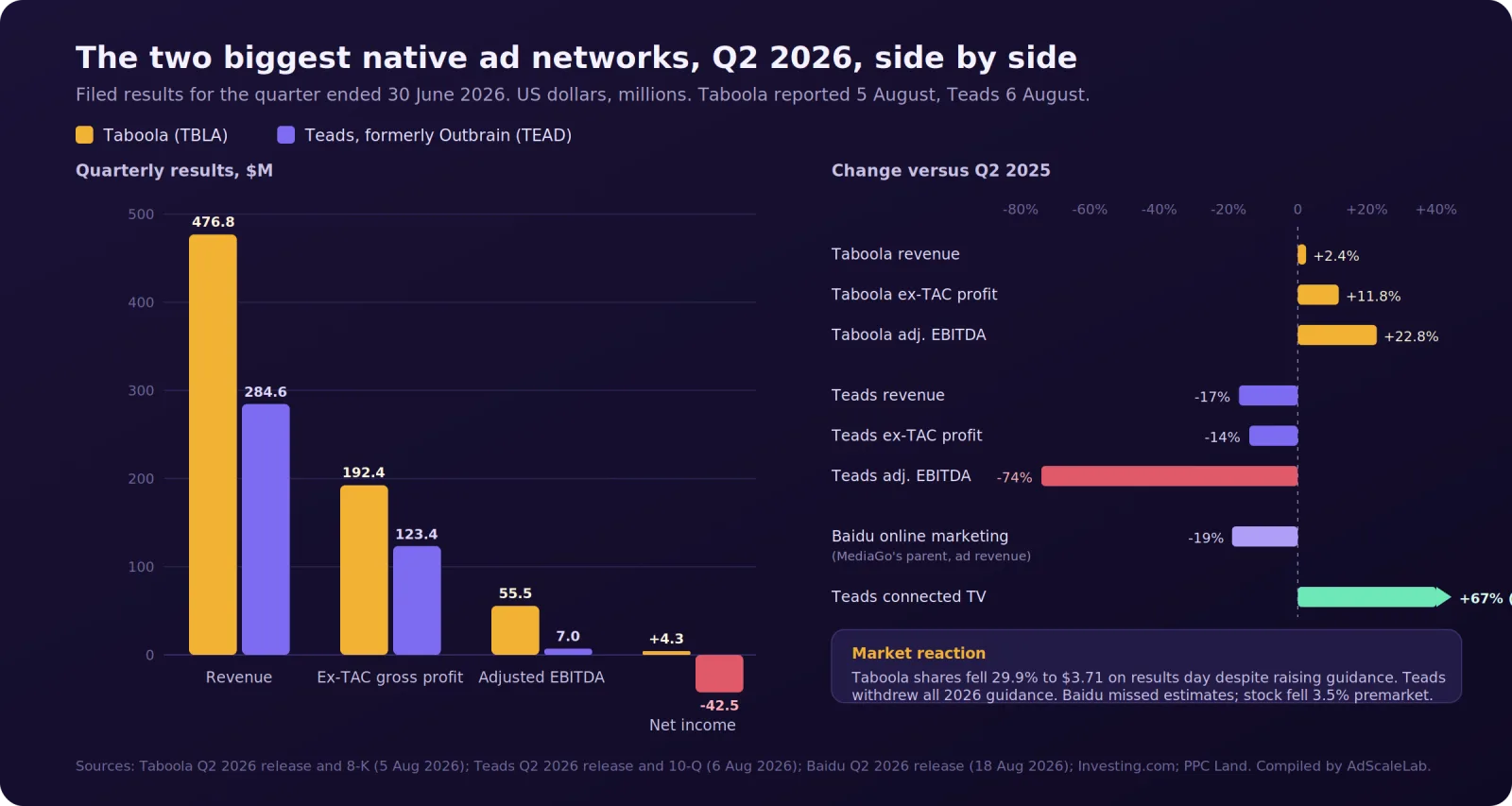
Taboola reported second-quarter revenue of $476.8 million, up 2.4 percent on the year, and swung to a net profit of $4.3 million from a $4.3 million loss a year earlier. The figure the company itself steers investors toward, gross profit after traffic acquisition costs, rose 11.8 percent to $192.4 million, and adjusted EBITDA rose 22.8 percent to $55.5 million with the margin expanding to 28.8 percent. For the first half of 2026, net income was $63.4 million against a $13.1 million loss in the same period of 2025. The company raised its full-year guidance for both profit measures, to between $772 and $783 million of ex-TAC gross profit and $228 to $240 million of adjusted EBITDA, on revenue of $1.93 to $1.96 billion.
Underneath that, some of the improvement came from one-off events. First-half results included a $77 million legal settlement, and the company cut about six percent of its workforce in April. Revenue missed analyst forecasts of around $499 million because Taboola lost a Google-related product faster than expected and spent the quarter removing low-quality publishers from its network. It has bought back roughly a fifth of its shares since 2025, including 9.4 million in the quarter for $41.4 million, and ended June with $133 million in cash.
The market did not reward any of it. Taboola shares fell 29.9 percent to $3.71 on the day the results were published, from a previous close of $5.29, landing near the bottom of the stock's 52-week range. Investors looked past the profit and the raised guidance and priced the revenue miss.
For an advertiser, the useful reading is this. Taboola is profitable, it is generating cash, it is cleaning up its publisher list, and it is spending on its Realize platform, where it says more than 300 advertisers have adopted the newer Realize+ tier. The addition of Fox News to its exclusive publisher roster during the quarter matters for reach. The platform is not going anywhere, and the network you are buying is being pruned of its worst inventory, which is what a buyer wants.
Teads: the Merger Has Not Paid Off yet
Teads, reporting a day after Taboola, told a very different story. Second-quarter revenue was $284.6 million, down 17 percent from $343.1 million a year earlier. Gross profit fell 21 percent. Adjusted EBITDA collapsed from $27 million to $7 million, a 74 percent fall, and came in below the $14 to $22 million range the company had guided to only three months earlier. The net loss widened to $42.5 million, or 44 cents a share, from $14.3 million. For the first half, the net loss was $81.3 million.
The company then withdrew its full-year guidance entirely, including the roughly $100 million adjusted EBITDA target it had reiterated in May, citing volatility in its direct response and small business advertiser segments. Profit from direct response, which is the part of the business most relevant to the advertisers reading this, fell about 30 percent. Management attributed the cost miss to expense timing, a cloud migration, currency movements in the Israeli shekel, and elevated bad debts from customers dropped during a 2025 quality clean-up.
The balance sheet is the number to watch. Teads ended June with $91 million in cash and investments against $614.5 million of debt, most of it senior secured notes taken on to fund the Outbrain purchase of Teads. Stockholders' equity had shrunk to about $7 million. First-half operating cash flow was negative.
The one strong line is connected TV, which grew 67 percent year on year and now accounts for 13 percent of revenue, up from 7 percent. The company says it will keep investing there.
For an advertiser, the reading is more complicated than Taboola's. The Outbrain-side native inventory still exists and still runs. But the company is shifting its attention and its capital toward television screens, the part of the business that serves performance advertisers is shrinking and losing money, and the debt load limits how much room there is to fix it. A buyer should expect continued changes to tooling, pricing and support, and should not assume the platform of 2027 looks like the platform of 2025.
Baidu: a Giant With a Shrinking Ad Business
MediaGo does not report its own numbers. It sits inside Baidu, a company with a market value in the tens of billions and total cash and investments of RMB 283 billion, roughly $40 billion, at the end of June. Baidu's second-quarter revenue was RMB 31.3 billion, about $4.6 billion, down 4 percent on the year and short of analyst forecasts. Net income fell 68 percent to RMB 2.3 billion.
The relevant line for MediaGo is online marketing, Baidu's advertising business, which fell 19 percent year on year to RMB 13.1 billion. The company attributed the drop to China's property slump and weak consumer demand at home, and to its own shift toward AI-driven search that is harder to monetise with traditional ads. Its AI cloud business grew 25 percent over the same period and now makes up half of general business revenue. Baidu's chief executive said plainly that online marketing remains under pressure and that the company is becoming an AI-first business.
None of that is about MediaGo specifically, which is an international product selling into US and European advertisers and is small relative to the group. But it explains the strategy. A company whose domestic ad revenue is falling 19 percent has every reason to grow an overseas ad platform aggressively, and to fund it from a balance sheet that its two native competitors combined could not approach. That is why MediaGo has been the fastest-growing name on this list, and why it is likely to stay well funded regardless of what happens to Baidu's search business at home.
What The Three Reports Add up to
The largest native network is profitable, cash-generating and improving its inventory, and its stock price reflects none of that. The second-largest is shrinking, losing money, carrying a heavy debt load and moving its investment toward television. The third is a small division of a company with more cash than the other two combined and a strong reason to grow it.
If you are choosing where to test native advertising in the next year, those are the facts behind the platform names. They matter more than any feature comparison, because features can be copied and balance sheets cannot.
The rest of this list, MGID, Yahoo, Revcontent and Newsbreak, are privately held and do not publish financials.
How to Read This List of Native Advertising Networks
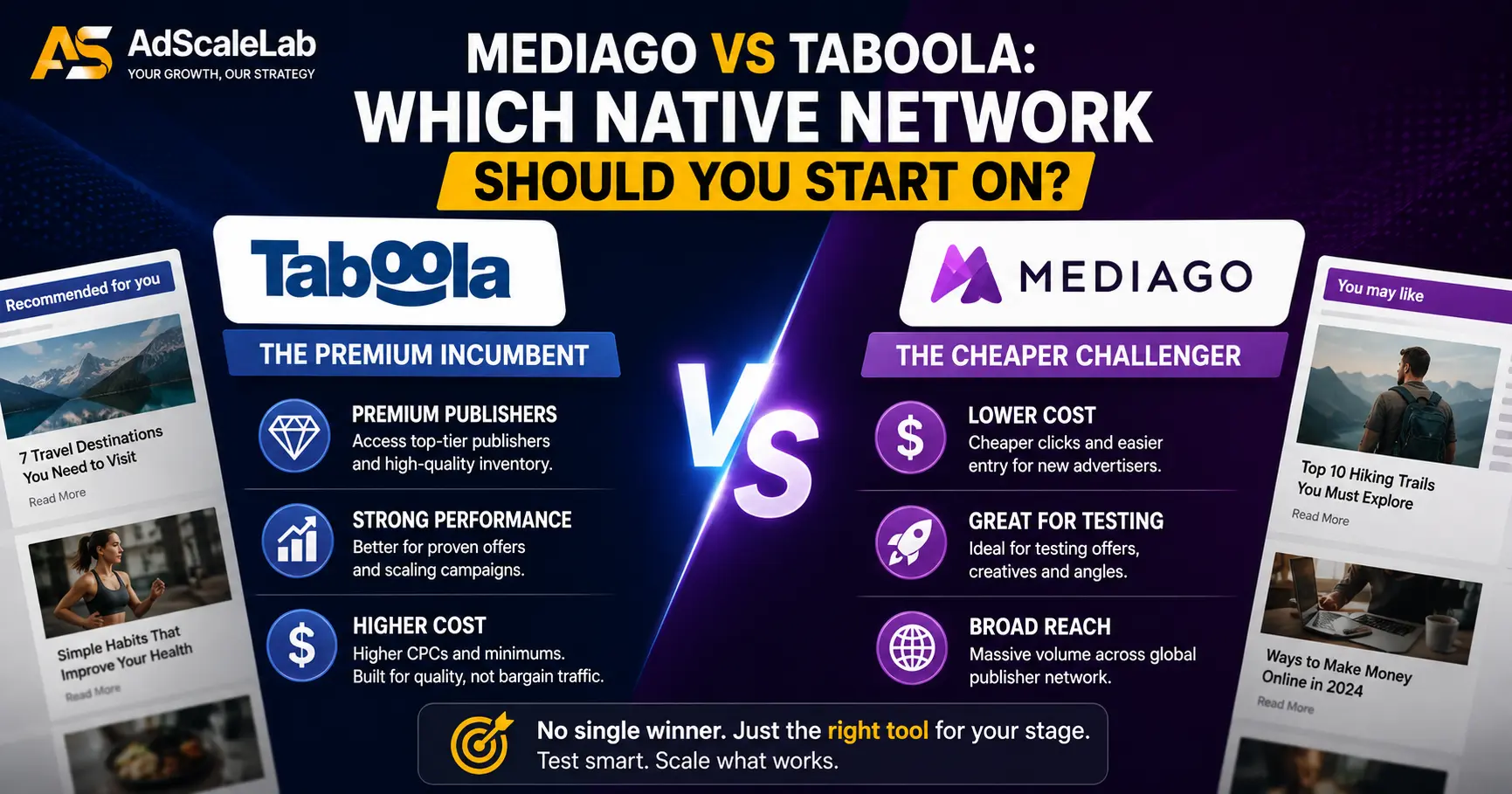
The top three between them carry the overwhelming majority of native ad spend on the open web, and for most businesses the decision is which of them to test first. Taboola is the default for reach and direct response. Teads is the default for brand and video. MediaGo is the fast riser, and the one many experienced advertisers add second.
The rest of the list is where advertisers go once they have a funnel that works and want more of it at a lower price, or a specific audience the majors do not serve well.
Getting onto the platforms is its own step. Each one reviews new advertisers and their landing pages before anything runs, approvals can take days, and a rejection often comes with no explanation. A growing number of businesses go through an account provider such as AdScaleLab to get set up on several networks at once, in the same way a small importer might use a customs broker instead of learning the paperwork themselves.
Whichever you pick, the format has rules that do not change from network to network. The reader was not looking for you, so the ad has to lead to an article that makes the case before it asks for the sale. The networks run on thousands of sites and the tools to choose among them exist but have to be used. And because the sale often happens days later through a different channel, the native platform's own reports will usually undercount what it delivered.
Native advertising networks are not new. What is new is who is using them. As the cost of the two biggest platforms keeps climbing, the row of headlines at the bottom of the article has quietly become the third option for businesses that could not keep paying more for the same thing.
Agency ad accounts, without the wait.
Buy and top up Google, Meta, native, and more from one dashboard.
Get started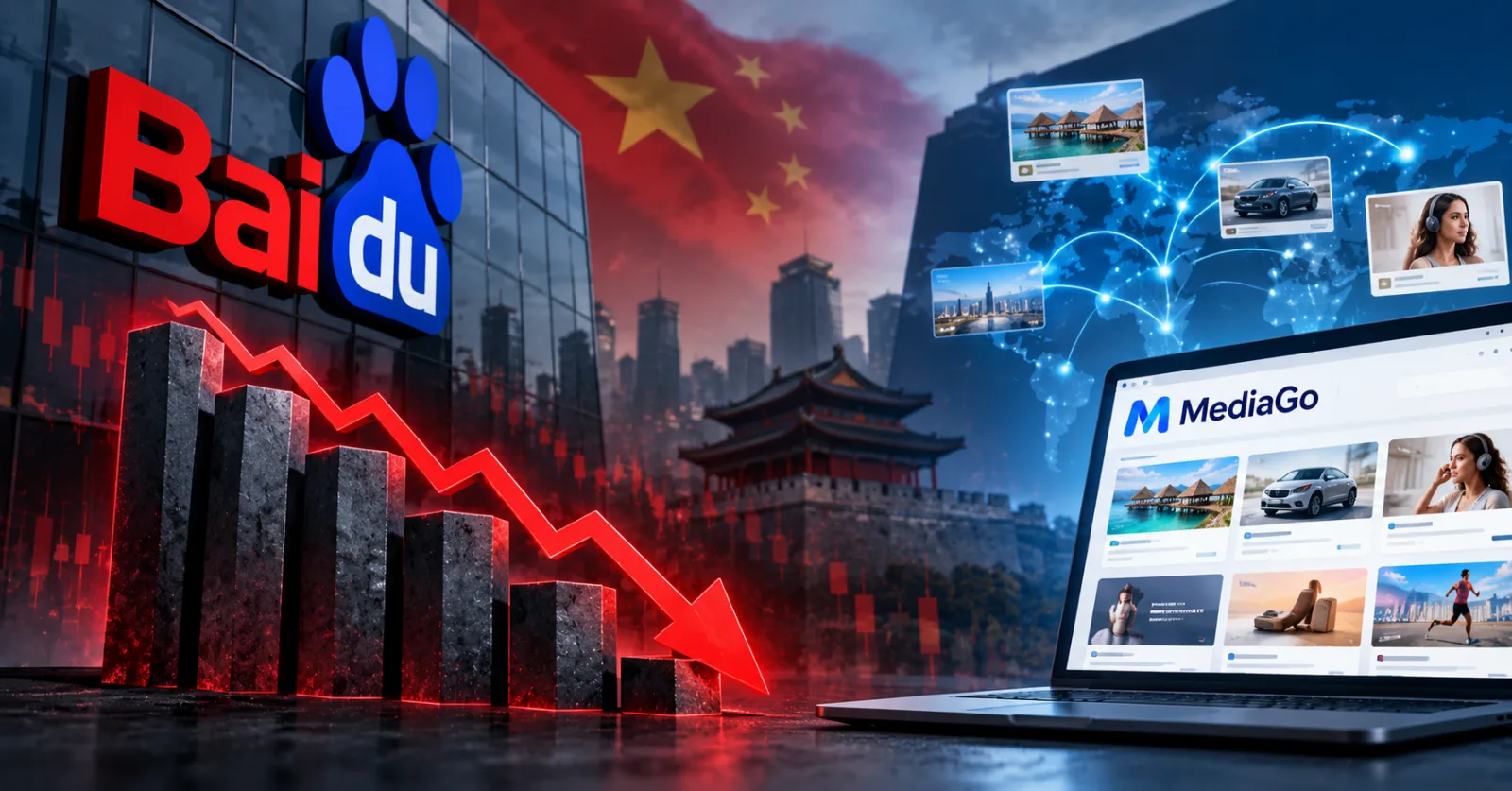

No comments yet. Be the first to comment.
Comments are open to registered AdScaleLab clients.
Sign in to comment