



MediaGo vs Taboola: Which Native Network Should You Start On?
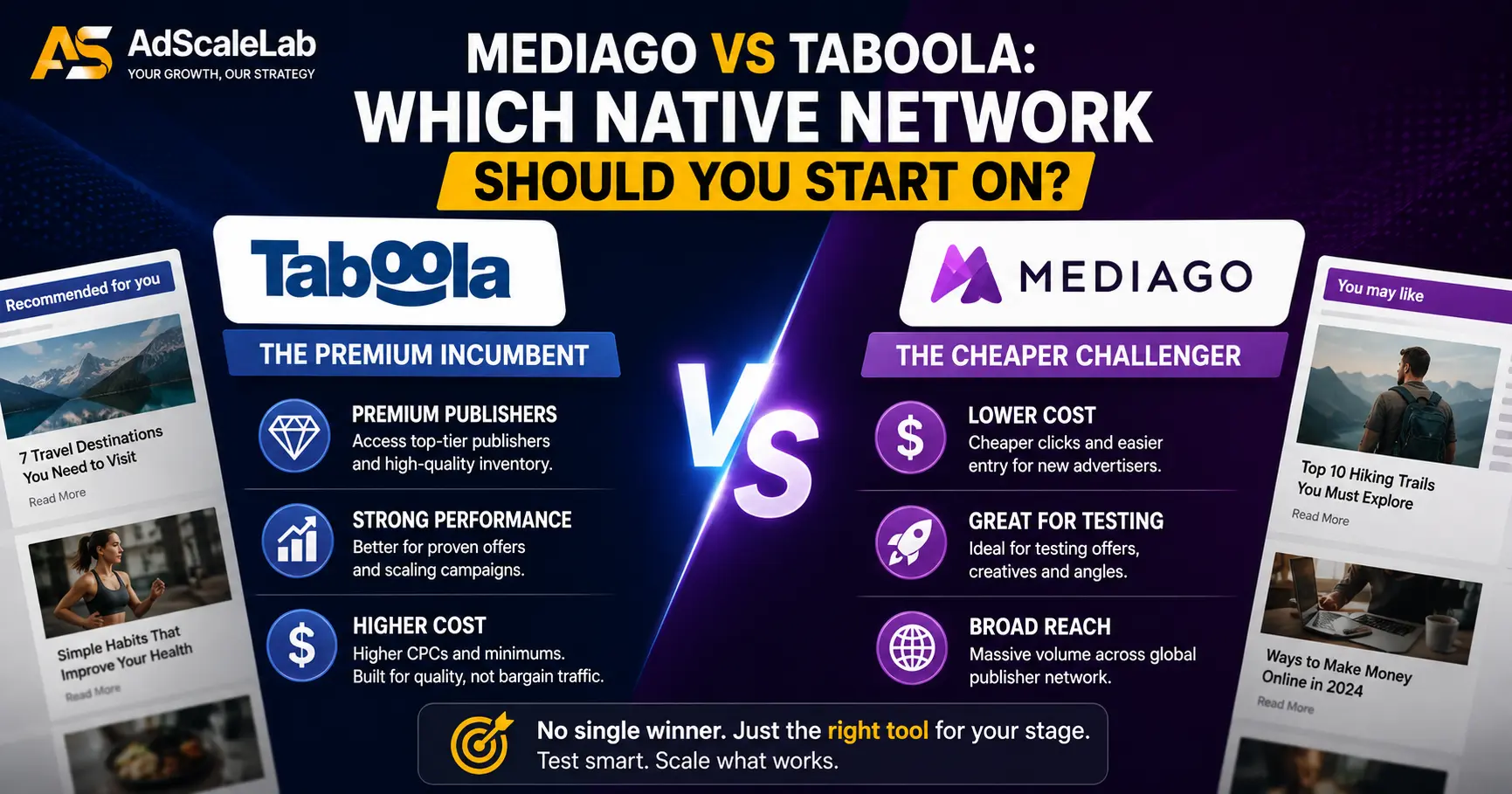
These two get compared a lot, and the comparison is usually shallow, because on the surface they do the same thing. Both are native advertising networks. Both put your ad inside the flow of content people are already reading. Both work on a headline-and-thumbnail model where the creative does most of the work.
But treating them as interchangeable is where people waste money. They are not the same kind of bet. Taboola is the premium incumbent. MediaGo is the cheaper challenger. Choosing between them is less about features and more about where you are in your campaign and what you are trying to find out.
The one-line version
MediaGo is the programmatic native platform tied to Newsbreak, so its traffic leans heavily American, skews a little older, and comes from a local-news and feed environment. It is cheaper, less crowded, and a good place to prove an offer works before you scale.
Taboola is the largest native network, placing ads across thousands of mainstream premium publishers. Bigger reach, more competition, higher cost per click, and now running under its Realize platform. It is where you go once you have something that already converts and you want volume.
Read that again and the decision almost makes itself. The question is not "which is better." It is "am I testing, or am I scaling."
Traffic: where your ad actually shows up
This is the real difference, and it is bigger than the pricing everyone fixates on.
MediaGo draws heavily on Newsbreak's audience. That means a strongly US-weighted user base, a lean toward local news consumption, and a demographic that trends a bit older and highly engaged with their feed. If your offer is US-focused, or plays well to an older, mainstream audience, that is a gift. If you need heavy international volume, it is a limit.
Taboola spreads across mainstream premium publishers, the kind of large news and content sites you already know. Broader geography, broader demographics, and enough scale that a working campaign can grow a long way before it saturates. The cost of that breadth is that you are bidding against a lot of other advertisers for the same attention.
So the honest framing is not "more traffic vs less." It is "a specific, cheaper, US-leaning audience vs a broad, premium, competitive one."
Cost: the reason people try MediaGo first
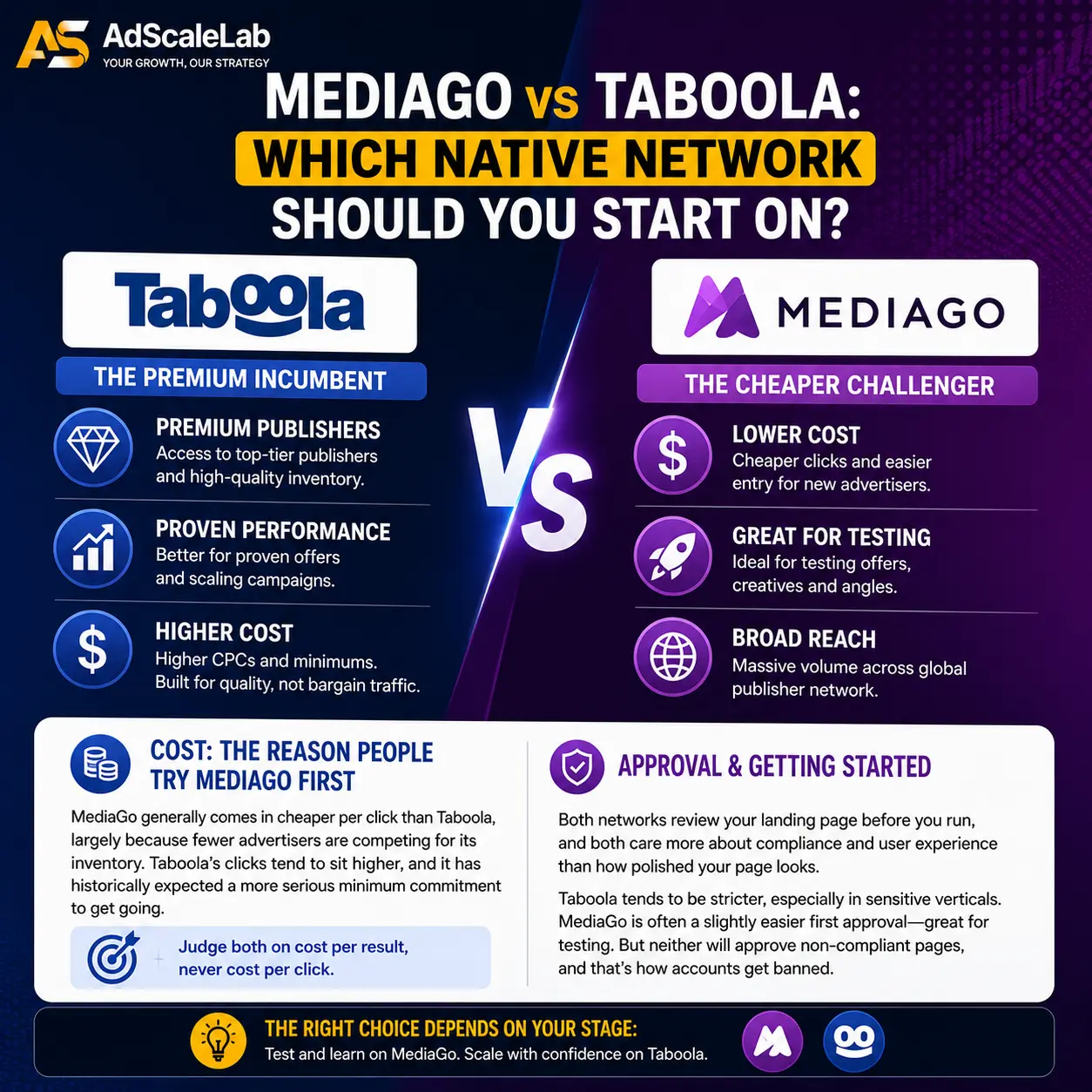
MediaGo generally comes in cheaper per click than Taboola, largely because fewer advertisers are competing for its inventory. Taboola's clicks tend to sit higher, and it has historically expected a more serious minimum commitment to get going.
But cheaper clicks are not automatically better clicks, and this is where people fool themselves. A cheap click that never converts is more expensive than a costly click that does. The right way to read the cost difference is this: MediaGo lets you gather data and test angles for less money, which is exactly what you want early. Taboola's higher cost buys you access to more volume once you already know your numbers work.
Judge both on cost per result, never cost per click. The click price only tells you how crowded the auction is, not how good the traffic is for your offer.
Approval and getting started
Both networks review your landing page before you run, and both care far more about compliance and user experience than about how polished your page looks. Unsupported claims, missing trust signals like a privacy policy or contact page, thin bridge pages, and misleading creative will get you rejected on either one.
Taboola, as the larger and more scrutinised platform, tends to be the stricter of the two, particularly in sensitive verticals. MediaGo is often a slightly easier first approval, which is another reason it suits testing. But "easier" is relative. Neither will wave through a non-compliant page, and you should not want them to, because that is how accounts get banned.
Competition and creative
On MediaGo, thinner advertiser competition means a working headline-and-thumbnail combination can stay effective a bit longer before it fatigues, and you are not immediately in an arms race. On Taboola, the sheer number of advertisers means creative burns out faster and you need a real pipeline of new angles to keep performance up.
One thing that carries across both, and trips up beginners: you cannot reuse your Facebook creative here. Native ads have to read like content, not like a social ad. A polished, obviously-staged image that screams "advertisement" underperforms on both networks. Authentic, editorial-feeling creative wins.
So which should you pick?
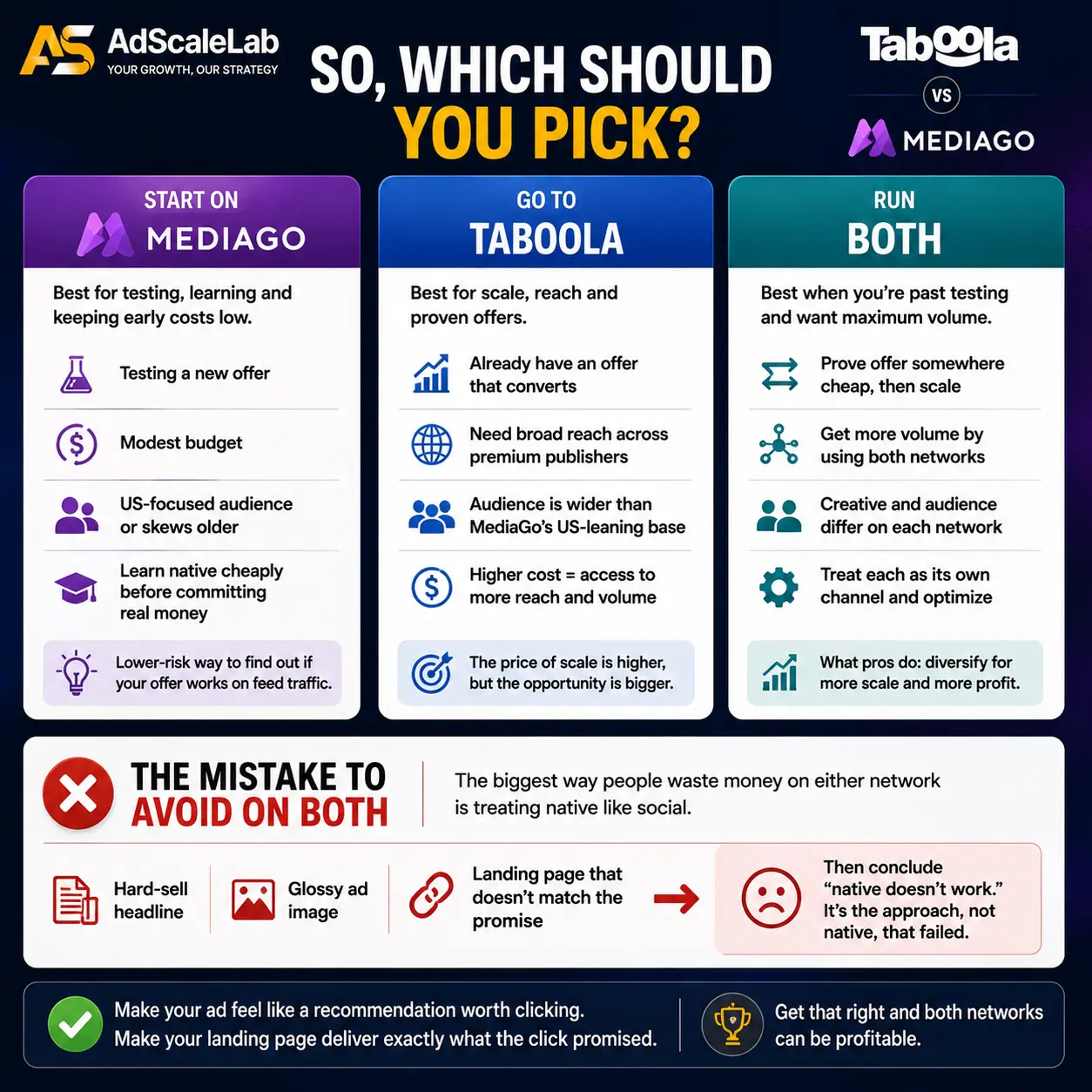
Start on MediaGo if you are testing a new offer, your budget is modest, your audience is US-focused or skews older, or you simply want to learn native cheaply before committing real money. It is the lower-risk place to find out whether your offer works on feed traffic at all.
Go to Taboola if you already have an offer that converts and you want scale, you need broad reach across premium mainstream publishers, or your audience is wider than MediaGo's US-leaning base. The higher cost is the price of that reach and volume.
Run both if you are past the testing phase and want more volume than one network gives you. This is what a lot of experienced native buyers do: prove the offer somewhere cheap, then run it across multiple networks for scale. Just remember that creative and even the audience differ between them, so you cannot copy a campaign one-to-one and expect identical numbers. Treat each as its own channel.
The mistake to avoid on both
The single biggest way people waste money on either network is treating native like social. They write a hard-sell headline, use a glossy ad image, point it at a page that does not match the promise, and then conclude "native does not work." Native is not broken. The approach was. Your ad has to feel like a recommendation worth clicking, and your landing page has to deliver exactly what the click promised. Get that right and both networks can be profitable. Get it wrong and neither will save you.
Getting an account on either
Whichever you choose, the account you run on matters. A brand new self serve account is treated as an unknown, gets reviewed harder, and leaves you with a support form when something breaks. An agency account starts with standing, gets your URL reviewed before you pay, and gives you a real person to escalate to.
You can get a MediaGo agency account or a Taboola agency account from us, with URL pre-approval before you pay and same-day USDT topups. If you want the deeper single-network walkthroughs, see our MediaGo agency account guide and our Taboola agency account guide. Send your URL first either way, and we will tell you honestly whether it passes before you spend anything.
FAQ
Is MediaGo cheaper than Taboola?
Generally yes, mostly because fewer advertisers compete for its inventory. But cheaper clicks only matter if they convert, so compare the two on cost per result rather than cost per click.
What is the main difference between MediaGo and Taboola?
Audience and scale. MediaGo runs on Newsbreak's largely US, slightly older, local-news feed audience and is cheaper and less crowded. Taboola reaches a much broader premium publisher network with more volume, more competition and higher costs.
Which is better for beginners?
MediaGo is usually the easier place to start: lower cost to test, thinner competition, and often a slightly easier first approval. Taboola makes more sense once you have a proven offer to scale.
Is MediaGo the same as Newsbreak?
MediaGo is the programmatic advertising platform associated with Newsbreak, so buying MediaGo traffic largely means reaching Newsbreak's audience.
Can I run the same campaign on both?
You can run the same offer, but not a straight copy-paste. The audiences differ and creative fatigues differently, so build for each network rather than cloning one into the other.
Do I need an agency account for these?
Not strictly, but it helps. An agency account gets your URL reviewed before you pay, gives you better standing than a cold self serve signup, and gives you someone to escalate to instead of a support queue.
Agency ad accounts, without the wait.
Buy and top up Google, Meta, native, and more from one dashboard.
Get started
No comments yet. Be the first to comment.
Comments are open to registered AdScaleLab clients.
Sign in to comment