






Taboola Q2 2026: Revenue Missed, Profit Grew Anyway
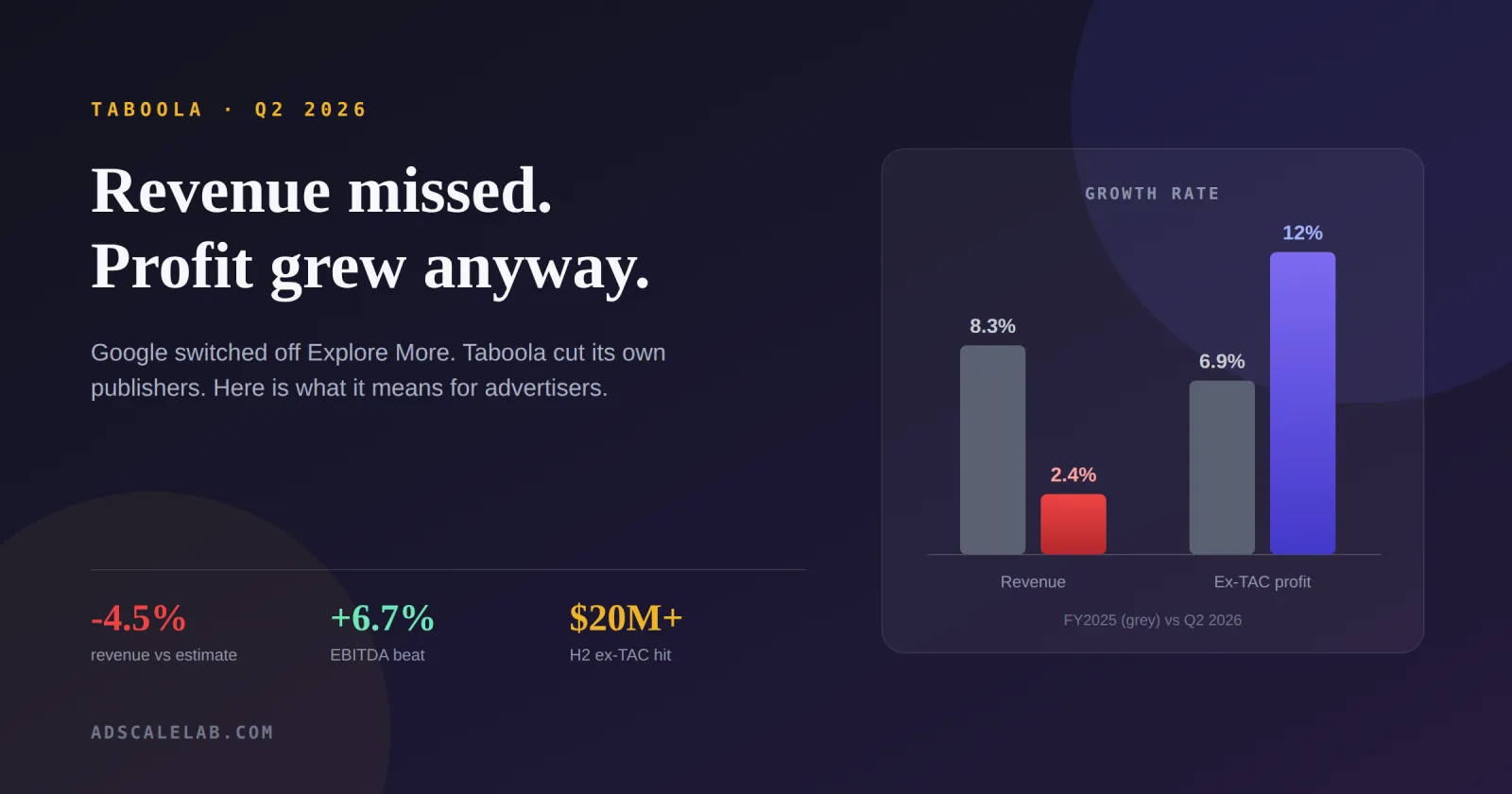
Taboola's second quarter of 2026 was the kind of report that looks contradictory until you take it apart. The company beat its own profit guidance, raised its full year profit outlook, and kept buying back its own stock in size. It also missed revenue expectations, cut its full year revenue forecast, and watched the shares fall from around $5.29 before the release to roughly $4.12 after it.
Both of those things are true at once, and the reason why is more useful to advertisers than the share price ever will be. Below is what actually happened, why it happened, when the damage lands, where it came from, and what it changes for anyone buying native traffic through Taboola agency accounts.
What the quarter actually said
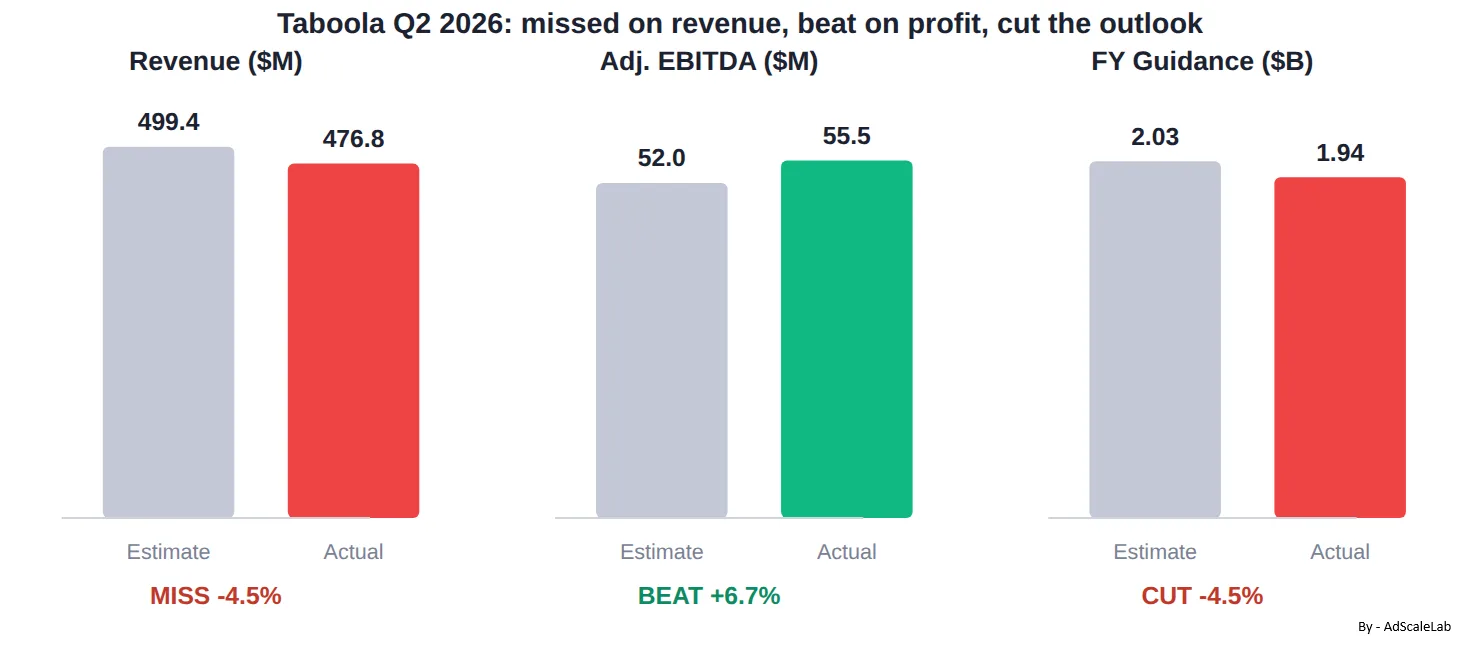
Revenue came in at $476.8 million against Wall Street expectations of about $499.4 million. That is a 4.5% miss, and year on year growth of only 2.4%. On the profit side the picture flips. Adjusted EBITDA landed at $55.49 million against expectations near $52.03 million, a beat of roughly 6.7%. Adjusted earnings per share of $0.14 matched what analysts had penciled in. Ex-TAC gross profit, which strips out what Taboola pays publishers to carry its ads, rose about 12% to $192.4 million.
Read those together and the shape becomes clear. Taboola sold less than expected but kept more of what it sold. Operating margin moved to 1.5% from roughly zero in the same quarter a year earlier. Net income was $4.3 million on a GAAP basis and $41.3 million on a non-GAAP basis, the gap being the usual mix of share based compensation and amortisation.
The number that moved the stock was none of those. It was guidance. Full year revenue guidance dropped to about $1.94 billion at the midpoint from $2.03 billion, a cut of 4.5%. Full year adjusted EBITDA guidance of roughly $234 million stayed in line with expectations, and the company actually raised its ex-TAC gross profit and adjusted EBITDA outlook. Markets forgive a soft quarter. They punish a lowered year.
Why revenue missed: two headwinds, one self inflicted
Management was unusually direct about the cause, and it splits neatly in two.
1. Google switched something off
Taboola ran a product called Explore More. When a user clicked a link and then hit the browser back button, Explore More surfaced additional sponsored content on the way back. It was a meaningful revenue stream built on top of browser behaviour that Google controlled.
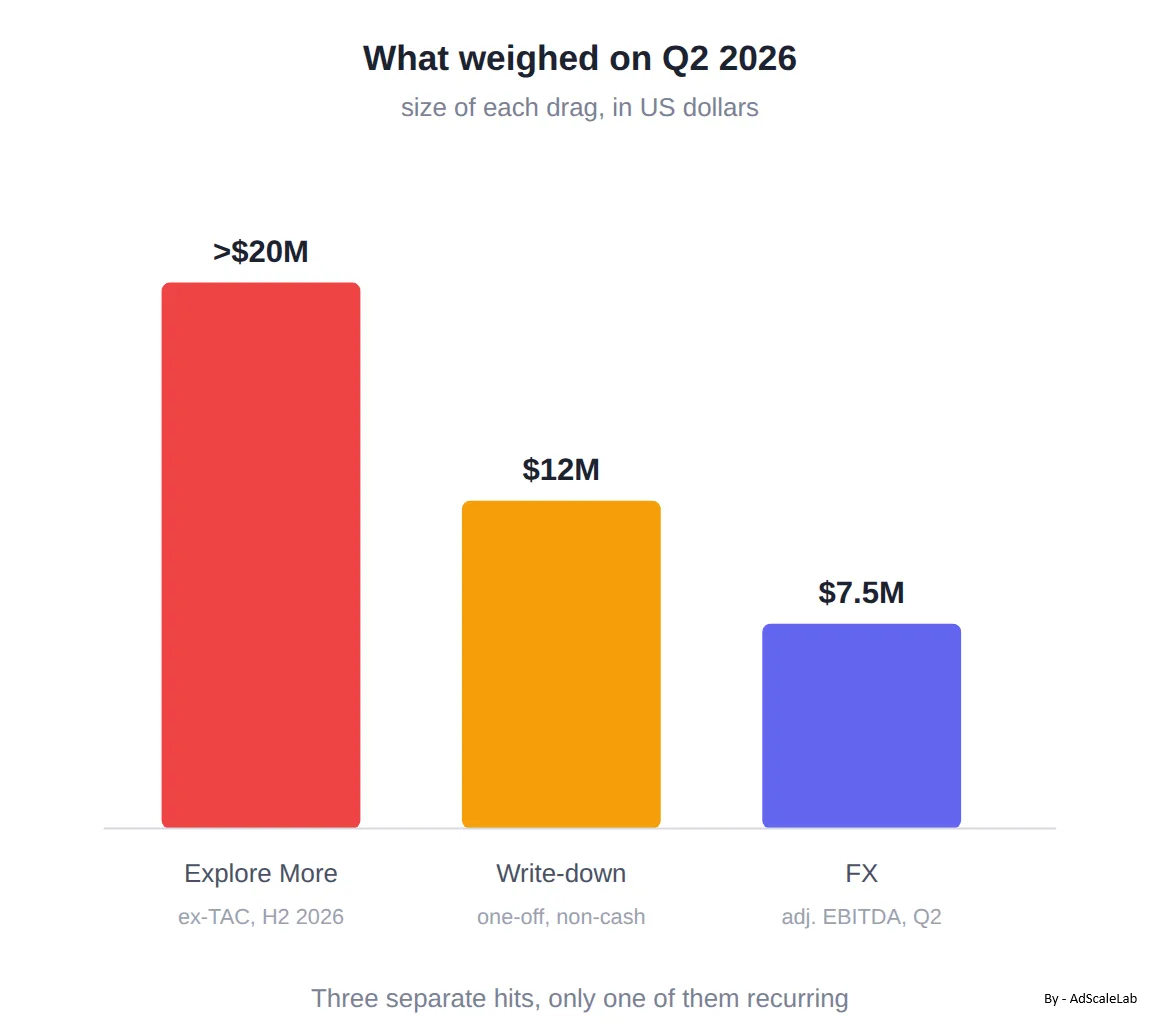
During the quarter Google changed its policies in a way that ended the product. CFO Stephen Walker told analysts the change arrived faster than the company had anticipated, which is why the full year outlook was adjusted immediately rather than gradually. The financial size of it is specific: more than $20 million of ex-TAC gross profit in the second half of 2026.
Taboola has already shipped a replacement called Next Engage. CEO Adam Singolda's position is that it can recover a substantial share of what was lost over time, while stopping short of promising it replaces Explore More entirely. When Rosenblatt's Barton Crockett pushed on whether other products carried similar Google exposure, Walker's answer was reassuring in a specific way: no other major product depends on Google policy to that degree, and search traffic from Google accounts for less than 5% of US page views across Taboola's publishers.
2. Taboola fired a chunk of its own supply
The second headwind was a decision, not an accident. Taboola removed a batch of publishers that were not delivering results for advertisers. Needham's Laura Martin asked why the cleanup happened now and at this scale. Walker's answer was that network cleanup is continuous, but this quarter was unusual because of the sheer volume of publishers that had scaled up quickly while performing badly.
BTIG's Tyler DiMatteo pressed for the profile of what was removed. Management confirmed the cuts were concentrated among international publishers, largely in the Greater China region, and restated a focus on premium United States and global publisher relationships.
This is the part advertisers should care about most. Removing supply that converts badly costs revenue today and improves campaign performance tomorrow. If you have ever watched a native campaign bleed budget into a long tail of junk placements, this is Taboola doing that cleanup at the network level rather than leaving every advertiser to build their own blocklist.
Where the growth is supposed to come from
Strip out the headwinds and the strategy underneath is an aggressive pivot toward AI, on both sides of the marketplace.
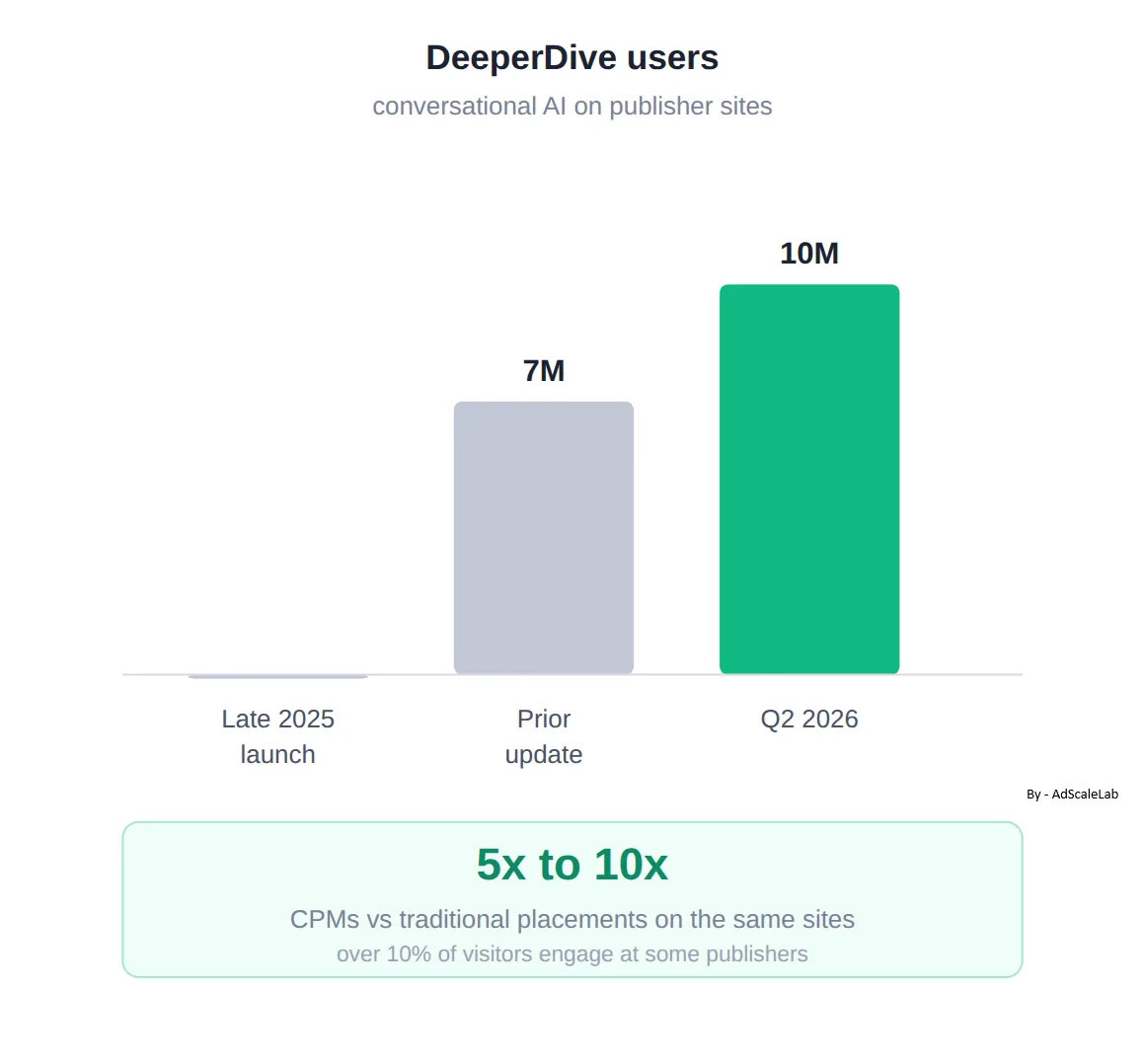
DeeperDive is the publisher facing one. It is a conversational AI product that sits on a publisher's site, and it is growing quickly. Launched in late 2025, it is approaching 10 million users, up from roughly 7 million at the previous update. At some implementations, including Yahoo, more than one in ten visitors engage with it. The monetisation figure is the eye catching part: Singolda said CPMs on DeeperDive run five to sometimes ten times higher than traditional Taboola placements on the same publisher sites. Taboola has also launched a DeeperDive advertising network aimed at other large language model services and utility apps.
Realize+ is the advertiser facing one, an optimisation layer meant to automate campaign management. B. Riley's Naved Khan asked for hard adoption and ROI numbers. The answer was that more than 300 advertisers are on the beta, with Singolda declining to give detailed performance or budget allocation data yet on the grounds that it is early.
That restraint is worth noting. A management team under pressure to change the subject after a guidance cut had an obvious opportunity to quote a flattering ROI statistic, and did not.
The wins that did not show up in the numbers yet
Two strategic developments landed in the quarter that will not appear in revenue for some time.
Taboola won Fox News, one of the top five publishers in the United States, expanding an existing relationship across the wider Fox ecosystem. For a company whose entire pitch is premium open web reach, landing a property of that size is a competitive statement as much as a commercial one.
The second is structural. Taboola signed what it described as a first of its kind expansion with a premier publisher to monetise that publisher's full suite of ad placements, not just native recommendation widgets, but display and vertical video formats too. Management estimated this kind of arrangement can be worth two to three times the revenue of traditional native placements alone.
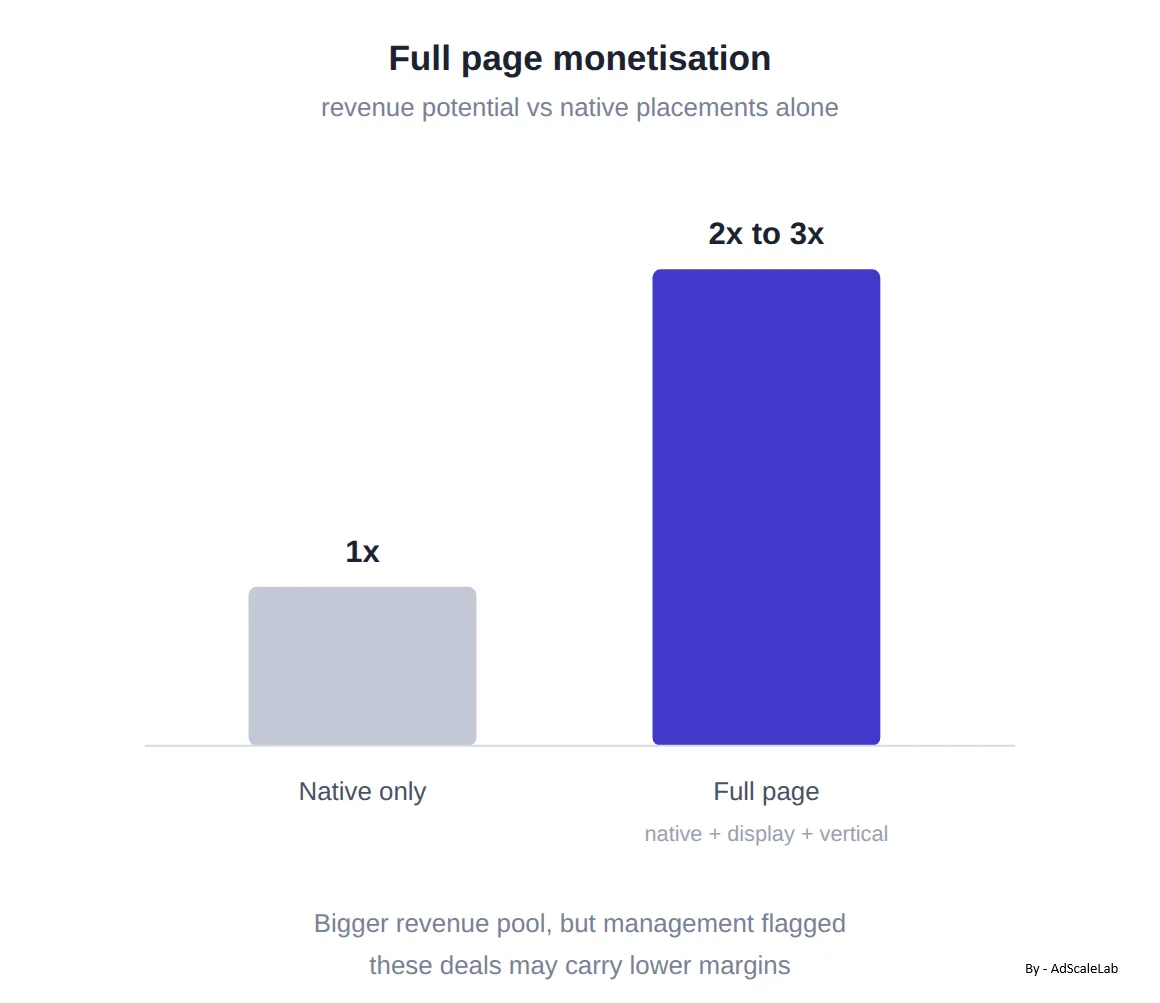
There is an honest caveat attached, and Singolda gave it himself: full page monetisation deals may carry lower margins than the legacy native business, even while they raise ex-TAC gross profit in absolute terms because the revenue pool is so much larger. Publishers, management noted, increasingly want to consolidate the number of ad tech vendors they deal with, and being the single partner for a whole page is how Taboola intends to win that consolidation.
When the pain lands, and what else hit the quarter
Timing matters here. The Explore More hit is a second half 2026 event, so the worst of it is still ahead rather than behind. That is precisely why the full year revenue guide came down while the quarter itself only missed modestly.
Two other items weighed on the period. Foreign exchange was a $7.5 million negative to adjusted EBITDA and is expected to persist through the rest of 2026. Separately there was a one time non-cash write-down of roughly $12 million tied to publisher prepayments the company no longer expects to recoup. Management was clear that the write-down does not change the long term economics of the business, but it is a reminder that prepaying publishers for traffic carries real risk when those publishers underdeliver.
Management also described the wider advertising environment as skittish rather than robust, with advertisers watching geopolitical and inflationary pressure. That is a demand side caution that has nothing to do with Taboola specifically, and it applies to every network in the space.
What Wall Street did with it
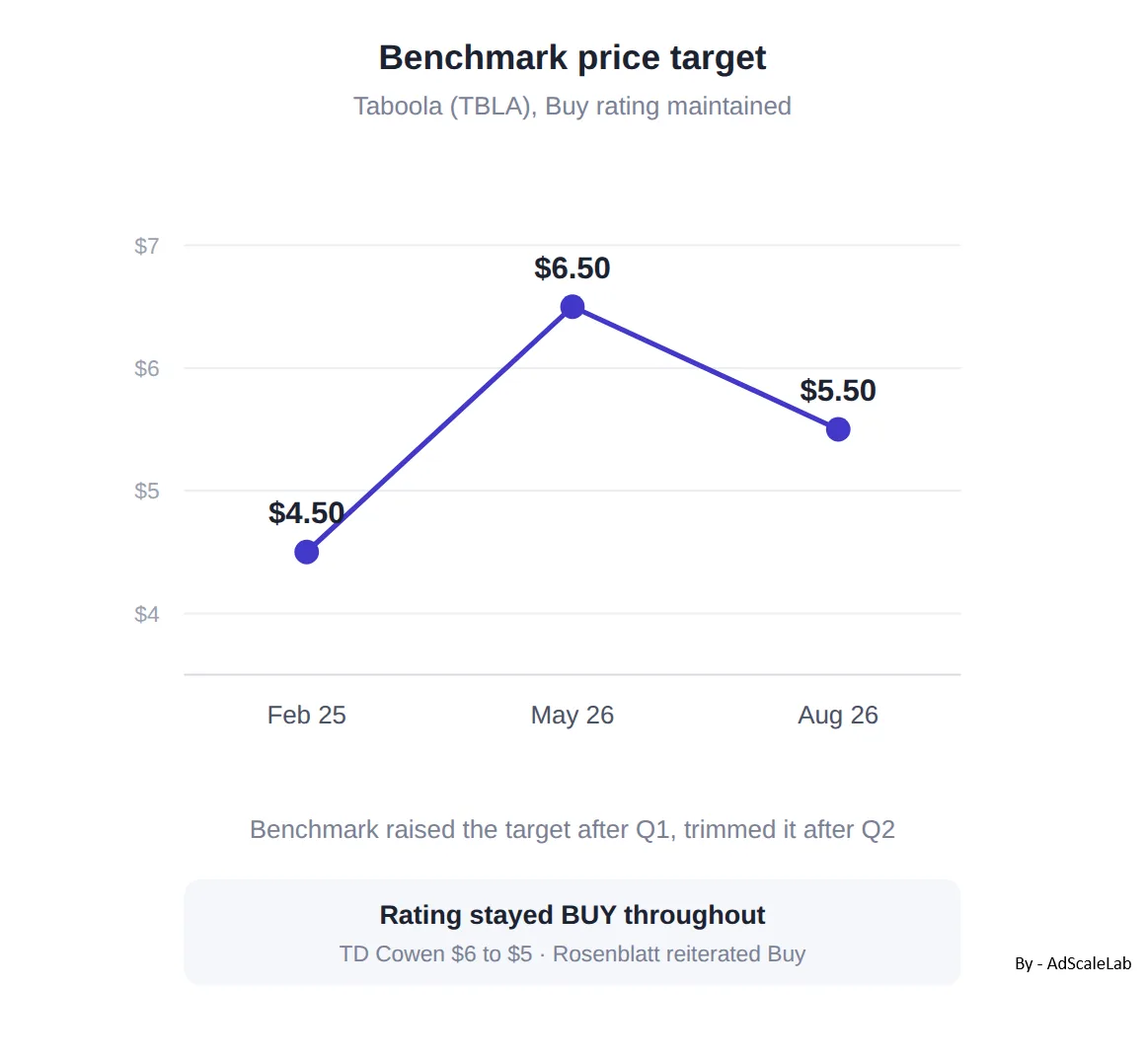
The analyst response was consistent in an interesting way: targets came down, ratings did not.
Benchmark's Mark Zgutowicz cut his price target from $6.50 to $5.50 while maintaining a Buy. TD Cowen moved from $6 to $5. Rosenblatt reiterated its Buy. The context makes the trim more telling than the number, because Benchmark had raised that same target from $4.50 to $6.50 back in May after a strong first quarter. So the same analyst who marked Taboola up on Q1 marked it down on Q2 and still kept the rating.
Valuation now sits in an odd place. With the stock near $4 and a market capitalisation around $1.1 billion, Taboola trades at roughly 10.5 times trailing earnings but around 82 times forward earnings, at about 0.63 times sales and under 6 times EV to EBITDA, while generating around $116 million of levered free cash flow on a trailing basis. Cheap on what it has earned, expensive on what it is expected to earn next year. That gap is the Explore More hit expressed as a multiple.
The buyback deserves a mention because of its scale. Taboola repurchased about $41.5 million of stock in the quarter and $64.2 million across the first half, and has retired roughly 20% of its shares since the start of 2025 after cutting share count 18% during 2025 alone. Whatever the market thinks, the company keeps buying itself.
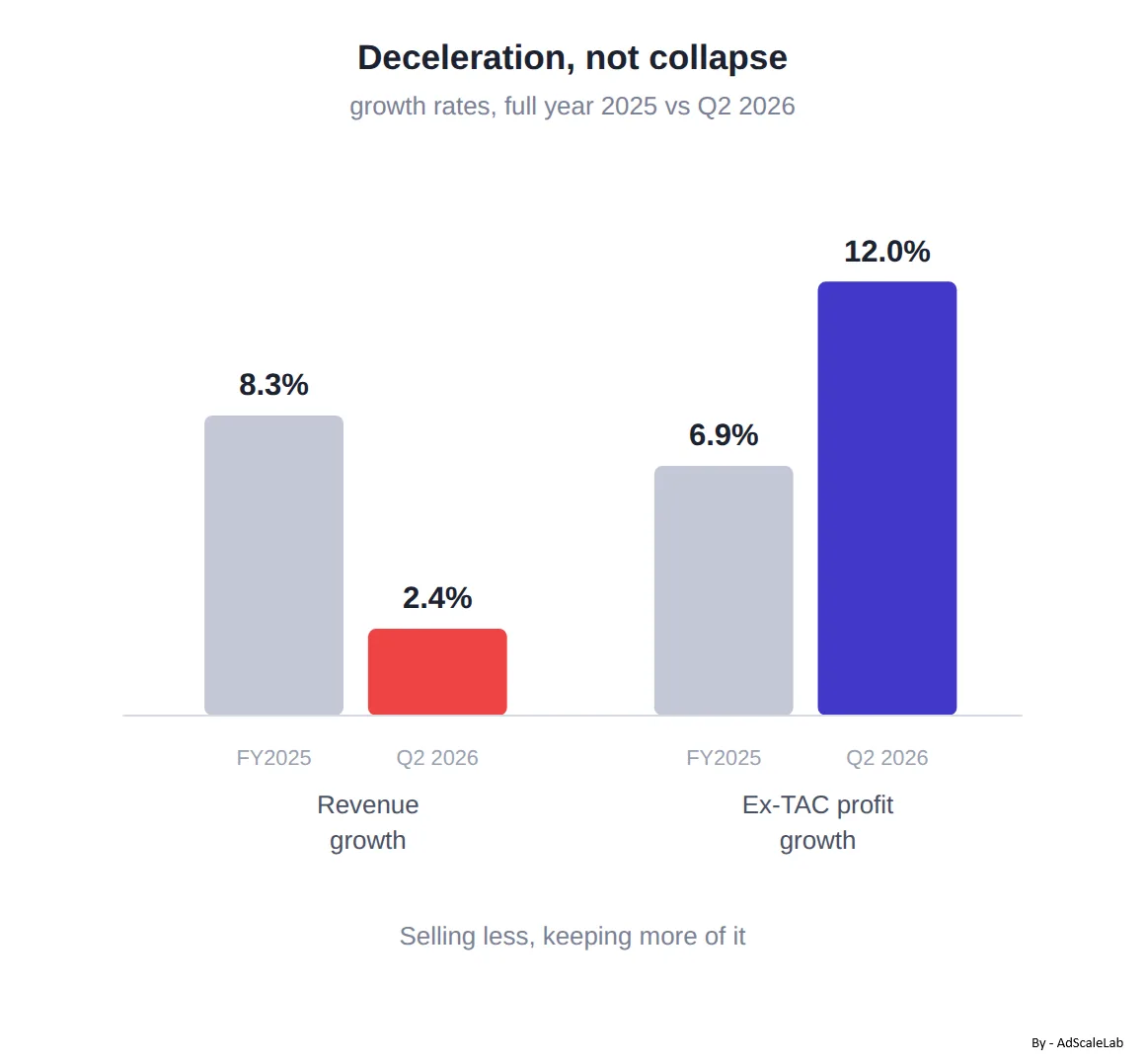
The context most coverage skipped: this is a deceleration, not a collapse
Set 2026 against the year before and the story sharpens. Full year 2025 revenue was $1.9 billion, up 8.3%, with ex-TAC gross profit of $713.5 million up 6.9%, adjusted EBITDA of $215.5 million at a 30.2% margin, free cash flow of $163.4 million, and net income of $42.3 million after a small loss the year before. In February, Singolda called 2025 a turning point and evidence that Realize was working.
Now compare. Revenue growth has fallen from 8.3% for the year to 2.4% in the quarter. But ex-TAC gross profit growth went the other way, from 6.9% to about 12%. Taboola is growing its top line more slowly and its gross profit faster. That is what deliberately removing bad supply looks like in a financial statement, and it is a very different condition from demand drying up.
What this means if you buy traffic on Taboola
The share price is noise for a media buyer. Three things from this quarter are not.
The inventory you reach is getting cleaner. A network that pulls thousands of underperforming international placements is a network where your budget spends against better traffic. Expect lower volume from certain geographies and better conversion quality on what remains, which is exactly the environment where buyers running Taboola agency accounts at scale tend to see their numbers improve.
The format mix is widening. Between full page monetisation deals and DeeperDive, Taboola is moving beyond the recommendation widget into display, vertical video and AI conversational surfaces. More placement types on premium publishers means more room to test, and the buyers who test early usually get the cheap CPMs before everyone else arrives. Access to those formats at scale generally runs through Taboola agency accounts rather than a basic self serve setup.
Competition for premium supply is rising. Fox News joining the network is good for reach and bad for anyone hoping premium inventory stays uncontested. As better publishers come on, the bar for creative and landing page quality rises with them.
Why account structure matters more in this environment
All three of those trends push in the same direction: Taboola is getting stricter about quality, on the supply side and therefore on the demand side too. A network cleaning up its publishers is a network that also cares what advertisers are running.
That is where account structure stops being an administrative detail. A basic self serve account is fine for a small test. Once you push real budget you meet the same friction every large platform creates: sudden reviews, tighter approval rules, spend limits arriving without warning, and a support queue that is hard to escalate through when a campaign stops mid flight.
Taboola agency accounts exist for that stage. They give you a more stable base to scale on, more room on limits, and a real person to escalate to when the platform does something you cannot diagnose yourself. In a quarter where the company has publicly committed to removing anything that performs badly, having a direct line into the platform is worth more than it was a year ago.
Pair that with landing page pre-approval before you spend and you remove the most common way buyers lose money here. Taboola reviews destination pages like every native platform does, and finding out your page is rejected after funding an account is an expensive way to learn. Check the page first, then scale through a properly structured account, and the platform's new strictness works for you instead of against you.
The bottom line
Taboola's Q2 2026 was a revenue miss wrapped around a profit beat, followed by a guidance cut that did the real damage to the stock. The revenue shortfall traces to two specific causes: Google switching off Explore More faster than expected, worth more than $20 million of ex-TAC gross profit in the second half, and a deliberate purge of underperforming publishers concentrated in Greater China.
Underneath that, ex-TAC gross profit grew about 12%, profit guidance went up rather than down, DeeperDive is approaching 10 million users at CPMs several times the traditional rate, Realize+ has 300 plus advertisers in beta, Fox News signed on, and the company retired another slug of its own shares. Analysts trimmed their targets and kept their Buy ratings, which is roughly the right reaction to a company taking a known, quantified, one-off hit while the underlying machine improves.
For advertisers the read is simpler than for investors. The platform is becoming more selective, more premium and more automated. That rewards buyers who show up with clean pages, tested creative and the account stability to scale when something works. Taboola agency accounts are built for exactly that, and this is a good quarter to be set up properly rather than improvising.
Source
This article is for general information only and is not financial advice. Figures are from Taboola's Q2 2026 results and earnings call (reported August 2026), its full year 2025 results (February 2026), and the reporting linked above.
Agency ad accounts, without the wait.
Buy and top up Google, Meta, native, and more from one dashboard.
Get started

No comments yet. Be the first to comment.
Comments are open to registered AdScaleLab clients.
Sign in to comment