






How To Filter Taboola Bot Traffic With Real Traffic

Ask about Taboola bot traffic in any advertising forum and the thread splits the same way every time. One group says bots, bots, bots, and cannot understand how anyone thinks otherwise. Another group is running lead generation on the platform and says it beats every other channel on cost, hands down. A third person, usually a Taboola employee, appears to say ecommerce does very well and invites you to message them.
All three are describing something real. The gap between them is the interesting part, because it is not about the platform. It is about who the platform is showing to whom. Get Taboola Agency Account here

The Claim, and The One Number Behind it
The bot claim is not made up. Bot traffic has become more sophisticated, it is easier to generate than it was five years ago, and every ad network on the open web carries some of it. Taboola runs across roughly nine thousand publisher properties, and not all of them are the Associated Press.
There is also a specific mechanism that puts bad traffic into the network, and it is worth understanding. Some publishers exist to arbitrage clicks. They buy cheap traffic from a network like Taboola, send it to pages stacked with their own ads, and collect on the ad impressions. If a share of the traffic they buy is automated, they still get paid for it. One advertiser who works in fraud detection called this piggyback click fraud: the arbitrage site can say it bought traffic from a legitimate source, while knowing a chunk of that traffic will be bots clicking its ads. Those arbitrage publishers are inside the network, and their inventory is cheap.
The number that makes the claim stick comes from a software review site, where one reviewer reported around one real human per hundred visitors. On a small budget, that figure is believable. On a well-run account it is not, and the difference is the whole story.
Why Small Budgets See Taboola Bot Traffic and Large Ones Do Not
Someone in one of those threads put it better than any vendor would. There is no official punishment for a low budget. But at fifty dollars a day you are stuck in a weak learning phase indefinitely, and the algorithm has no reason to work hard for you. You are not being scammed on purpose. You are too small to matter.
The mechanics behind that are straightforward. Taboola's system distributes spend across inventory to find placements that produce the outcome you asked for. With very little spend and very few conversions, it never gets enough signal to learn which placements are good, so it keeps buying the cheapest clicks available, and the cheapest clicks are on the worst publishers. The arbitrage sites, the low-quality apps, the placements built for accidental taps. A tiny budget does not just buy less traffic. It buys the bottom of the barrel.
A lead-gen advertiser in the same thread who called Taboola the cheapest channel he runs added one qualifier: for quality, you need to add more questions to the form. This is the other half of the answer. Bots and accidental clickers fill in one-field forms. They do not complete four-field forms. If your conversion is a name and an email, you will count bots as leads. If it asks for a phone number, a company name and a reason for enquiry, most of the junk falls out before it costs you anything.
What Real Taboola Traffic Looks Like in the Numbers
One advertiser published a small test that is worth reading closely, because it is the only set of actual figures in most of these discussions.
He spent three hundred dollars, split evenly between Taboola and Outbrain, on a fitness recovery offer with an email opt-in. Two headlines tested, two thumbnail styles, interest targeting on health and fitness, United States and Canada, mobile and desktop together. The results on Taboola: 760 clicks at twenty cents each, 29 email sign-ups, a cost per lead of $5.17 and a conversion rate of 3.8 percent. Outbrain came in almost identical.
A 3.8 percent conversion rate on cold native traffic to an email form is not bot behaviour. Bots do not convert at 3.8 percent, they convert at zero or they convert at ninety. What that figure shows is real people reading a headline, clicking, and a reasonable share of them handing over an email.
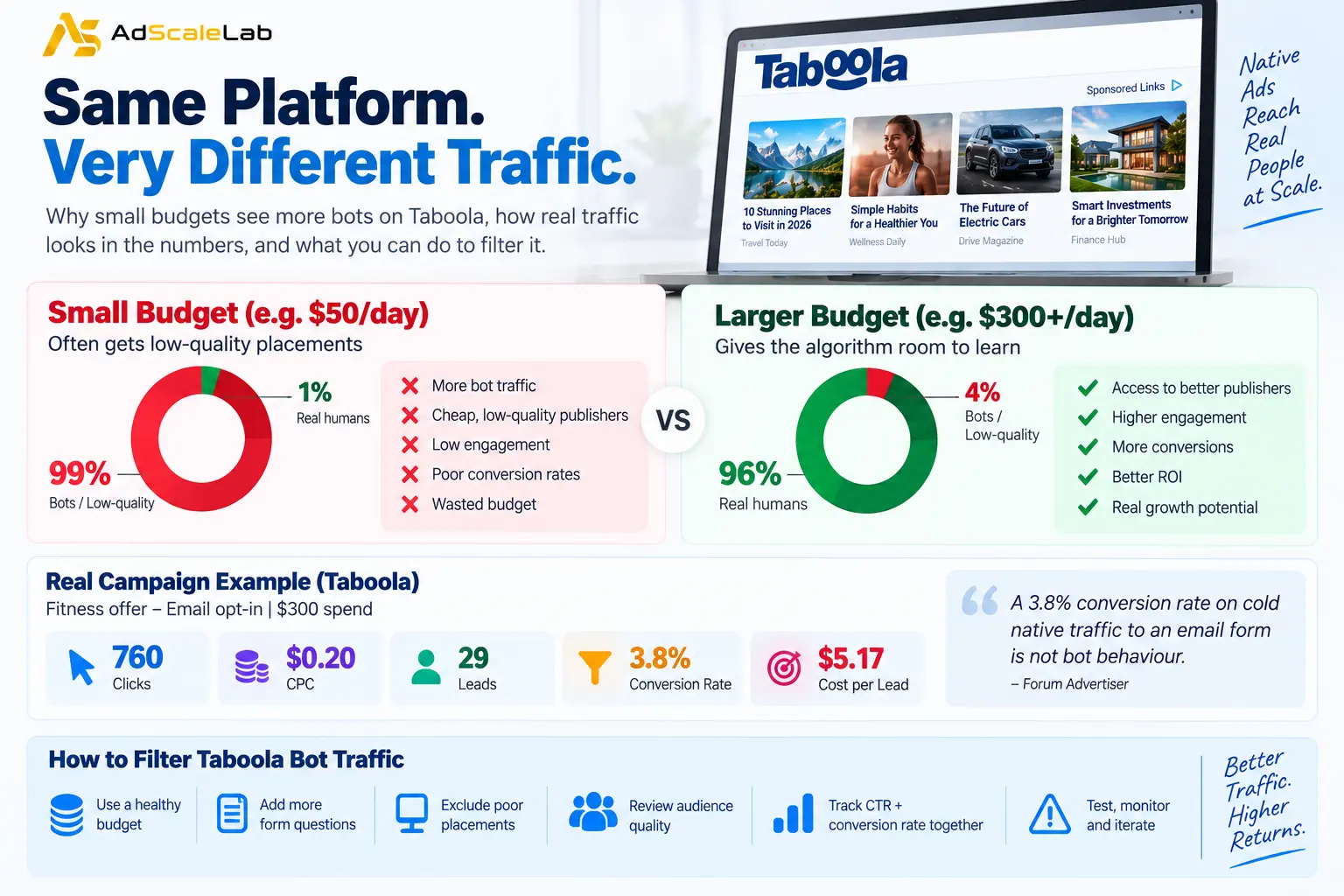
The caveats are also in the thread, raised by other commenters. Five dollars a lead is not cheap if the leads are poor, and the advertiser admitted he had not yet audited email quality. His maths only worked if fifteen to twenty percent of those leads went on to buy a sixty-dollar product at a thirty percent margin. He had also sent traffic straight to the form, with no advertorial in front of it, which experienced native buyers consider a mistake for anything more complex than a free download. And he peaked at around 0.8 to 0.9 percent click-through, just under the one percent that native buyers usually aim for.
So the test proves the traffic was real. It does not prove the campaign was profitable. Those are different questions, and most bot-traffic arguments confuse them.
The Rules That Filter Taboola Bot Traffic
This is the practical part, and it is the part almost nobody in a bot-traffic thread actually does before deciding the platform is junk. An experienced native buyer laid out the method, and it splits into what you can do yourself and what you need a person for.
Rules You Can Set Yourself, Today.
Block by site name. Taboola lets you create rules that automatically exclude publishers whose site name contains a string you specify. Two that experienced buyers block on sight are the hash symbol and the word "push," both of which show up disproportionately in low-quality app and arbitrage inventory.
Block on the click-through and conversion combination. A placement producing a very high click-through rate and almost no conversions is the signature of accidental clicks and automated traffic. The thresholds one buyer uses: a mobile click-through rate above three percent is usually a red flag, and on desktop anything above 1.5 percent deserves a look. Set a rule that blocks any site crossing those lines once it has enough impressions to be meaningful.
These rules work at campaign level or across the account. Setting them before launch means you never pay for the worst inventory in the first place. Setting them after a week of running means you have paid to discover it.
Things You Need a Person For.
A block list or white list for your target country. Taboola can apply a pre-built list of known-good or known-bad publishers to your account, but you have to ask, and the platform decides whether your account qualifies.
Premium placement settings. Your campaigns can be flagged to run on premium inventory only, which excludes a tier of placements before they ever serve. Again, this is a request, not a switch, and it usually takes a short call with a sales rep who will assess your budget and your offer before agreeing.
Both of those depend on having someone to ask. Self-serve accounts at small budgets generally do not get a rep, which is one reason those accounts see more of the bad inventory. Larger accounts, and accounts run through an agency relationship, have someone who can flip those settings. The account structure affects the traffic quality, and that is not a coincidence.
The Budget Reality Nobody Likes
The figures in these threads for how much it takes to get Taboola working are wide, and both ends are right for different purposes.
One commenter put it at around ten thousand dollars per offer to get placements dialled in and bids correct. The advertiser who ran the three-hundred-dollar test pushed back, saying focused tests with fast iteration, pausing any headline under 0.3 percent click-through within a day or two, produce solid learnings for one to two thousand dollars.
Both are true. Two thousand dollars tells you whether your creative and your offer have a pulse. Ten thousand tells you which placements to keep. If you stop at two thousand and the numbers look bad, you have learned something about your creative and nothing about the inventory. The bot complaints tend to come from people who stopped at the first number and blamed the second.
One more thing from the thread that is worth taking seriously. An advertiser reported his Taboola rep telling him to raise his twenty-five-cent bid because nobody was clicking, and he dropped the platform on the spot. He was not wrong to be suspicious of a rep asking for more money. But a twenty-cent bid does buy real clicks, the three-hundred-dollar test proves it, and at that bid level the algorithm is choosing from the cheapest inventory in the network. Sometimes the rep is right for the wrong reasons.
Where eCommerce Actually Stands
The thread that asked whether anyone generates sales profitably on Taboola got an honest answer from an ecommerce advertiser: never, even with rep white lists and hand-holding, and they could not find competitors running there either. Two Taboola employees replied that ecommerce does very well and offered to help.
Weigh those against each other with the obvious adjustment for who benefits. The pattern across native advertising communities is that lead generation, information products, and anything with a story to tell perform on Taboola, and straightforward consumer ecommerce with a low order value struggles. The advertiser who could not make it work is more typical than the employees implied. The advertisers who make ecommerce work on native are usually running an article in front of the product, a higher order value, and tracking that captures the sale days later through a different channel.
A former agency buyer made a sharper point in the same thread. Large brands with more budget than they can spend on measurable channels are happy to fund obscure networks for incremental, unattributed reach. A startup watching every dollar cannot. Know which of those you are before you judge the platform by their standards.
What To Do With All This
Taboola bot traffic is real, it lives on specific publishers, and it is served disproportionately to small budgets that have not set up any filtering. The advertisers who report the platform working are the ones who set the rules, ask for the lists, run enough budget to exit the learning phase, and put a form in front of the offer that a bot cannot fill in.
Set the site-name and click-through rules before you launch. Add fields to your form. Run at least the two-thousand-dollar test with fast iteration before you conclude anything, and treat ten thousand as the price of knowing your placements. If you are at a budget where Taboola will not give you a rep, consider running through an agency account where one already exists, because the block lists and premium settings are what separate the traffic the complainers got from the traffic the lead-gen buyers are getting.
Then look at your conversion rate. If it is 3.8 percent, the traffic is fine and the question is your margins. If it is zero on a one-field form after two thousand dollars with the rules in place, the problem is not bots either. It is the offer.
Agency ad accounts, without the wait.
Buy and top up Google, Meta, native, and more from one dashboard.
Get started
No comments yet. Be the first to comment.
Comments are open to registered AdScaleLab clients.
Sign in to comment