



Google Privacy Fine What the €403M Ruling Means for Ads
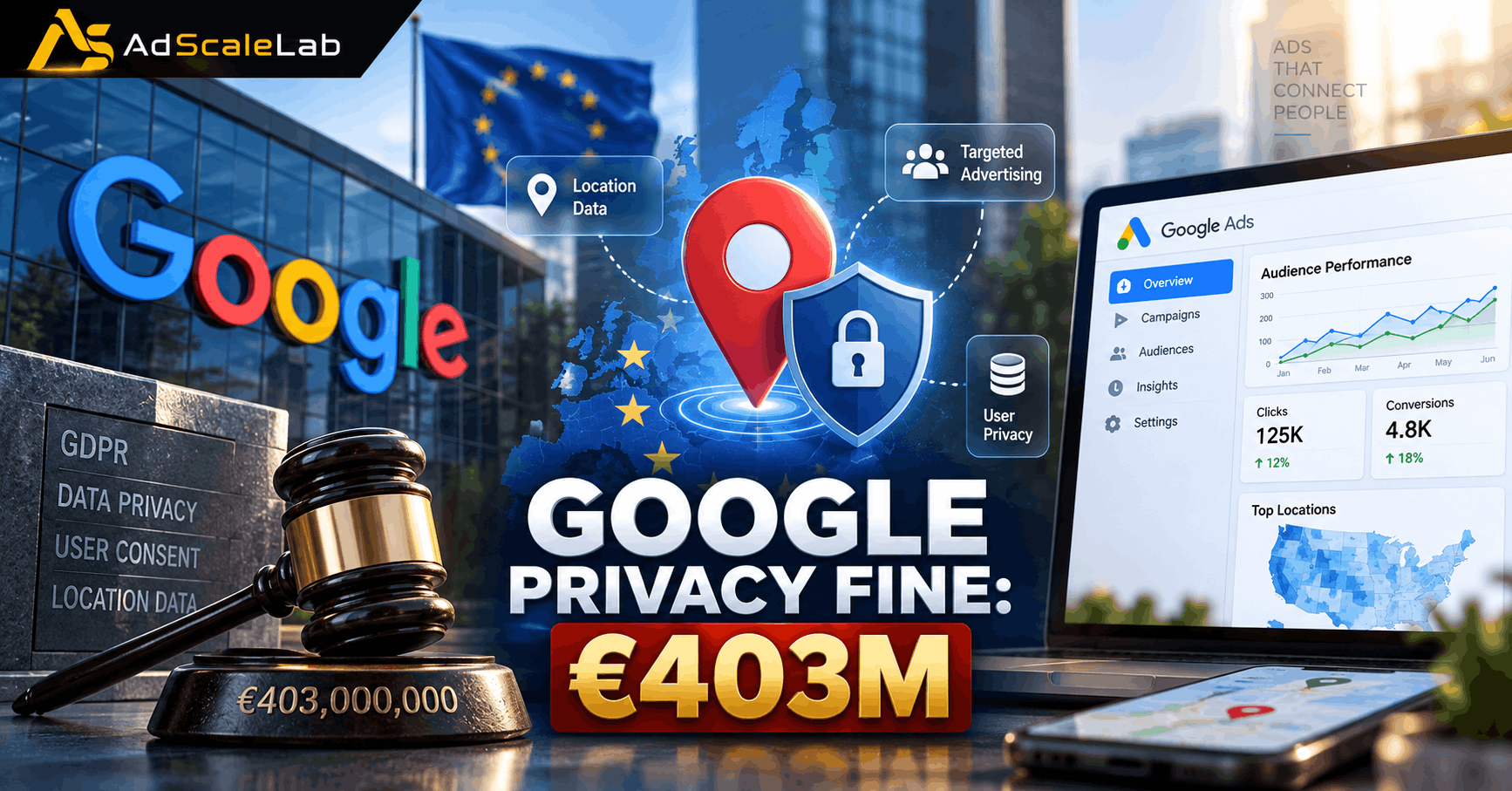
Google has been hit with a Google privacy fine of €403 million by Ireland’s Data Protection Commission (DPC) over GDPR infringements involving the processing of location data. The decision, announced on September 21, 2026, puts fresh attention on one of the most important questions in digital advertising: how much user data can companies use to make advertising more relevant, and how clearly must users be told about that use?
The case is important for advertisers because location data can reveal much more than a simple place on a map. When combined with other information, location signals can help build a picture of where people go, what they may be interested in, and which types of advertising could be relevant to them. The DPC said users could have been unaware that their location data was being used to influence advertising or infer interests. At the same time, the ruling needs to be understood in its proper time frame. The DPC investigation examined Google’s processing of location data between May 2018 and February 4, 2020. Google has said that the case concerns historical policies and that its privacy practices have changed significantly since then. This means advertisers should not read the decision as a statement that every current Google advertising practice involving location data has been found unlawful.
What Happened In The Google Privacy Fine?
The DPC opened its investigation in February 2020 following complaints from European consumer rights organizations. According to the Ireland Data Protection Commission's decision the investigation examined three Google features connected to location information: Web & App Activity, Location History and Location Accuracy.
The advertising connection is one of the most important parts of the decision because the DPC said users could have been unaware that their location data was being used to influence advertisements or infer interests. This matters because privacy is not only about whether data is collected. It is also about whether people understand what is happening to their information and have meaningful control over its use. The €403 million penalty is the fourth-largest fine issued by the Irish regulator, while the DPC also said that three other statutory investigations involving Google remain ongoing and have reached an advanced stage. As part of the decision, the DPC has ordered Google to bring the relevant processing into compliance within six months, with the regulator saying its full decision would be issued in due course.
Why Location Data Matters To Targeted Advertising
Location data has long been useful in digital advertising because it can add context to a user's online activity. An advertiser may want to reach people in a particular city, region or area, or may want to understand how online activity relates to physical locations. There is a difference, however, between using broad location information and building detailed profiles from a person's movements. The more detailed the information becomes, the more important questions about transparency, consent, retention and user control become.
This is why the Google privacy fine matters beyond the specific investigation. The case shows how advertising and privacy can become closely connected when platforms collect large amounts of behavioral information. A location signal may look like a simple technical data point, but its advertising value can increase when it is combined with other information. For advertisers, this does not mean that location-based advertising is disappearing. Instead, it highlights the importance of understanding the data and privacy rules behind the audience targeting tools being used.

Does The Google Privacy Fine Mean Targeted Advertising Is Ending?
No. The €403 million decision does not mean that targeted advertising has been banned. The DPC's investigation concerned Google's historical processing of location data during the period covered by the investigation. The regulator ordered Google to bring the relevant processing into compliance, but the decision itself does not establish that all targeted advertising is unlawful.
This distinction is important because targeted advertising can use many different types of information. Depending on the platform and campaign, advertisers may work with contextual signals, first-party data, geographic information, audience segments, search intent, website activity and other signals. The bigger lesson is that the way data is collected and used matters. An advertising strategy can be commercially useful while still needing strong privacy controls, so advertisers need to think about both campaign performance and the data practices behind the tools they use.
Google has also said that its practices have changed since the period covered by the investigation. In its response, the company pointed to changes introduced since 2019, including automatic deletion, on-device Timeline storage and additional controls over location and advertising use. These changes provide important context when considering what the ruling means for advertising today.
What Does The Google Privacy Fine Mean For Advertisers?
For advertisers, the most practical takeaway is not to stop using audience targeting. It is to pay closer attention to how audience data is collected, processed and controlled. Advertising platforms provide targeting options that can make campaign management easier, but advertisers do not always see every technical step that happens behind the interface. Privacy rules can affect how platforms collect information, how long they keep it, what users are told, and which controls are available.
The Google privacy fine is therefore a reminder that advertisers should understand the foundations of the platforms they depend on. This is particularly important for agencies managing campaigns across several platforms because privacy requirements can differ depending on the market, data type and advertising system. Advertisers should also avoid assuming that more data automatically produces better advertising. A large amount of user information does not guarantee stronger campaign performance, since creative quality, audience relevance, landing-page experience, measurement, conversion quality and campaign objectives still matter.
The privacy side of advertising should be treated as part of campaign planning rather than something considered only after a regulatory decision. When advertisers understand how audience data is collected and used, they can make more informed decisions about their campaign setup while also paying closer attention to changing privacy requirements.
Why The Ruling Matters Beyond Google Ads
Although the case involves Google, the wider issue applies to the digital advertising industry. Advertising platforms, publishers, data companies and agencies all work with different types of information. Some data comes directly from users, while other information may be generated through browsing activity, devices, websites, applications or advertising interactions. The more advertising depends on behavioral information, the more important transparency becomes.
Users need to understand what information is being collected and why it is being used, while companies need systems that support appropriate retention, access and control. This is especially relevant as the advertising industry continues to move toward more automated targeting. AI-powered advertising systems can process large amounts of information and make decisions faster than traditional campaign setups. That can create efficiency, but it also makes data governance more important.
A privacy issue may not always be visible to the person running a campaign. An advertiser can select an audience in a platform without seeing every underlying data process. That is why privacy and compliance should be considered at the platform and system level as well as at the campaign level. The way an audience is created can be just as important as the audience settings an advertiser sees inside the advertising dashboard.
What Advertisers Can Learn From The Ruling
One of the clearest lessons for advertisers is the importance of understanding the data behind targeting. Advertisers should know whether an audience is based on contextual information, first-party data, location signals, behavioral activity or another type of information. Understanding where an audience comes from can help advertisers make better decisions about both campaign performance and privacy.
Transparency is another important part of the issue. If a platform changes its privacy controls, data settings or audience products, advertisers should understand what those changes mean for their campaigns. This becomes especially important for agencies that manage campaigns across multiple platforms, where data practices and privacy requirements may not always be identical.
Advertisers should also avoid relying too heavily on a single targeting signal. A campaign that depends on one type of audience data can become more exposed when privacy rules or platform policies change. Using a broader measurement approach can make it easier to understand whether a campaign is actually delivering business results rather than simply producing a highly detailed audience profile.
Privacy should also be treated as an ongoing part of digital advertising operations. Regulations, platform policies and user expectations can change over time, which means a campaign setup that works today may require adjustments later. Keeping privacy considerations within the normal campaign planning process can help advertisers respond more effectively when platforms or regulations change.
Google Says Its Privacy Practices Have Changed
Google has responded to the decision by emphasizing that the case concerns historical policies. The company said it has significantly evolved its practices since 2019. Google has pointed to tools and controls such as automatic deletion, on-device storage for Timeline and options related to location and advertising settings. These changes are important context because the DPC's investigation focused on processing that took place several years ago.
Current Google support documentation gives users controls for managing different types of activity and personalization. Users can review or manage settings related to Timeline, Search activity and personalized advertising. That does not erase the regulatory findings about the historical period examined by the DPC. It does, however, show why advertisers and readers should distinguish between what regulators found about past practices and what a platform says it does today.
For advertisers, this distinction is especially important. A regulatory decision concerning historical practices should not automatically be treated as a description of every current product or advertising setting. Instead, advertisers should look at any specific changes Google announces and consider whether those changes affect their campaigns, audience strategies or measurement systems.
What Happens After the €403M Google Privacy Fine?
The DPC has ordered Google to bring the relevant processing into compliance within six months. That requirement will be important to watch because it could provide further information about how Google responds to the decision. The regulator also said that three other statutory investigations involving Google are ongoing and advanced, meaning the September 2026 decision is part of a wider regulatory picture rather than an isolated privacy discussion.
For advertisers, the next step is mainly to watch for concrete changes to Google's products, policies or data controls rather than assuming that every advertising product will change immediately. If Google changes how certain location signals are used, advertisers may need to review audience strategies, campaign settings or measurement approaches. Until specific product changes are announced, however, advertisers should avoid assuming that the ruling automatically changes every Google Ads campaign.
This is also an area where advertisers should pay attention to updates from Google and regulators. Changes to privacy controls or advertising products can sometimes affect campaign operations even when the underlying regulatory case began years earlier.
The Bigger Picture For Digital Advertising
The Google privacy fine shows how closely advertising and privacy are now connected. For many years, digital advertising developed around the idea that more information could create better targeting. Location, browsing behavior, search activity and other signals helped platforms understand audiences and helped advertisers reach people who appeared more relevant to their campaigns.
The industry is now operating in a different environment. Regulators are paying closer attention to how personal information is collected and used, users have become more aware of privacy controls, and platforms are changing how data is stored and processed. At the same time, advertisers still want useful targeting and measurable campaign results. The challenge is finding a workable balance between these needs.
The €403 million Google decision does not provide a simple answer for the entire advertising industry. Instead, it highlights the importance of transparency, lawful processing, data minimization and user control. For advertisers, the practical lesson is that targeting technology should not be evaluated only by how precise an audience looks inside an advertising dashboard. The underlying data practices matter too.
As digital advertising becomes more automated and data-driven, privacy is likely to remain an important part of how advertisers, agencies, publishers and platforms operate. The Google privacy fine is therefore not only a story about one regulatory decision. It is also a reminder that the systems behind targeted advertising are becoming just as important to understand as the campaigns themselves.
Agency ad accounts, without the wait.
Buy and top up Google, Meta, native, and more from one dashboard.
Get started


No comments yet. Be the first to comment.
Comments are open to registered AdScaleLab clients.
Sign in to comment