



Google Free Shopping Listings What Advertisers Need to Know
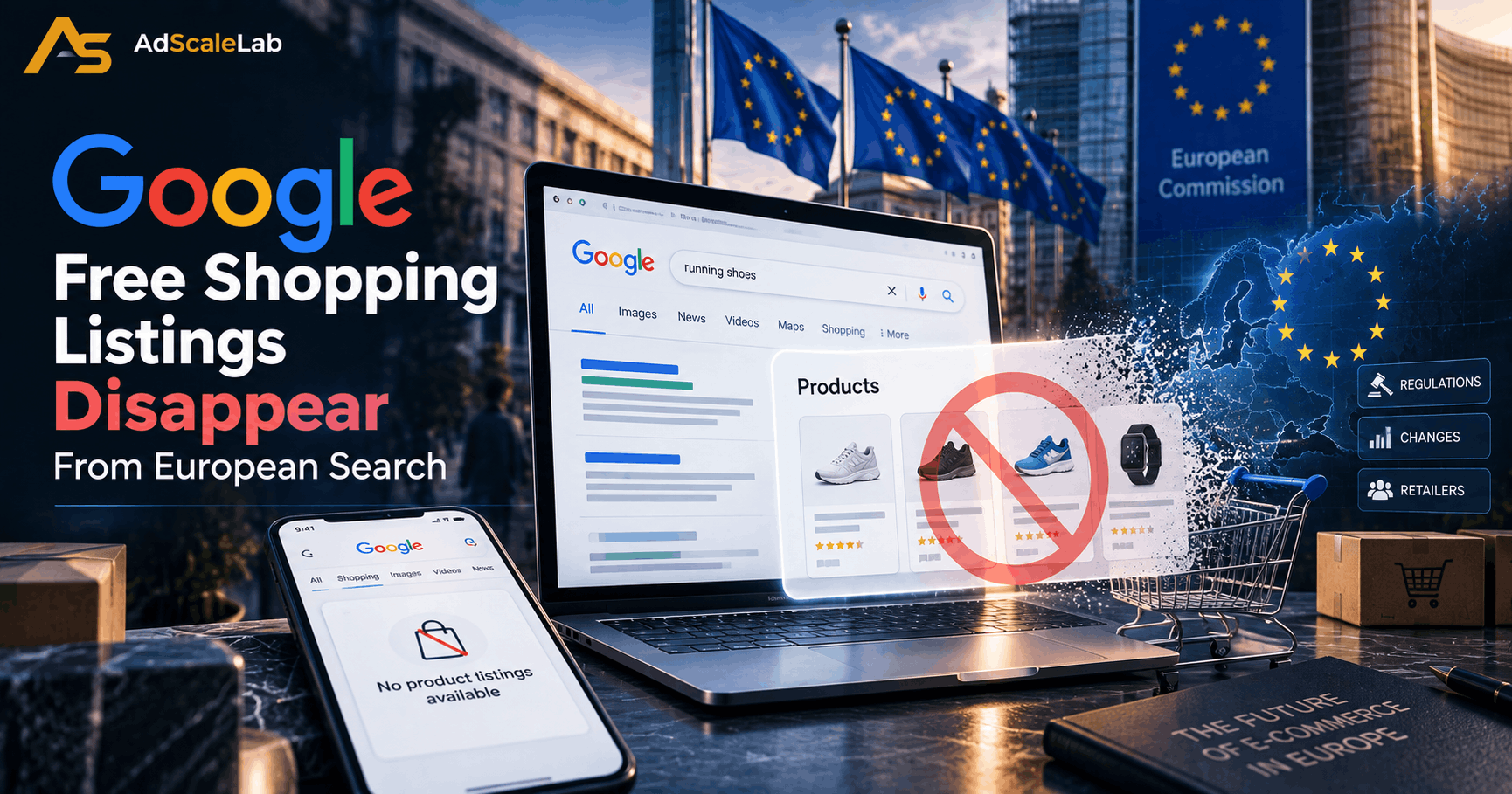
Google free Shopping listings have largely disappeared from parts of Google Search across the European Economic Area, creating a major change for retailers that have relied on unpaid product visibility. The change was observed across September 17 and 18, 2026, with product listing and “popular products” formats falling sharply in several European markets. That being said, Adriaan Dekker via Gabriel Baumgarten posted a screenshot on LinkedIn of how the product results look now in the EEA without those free listings. He wrote, "Free listings from Google Shopping look to be disappearing in the EEA.
The important point for advertisers is that Google has not eliminated every form of free product exposure across Europe. Free listings still exist across several Google surfaces, including the Shopping tab, Images, Lens, YouTube, Gemini and other eligible placements. What has changed is the presence of free product listings and popular product carousel formats within general Google Search results in the EEA.
That distinction matters because many retailers have treated free product listings as an additional source of organic shopping traffic alongside their paid Google Shopping campaigns. With those Search placements disappearing or being substantially reduced, merchants may need to pay closer attention to how their products are distributed through Google and through comparison shopping services.
What Happened to Google Free Shopping Listings in Europe?
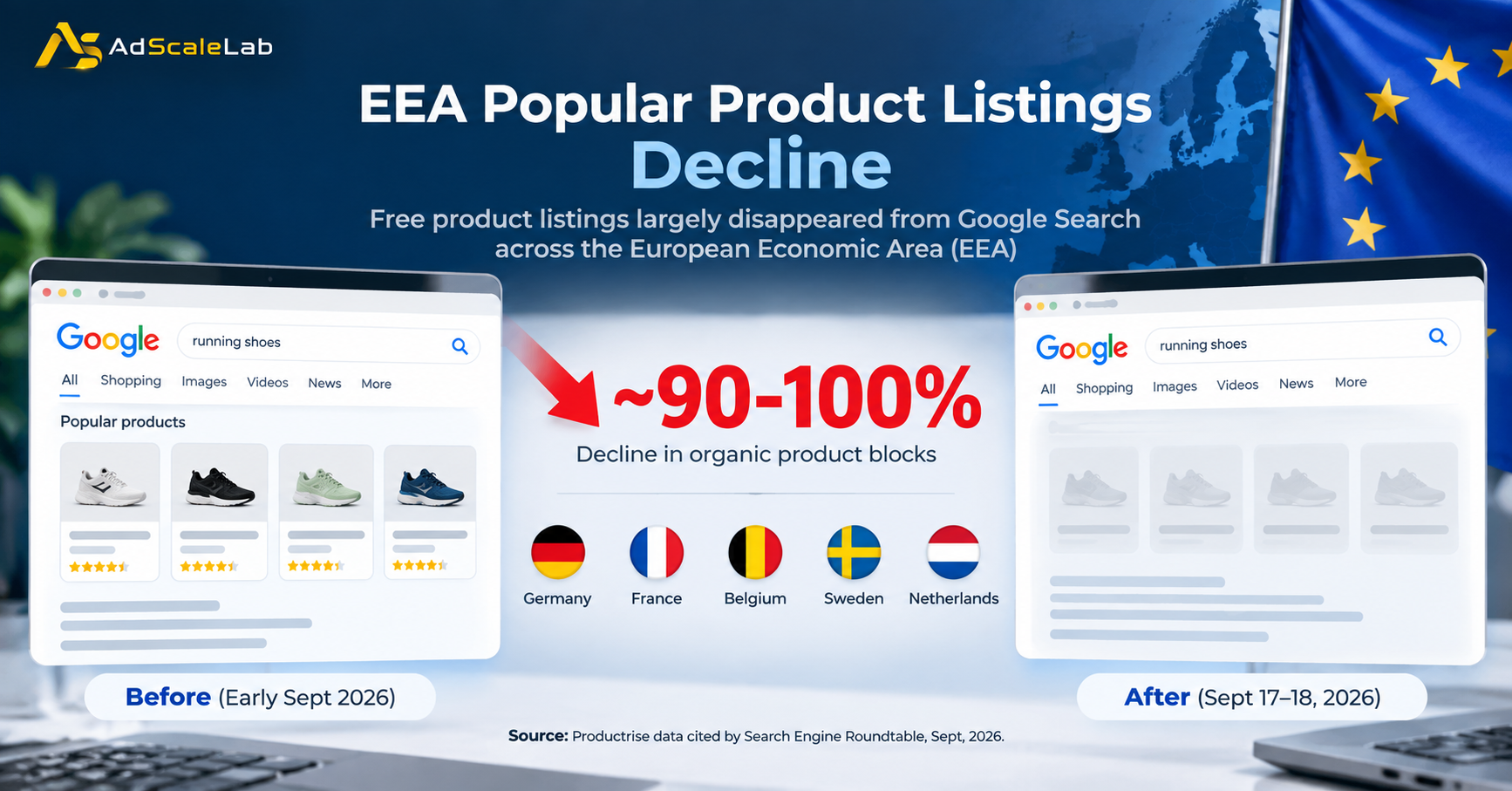
The change became visible in European Google Search results over a period of roughly two days. Independent tracking cited by Search Engine Roundtable showed very large declines in “popular products” and other organic product blocks in countries including Germany, France, Belgium, Sweden and the Netherlands. Search Engine Roundtable reported that the decline was close to 90% to 100% in the countries where sufficient tracking data was available.
PPC Land separately reported that Google had removed free product listings and popular product carousels from Search results across the EEA. The publication connected the change to Google's compliance with Europe's Digital Markets Act, or DMA.This is important because the change is not simply a routine Google Search interface update. It is connected to a much larger regulatory effort in Europe around how large technology platforms rank and display their own services compared with competing services.
The European Commission said in July 2026 that Google had failed to comply with the DMA's rules against self-preferencing on Google Search. The Commission specifically said Google had given preferential treatment to its own services, including shopping, hotels, transport and sports results, compared with third-party services. The Commission issued a €460 million fine relating to the Search self-preferencing finding.
Why Is Google Changing Shopping Results In The EEA?
The European Union's Digital Markets Act is designed to place additional obligations on large digital platforms designated as gatekeepers. Alphabet, Google's parent company, is designated for several core platform services, including Google Search and Google Shopping.
One of the DMA's requirements is that gatekeepers cannot give their own services more favorable treatment in ranking than competing third-party services. The European Commission's July decision said Google's Search practices did not meet that requirement.
The result is a different Search experience in the EEA. Instead of Google simply giving prominent organic product visibility to its own shopping-related results, competing comparison and vertical shopping services can receive greater access to relevant Search features.
Google has also introduced different Search structures for European users, including aggregator and supplier units for certain commercial queries. Google Search Central describes aggregator units as multi-provider features that can include results from eligible vertical search services, including comparison shopping services.
For retailers, this means that product discovery in European Search is becoming less dependent on one Google-controlled shopping presentation and more connected to a wider ecosystem of comparison and vertical shopping services.
What Happens To Retailers That Used Free Product Listings?
For retailers, the immediate concern is visibility.
Free product listings were designed to provide merchants with unpaid exposure across Google's ecosystem. Google says eligible products can appear in places including Search, Shopping, Images, Lens, YouTube, Gemini and Maps. These listings can help merchants reach shoppers without paying for every click. The disappearance of certain Search placements therefore does not mean a merchant's products have vanished from Google completely. Instead, one important discovery route has changed.
A retailer that previously received impressions or clicks from organic product blocks in general Search may see a different traffic mix after the change. Some shoppers may encounter products through the Shopping tab, while others may discover them through paid Shopping ads or through comparison shopping services appearing in Google's European Search features.
This could make product-feed quality, Merchant Center setup and campaign management more important for advertisers competing for visibility.
Retailers should also avoid assuming that a product being eligible for free listings guarantees exposure. Google's documentation states that free-listing eligibility does not guarantee that products will appear in every eligible location.
Comparison Shopping Services Become More Important
One of the biggest changes for European advertisers is the increased importance of Comparison Shopping Services, commonly called CSSs.
Google's Merchant Center documentation explains that comparison shopping services can place Shopping ads and free product listings on behalf of merchants in a number of European markets. Merchants can work with multiple CSS providers for Shopping ads and can select a CSS for free listings in Europe.
The role of CSSs comes from Europe's earlier competition action against Google Shopping. Instead of Google Shopping being the only service able to compete for certain shopping placements, competing comparison shopping services were brought into the ecosystem.
This means European retailers now operate in a more complicated shopping environment. A merchant may have its own Merchant Center setup, work with one or more CSS providers, run paid Shopping campaigns and still need to monitor how its products appear across different Google surfaces.
For advertisers, understanding the CSS structure is therefore becoming less of a technical side issue and more of a practical part of European Shopping strategy.
Free Listings Are Not The Same As Shopping Ads
It is also important not to confuse free product listings with paid Shopping ads.
Google's own documentation says free listings can generate organic traffic and appear across several Google surfaces, while Shopping ads continue to occupy paid advertising positions. On the Shopping tab, for example, Google says Shopping ads will continue to appear in ad slots alongside eligible free listings.
That means the European change does not represent the end of Google Shopping advertising.
For advertisers, the difference is mainly about where unpaid product visibility is available and how Google Search presents shopping information. Paid campaigns remain a separate channel. This distinction will be particularly important when retailers compare performance before and after the change. A reduction in organic product impressions should not automatically be interpreted as a reduction in total Shopping demand. Instead, advertisers need to separate paid traffic, organic product traffic and traffic coming through comparison or vertical shopping services.
What European Advertisers Should Watch Now
The next stage will be about how the new European Search experience develops.
Retailers should monitor their Search and Merchant Center performance by country rather than looking only at an overall European number. The effect may differ between markets depending on the Search experience, available comparison services and consumer behavior.
Advertisers should also monitor changes in product impressions, clicks, conversions and paid Shopping performance. If a significant amount of previous traffic came from free product placements, the removal of those placements could change the balance between unpaid and paid traffic. Product-feed quality also remains important. Accurate titles, prices, availability, images, shipping information and landing pages can affect whether products are eligible for Google's different shopping surfaces.
The regulatory environment should also be watched closely. The European Commission's DMA enforcement against Google is not limited to one isolated Search interface change. It is part of a broader effort to prevent gatekeepers from favoring their own services over competing services.
What This Means For Google Shopping Strategy
For advertisers operating in Europe, the biggest lesson is that Google Shopping can no longer be viewed as a single traffic source.
A retailer may now need to think about several layers at the same time: paid Shopping campaigns, free listings where they remain available, the Shopping tab, comparison shopping services, product-feed quality and Google's changing Search presentation.
This makes measurement particularly important. Advertisers should compare their historical performance with current performance by country and by traffic source instead of assuming that every change in product visibility is caused by advertising performance.
It may also become more important for retailers to diversify their acquisition strategy. Google remains a major shopping discovery channel, but advertisers can also evaluate other forms of paid search, marketplace traffic, social advertising, native advertising and programmatic campaigns depending on their products and target customers. The broader advertising lesson is that regulatory changes can alter how inventory and traffic are distributed without necessarily changing the underlying demand for products. For retailers, the challenge is understanding where that demand moves next.
The Bigger Picture for European E-commerce Advertising
The removal of Google free Shopping listings from parts of European Search is another example of how regulation is changing digital advertising infrastructure.
For years, retailers have optimized their product feeds around Google's ecosystem. The European changes introduce more intermediaries and alternative services into the shopping journey. That does not mean Google Shopping has become irrelevant. Instead, the Search experience is becoming more fragmented. Retailers have to understand not only how Google ranks products, but also how comparison shopping services, paid Shopping campaigns and other shopping surfaces participate in the customer journey.
For advertisers, this makes European e-commerce more dependent on careful measurement and channel management. The retailers that understand where their product impressions and clicks are coming from will have a clearer picture of what the regulatory changes actually mean for their businesses.
Google's current documentation still confirms that free product listings remain available across multiple surfaces, so the most accurate way to describe the September 2026 development is not that free listings have disappeared from Google altogether. Rather, important free product placements have been removed or substantially reduced from general Search results in the EEA. That distinction will matter as Google continues adapting its European Search experience and advertisers adjust their strategies
Agency ad accounts, without the wait.
Buy and top up Google, Meta, native, and more from one dashboard.
Get started

No comments yet. Be the first to comment.
Comments are open to registered AdScaleLab clients.
Sign in to comment