





Google AI Overviews Shift As Advertisers Review Budgets
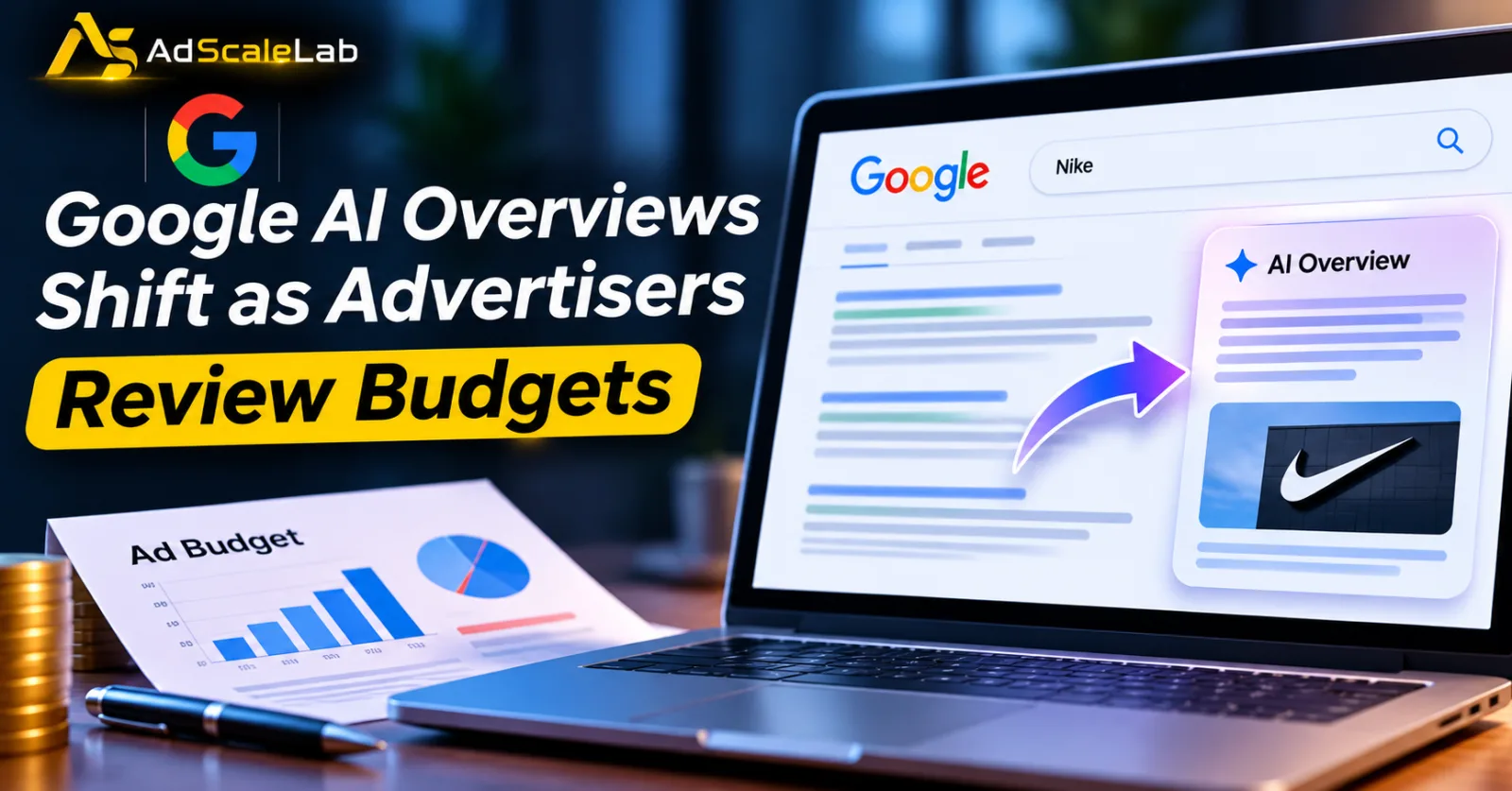
Google AI Overviews are appearing in a different place for many brand-name searches, adding another change to the way businesses appear on Google. Search specialists reported that, on desktop, Google's AI-generated summaries for several well-known brands have moved into the right-hand column, where Knowledge Panels have traditionally appeared. The change was noticed on November 2, 2026, and comes as advertisers are taking a closer look at how much value they receive from Google Search campaigns.
The timing is important. Advertisers are already questioning whether their search budgets are producing enough qualified traffic and sales. A recent report by Digiday, based on conversations with 18 media buyers, found that some agencies are discussing moving around 10% to 30% of Google search budgets to other channels. This does not mean that advertisers are leaving Google in large numbers, but it shows that the platform is facing more pressure to prove the value of its advertising products. The latest developments bring two connected issues into focus: how Google presents information about brands in search results and how advertisers measure the return they get from paid search.
Google AI Overviews Move To The Right Side For Brand Searches
For many years, Google's right-hand search panel was mainly used for Knowledge Panels. These panels displayed information about a company, person, product or place. For businesses, they offered a familiar space where users could quickly find basic information such as a company description, website, address and other details. That layout now appears to be changing for some brand-related searches. Search industry publication Search Engine Roundtable reported on November 2 that Google was showing AI Overviews in the right-hand column for many brand-name keywords. The examples included searches for companies and brands such as Apple, Zillow, Coca-Cola and Google.
SEO professionals Chris Long and David McSweeney also shared examples of the new layout. Their observations suggest that the AI-generated summary is appearing in the area where users would normally expect to see a Knowledge Panel. In some cases, the AI Overview had previously appeared higher in the main search results. The change has been observed on desktop search results. It should not yet be described as a confirmed permanent update across every country, device or brand query. Google has not publicly explained the change or confirmed whether it is testing a new layout or expanding it more widely.
Moving the summary to the side could make the main search results easier to scan because the AI-generated information no longer takes up as much space above the regular listings. However, it also means that users may see an AI-written description of a company in a place that was previously used for a more structured Knowledge Panel.
Why The Change Matters To Brands
A search for a company's name is different from a general search such as "best advertising platforms" or "top marketing software." When someone searches for a specific brand, they may already know the company and want to visit its website, check its products or find contact information. This is why branded search results are important to businesses. A company wants users to find accurate information and reach the right website without confusion. If an AI-generated summary appears in the same area as a traditional Knowledge Panel, it can influence what people notice first and how they understand the brand.
There is also a question of accuracy. An AI Overview can collect and summarize information from different sources, but its description may not always match the latest information published by the company. That example does not prove that all AI Overviews contain incorrect information. It does show why businesses should check how their brands are being presented in search results rather than assuming that every generated summary is accurate.
Companies should also remember that the right-column change does not automatically mean their organic rankings have fallen. The position of an AI Overview and the ranking of a website in the main results are different things. Businesses need to monitor both their search visibility and the traffic reaching their websites.
Advertisers Are Taking A Closer Look At Google Search Budgets
The layout change comes at a time when some advertisers are reviewing their spending on Google Search more carefully. The report found that some clients were asking whether a portion of their Google spending could produce better results on other channels, including Meta, TikTok, Local Services Ads and newer AI-based discovery platforms.
The percentages discussed by the media buyers varied. Lindsay Marty, founder of Above the Bar Marketing, said around 10% to 20% of some Google budgets were being questioned. Farhad Divecha, group CEO of Accuracast, said about 10% was under review among the clients he discussed, with the possibility of that figure increasing to 20% or 30% during the competitive Black Friday and Cyber Monday period. Bryce Hamlin of Power Digital also discussed possible reallocations in the 10% to 30% range.
These figures are based on conversations with industry professionals. They should not be treated as an industry-wide survey showing that every advertiser is cutting Google spending. Instead, they show that some marketing teams are reviewing their budgets more closely and comparing search with other ways of reaching customers. For advertisers, the main question is no longer just how many clicks a campaign receives. They also want to know whether those clicks lead to qualified leads, purchases and revenue. A campaign can generate a large number of visits but still perform poorly if the visitors do not take meaningful action.
Rising Click Costs Add More Pressure
The cost of advertising is another reason why marketers are paying closer attention to campaign performance. However, advertisers have to compare the cost of those clicks with the results they generate. If CPC increases while conversion rates remain flat or fall, the cost of acquiring each customer can rise. This can make it harder for marketing teams to justify additional spending.
The issue becomes more important during the final quarter of the year. Retailers and other seasonal advertisers often compete more heavily for search traffic before Black Friday and Cyber Monday. More competition can put additional pressure on bidding costs, especially for valuable commercial keywords. This is why advertisers are looking beyond click volume. They are reviewing conversion rates, cost per acquisition, revenue and the number of sales that would not have happened without the campaign.
Google's Latest Financial Results Add More Context
Google's own financial results show why the company is continuing to invest in AI-powered search while working to improve advertising performance. According to Alphabet's third-quarter 2026 results, announced on October 28, total company revenue increased 25% year over year to $127.6 billion. Google Search and other revenue reached $63.35 billion, an increase of 12% compared with the same quarter last year.
The company also reported that its year-over-year Search query growth rate was the highest it had been in five years. This is an important point because it shows that people are still using Google Search, even as AI-powered search experiences become more common. However, more searches do not always produce the same advertising revenue. During the earnings call, Google's Chief Business Officer Philipp Schindler said that the strong growth in AI Mode queries had affected Search performance because AI Mode was generating lower monetization than traditional Search.
In simple terms, Google was seeing more activity in AI Mode, but those interactions were not yet generating advertising revenue at the same level as conventional search activity. Schindler also said that Google was seeing promising results from its advertising experiments and was expanding ads in AI Overviews and AI Mode to more users and queries. Google's earnings call also discussed expanding AI Mode advertising into international markets and introducing multi-turn ads in the United States. These developments show that Google is working to make its AI search experiences more commercially useful while continuing to develop new advertising formats.
Google Says AI Overviews Create New Opportunities For Brands
Google has pushed back against the idea that AI-powered search is only a threat to advertisers. Google also said its AI-powered campaigns are designed to help advertisers reach opportunities as Search becomes more conversational. This is an important part of the story. Google sees AI Overviews and AI Mode as ways to improve the search experience and create new opportunities for businesses. Advertisers, on the other hand, need evidence that these new experiences can deliver useful traffic and measurable results.
Both sides are looking at the same change from different positions. Google is focused on building new search experiences and expanding advertising within them. Advertisers are focused on whether those experiences help them reach customers at a cost that makes sense for their businesses. The difference will become clearer as more campaign data becomes available.
What Advertisers Should Watch Next
For advertisers, the latest Google AI Overviews change is a reason to review search performance, not a reason to pause campaigns immediately. Businesses should check how their own brand searches appear on desktop and mobile, because the layout may not be identical for every query or device. They should also review branded and non-branded campaigns separately. Branded searches often capture people who already know a company, while non-branded searches can help reach users who are still researching a product or service. Combining both types of traffic into one performance figure can make it harder to understand where the results are coming from.
Campaign reporting should go beyond clicks and impressions. Advertisers should compare CPC, conversion rate, cost per acquisition and revenue over time. They should also check whether changes in search traffic are affecting lead quality or sales. It is equally important to review the information Google displays about a business. Companies should keep their website, business profiles and important public information accurate and up to date. While businesses cannot directly edit every AI-generated answer, clear and consistent information across trusted sources can help reduce confusion about their brand. For more background on the wider shift, readers can also explore AdScaleLab's guide on AI search visibility and its coverage of programmatic advertising changes as Google search traffic changes.
The Bigger Picture
Google AI Overviews moving into the right-hand column for brand searches is a developing change, and its full impact is not yet clear. Google has not confirmed whether the layout is a permanent update, and there is not enough public click data to prove that the new position is increasing or reducing visits to brand websites. At the same time, the advertising budget debate is real. Media buyers are asking more questions about the value of Google Search, while Google's latest earnings call shows that the company is still working to improve monetization across its AI-powered search products.
This does not mean Google Search is losing its importance overnight. It remains a major source of traffic and advertising revenue. But the way people search, discover brands and interact with ads is changing.
For businesses and advertisers, the next step is to follow the data closely. The brands that understand where their visibility is coming from and which campaigns are actually producing results will be in a better position to make decisions as Google's search experience continues to develop.
Agency ad accounts, without the wait.
Buy and top up Google, Meta, native, and more from one dashboard.
Get started


No comments yet. Be the first to comment.
Comments are open to registered AdScaleLab clients.
Sign in to comment