






Meta Product Browsing Update On Existing Facebook And Instagram Ads
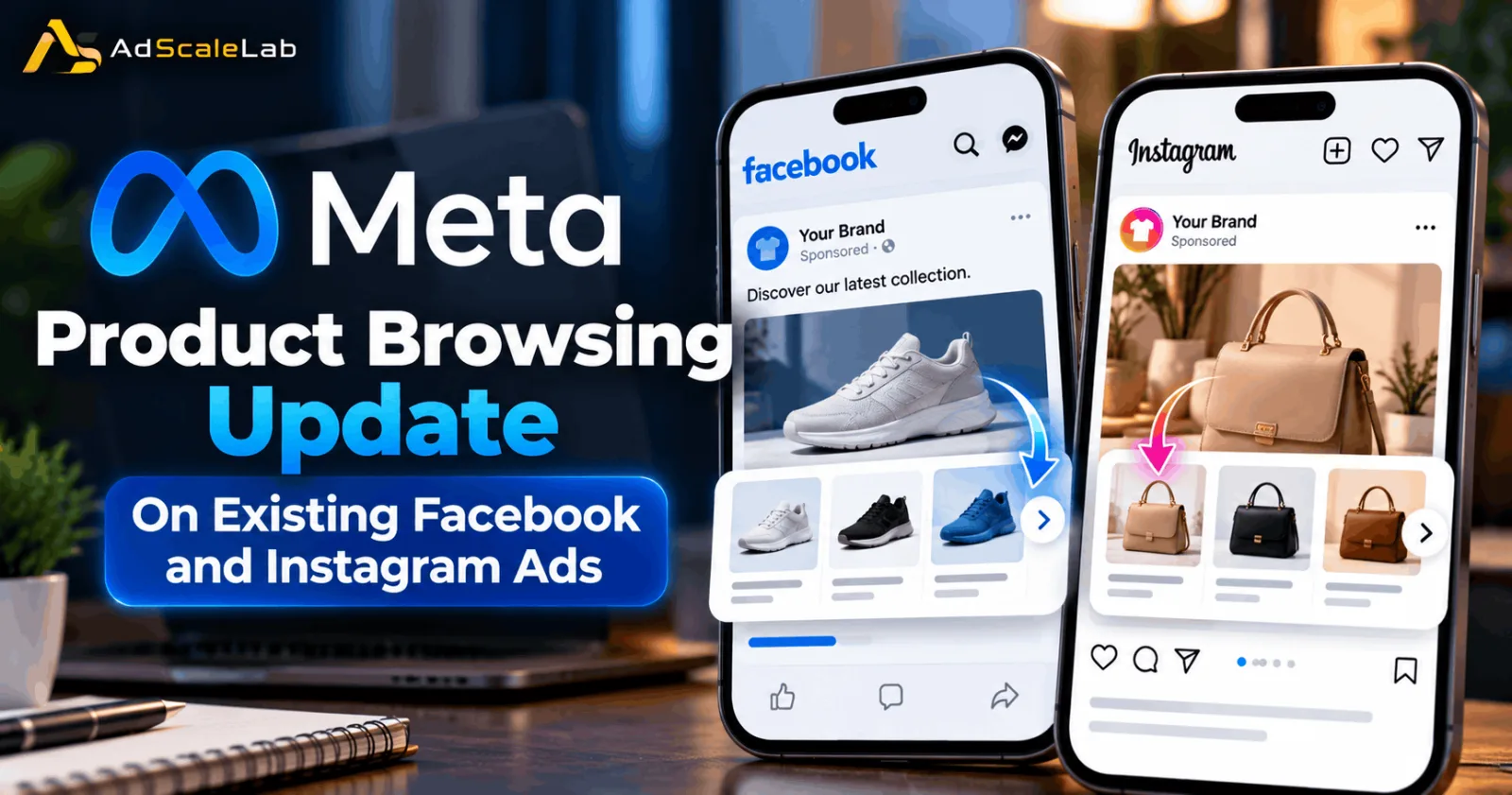
The Meta product browsing update is expected to change how people interact with existing Facebook and Instagram ads from October 28, 2026. According to a notice received by advertisers and reported by advertising industry publications, Meta plans to turn on its product browsing feature for existing ads by default unless advertisers opt out. The change could affect what happens after a person taps an ad, allowing them to explore product information and personalized suggestions inside Facebook or Instagram before visiting a business website.
The reported update is important for advertisers because it changes more than the appearance of an ad. It may also affect the customer journey, website traffic, conversion tracking and the way businesses judge campaign performance. Meta says the feature improved conversions in its own experiment, but some details about that test have not been publicly explained. Advertisers therefore need to understand what is changing and check their settings before the planned rollout.
Meta Product Browsing Update: What Is Changing On October 28?
The notice reportedly says that people who tap an ad may see an in-app experience containing product information and personalized suggestions. Product browsing is not being introduced as a completely new advertising feature. Advertisers have already had access to product browsing controls through Meta’s Advantage+ creative and destination settings. The reported change concerns the default setting for ads that are already running. Instead of leaving the feature off, Meta plans to turn it on unless advertisers take action.
This distinction matters to businesses that have already created and approved their campaigns. An advertiser may have selected a particular image, video, headline and website destination to guide customers toward a product page. If product browsing becomes active, some people who tap the ad may see an additional shopping experience inside Meta’s apps before reaching the advertiser’s website.
However, the notice does not explain every part of the rollout. It does not clearly identify all affected campaign objectives, ad formats or placements. It also does not confirm whether newly created ads after October 28 will follow the same default. Advertisers should check the notice in their own accounts rather than assume that every campaign will be affected in exactly the same way.
How Product Browsing Could Change The Facebook And Instagram Ad Experience
The main purpose of product browsing is to help people explore products without immediately leaving Facebook or Instagram. When someone taps an eligible ad, the person may see product details and personalized recommendations within the app. Depending on the experience shown, this could give shoppers more information before they decide whether to continue to the advertiser’s website.
For example, an online clothing store might run an Instagram ad promoting a particular jacket. Under a traditional advertising journey, a person taps the ad and goes directly to the website or landing page selected by the advertiser. With product browsing enabled, that person may first see a shopping experience with product information and suggestions for other items. This approach could help shoppers discover products they were not originally looking for. It may also give retailers another opportunity to encourage people to explore their catalog. For businesses with many related products, that could make the experience more useful than a single product page.
At the same time, the extra step may not suit every campaign. Some advertisers build campaigns around a specific landing page, offer, lead form or carefully designed customer journey. If the experience after the tap changes, the advertiser needs to understand whether the new journey supports the original campaign goal. Meta’s notice uses the word “may,” which means the in-app experience is not necessarily shown after every tap. The company has not publicly explained the exact conditions that determine when product browsing appears. Advertisers should therefore avoid assuming that every person who interacts with an eligible ad will see the same experience.
Meta Reports 3% More Conversions In Its Product Browsing Test
One of the most notable parts of the reported update is Meta’s performance claim. The notice reportedly says the experiment ran from August 6 to August 21, 2026, and covered approximately 117,700 advertisers globally across more than three business categories. E-commerce, consumer packaged goods and retail were among the categories named. Meta also reportedly stated that the product browsing experience outperformed with more than 99% confidence.
If the reported result applies to a particular business, additional conversions could be valuable. Even a small improvement may matter to advertisers managing large campaigns or selling products with healthy profit margins. Product browsing could also help people find relevant items before they leave the app.
However, advertisers should understand the limits of the available information. The 3% figure comes from Meta’s own experiment and has not been independently verified. The reproduced notice does not provide a full breakdown of the conversion events, attribution window, testing method or results for individual industries. It also does not show whether the feature improved revenue, reduced acquisition costs or increased return on ad spend. A higher number of reported conversions does not automatically mean a campaign is more profitable. Businesses still need to consider the cost of acquiring each customer, the value of each order and whether the conversions represent additional sales that would not otherwise have happened.
For this reason, advertisers should treat Meta’s 3% figure as a reported result, not a guarantee that every campaign will improve by the same amount.

Why Advertisers Should Review Their Campaign Settings
The timing of the reported change is another reason for advertisers to pay attention. October 28 falls close to the start of the main US holiday shopping period, when many retailers prepare campaigns for Black Friday and Cyber Monday. For businesses with large seasonal budgets, even a small change to the customer journey can deserve a closer review. Advertisers may have already tested their creative, landing pages and audience targeting. If product browsing changes what customers see after tapping an ad, they may need to review whether their existing campaign setup still matches their goals.
Measurement is another concern. Many businesses use website analytics and conversion tracking to understand how people move from an advertisement to a purchase. An in-app product browsing experience may change the path users take before reaching the website. Advertisers should check their reporting carefully so they can distinguish between more engagement inside Meta and meaningful business results.
This is particularly important for agencies managing multiple client accounts. They may need to review different campaigns, check which accounts received the notification and confirm that the selected settings match each client’s strategy. Businesses already working to improve their Meta Ads campaign performance should include this change in their regular account review.
How Advertisers Can Opt Out Of Product Browsing
The second option is to review the relevant Advantage+ creative and destination settings for individual ads. According to the reproduced notice, advertisers can turn product browsing on or off through these settings. This also means the feature can reportedly be changed after the rollout, although reviewing ads beforehand may help businesses avoid unexpected changes during important campaigns. Advertisers should verify the result after changing a setting rather than assume that one action covers every account they manage. The available report does not clearly explain the scope of the notification’s opt-out button, so businesses operating several ad accounts should confirm which accounts are covered.
For agencies, it is also sensible to document the decision made for each client. Some retailers may want to test product browsing, while others may prefer to send customers directly to a specific website page. The right choice depends on the campaign objective, product catalog, landing page and measurement setup.
Businesses that choose to test the feature should compare its results with a suitable alternative. Looking at conversions alone may not be enough. Website sessions, cost per acquisition, revenue and return on ad spend can help provide a clearer picture of whether the changed experience benefits the business.
Meta Has Not Publicly Explained Every Detail Of The Rollout
Although multiple industry publications have discussed the reported update, an important verification point remains. The report is based on a notification reportedly received by advertisers and reproduced in industry coverage. That is meaningful evidence that the change is being communicated to advertisers, but it is different from a detailed public announcement that anyone can independently consult.
Some important questions remain unanswered. The available notice does not clearly state every eligible ad format, placement or campaign objective. It also does not explain how the reported 3% conversion increase was calculated in enough detail for an independent assessment. Advertisers should use the notification in their own Meta account as the practical reference for their account and check for further official instructions. This distinction is important for businesses making decisions about advertising budgets. The reported rollout should not be confused with a confirmed performance improvement for every advertiser. Until more details are available, campaign owners should focus on checking their settings and measuring the results that matter to their own businesses.
What The Meta Product Browsing Update Means For Advertisers
Meta’s reported product browsing change reflects a wider shift toward advertising experiences that use automation and personalized recommendations. Rather than treating every ad click as a direct route to a website, platforms are creating more opportunities for people to explore products within their own apps. That approach could help some retailers introduce shoppers to additional products and improve the overall shopping experience. But it also creates a need for advertisers to pay closer attention to destination settings, campaign measurement and the way results are reported.
For now, the most practical step is to review existing Facebook and Instagram ads before October 28, 2026. Advertisers should check whether they received the notification, decide whether product browsing fits their campaign goals and verify the relevant settings. If they choose to use the feature, they should measure its impact on conversions, costs and revenue instead of relying only on the average improvement reported by Meta. The planned rollout is worth watching, but its actual impact will depend on how the feature behaves across different accounts and campaigns. Further details from Meta would help advertisers make more informed decisions.
Agency ad accounts, without the wait.
Buy and top up Google, Meta, native, and more from one dashboard.
Get started


No comments yet. Be the first to comment.
Comments are open to registered AdScaleLab clients.
Sign in to comment