





How To A/B Testing Native Ad Headlines Without Wasting Your Budget

Native advertising can bring new visitors to your website, but getting clicks does not always mean getting customers. Sometimes, an ad receives plenty of attention but generates very few leads or sales. In other cases, changing a few words in the headline can help attract a more relevant audience and improve campaign performance. This is where A/B testing native ad headlines becomes useful. Instead of guessing which headline will perform better, advertisers can compare different versions and use campaign data to make informed decisions. A good testing process can help improve click-through rates, understand audience behavior, and make better use of an advertising budget.
However, native ad headline testing can also waste money when it is not planned properly. Testing too many variations, changing several campaign settings at once, or stopping an experiment too early can lead to misleading results. The goal is not simply to find a headline that gets more clicks. It is to discover which headline helps achieve the campaign's actual objective. In this guide, we explain how to A/B test native ad headlines step by step, how to measure the results, and how to avoid common mistakes that can increase your advertising costs.
What Is A/B Testing In Native Advertising?
A/B testing in native advertising means comparing two versions of an ad to understand which one performs better. Version A is the original headline, while version B is the alternative you want to test. Both versions should reach a comparable audience under similar conditions so that their results can be evaluated fairly. For example, imagine you are promoting a guide that helps small businesses reduce their software expenses. Your first headline could be “How to Reduce Your Business Software Costs.” The alternative could be “5 Ways to Cut Business Software Costs Without Losing Features.”
Both headlines promote the same guide, but they present the benefit differently. One is direct, while the other promises a specific set of practical ideas. By comparing their performance, you can learn which message attracts the right audience. The same approach can be used in campaigns on platforms such as Taboola's Realize and Teads, depending on the testing features available in your account. Taboola's official creative best-practices guide discusses testing creatives and considering device-level performance. Its native advertising campaign guide also recommends preparing alternative titles and thumbnails for testing.
Why A/B Testing Native Ad Headlines Matters For Campaign Performance
The headline is one of the first things people notice when they see a native ad. It helps them decide whether the advertised content is relevant to their interests or problems. If the message is unclear or offers little value, potential customers may scroll past the ad without clicking. Effective native ad headline testing helps advertisers understand which messages attract attention. A headline that highlights a clear benefit may perform differently from one that asks a question or focuses on a common problem. Testing these approaches can reveal what resonates with a particular audience.
However, click-through rate (CTR) is only one part of the picture. CTR measures the percentage of impressions that result in clicks. A higher CTR may indicate that a headline attracts more attention, but it does not automatically mean the campaign generates more sales or leads.
For lead generation campaigns, cost per lead and lead quality may be more important. For ecommerce campaigns, completed purchases, revenue, and return on ad spend may be the better measures. The right metric depends on what the campaign is designed to achieve. The main benefit of A/B testing native ad headlines is that it replaces guesswork with a more structured decision-making process. Instead of increasing your budget based on a promising headline alone, you can examine how that headline contributes to the results that matter to your business.
A/B Test Native Ad Headlines Without Wasting Your Budget
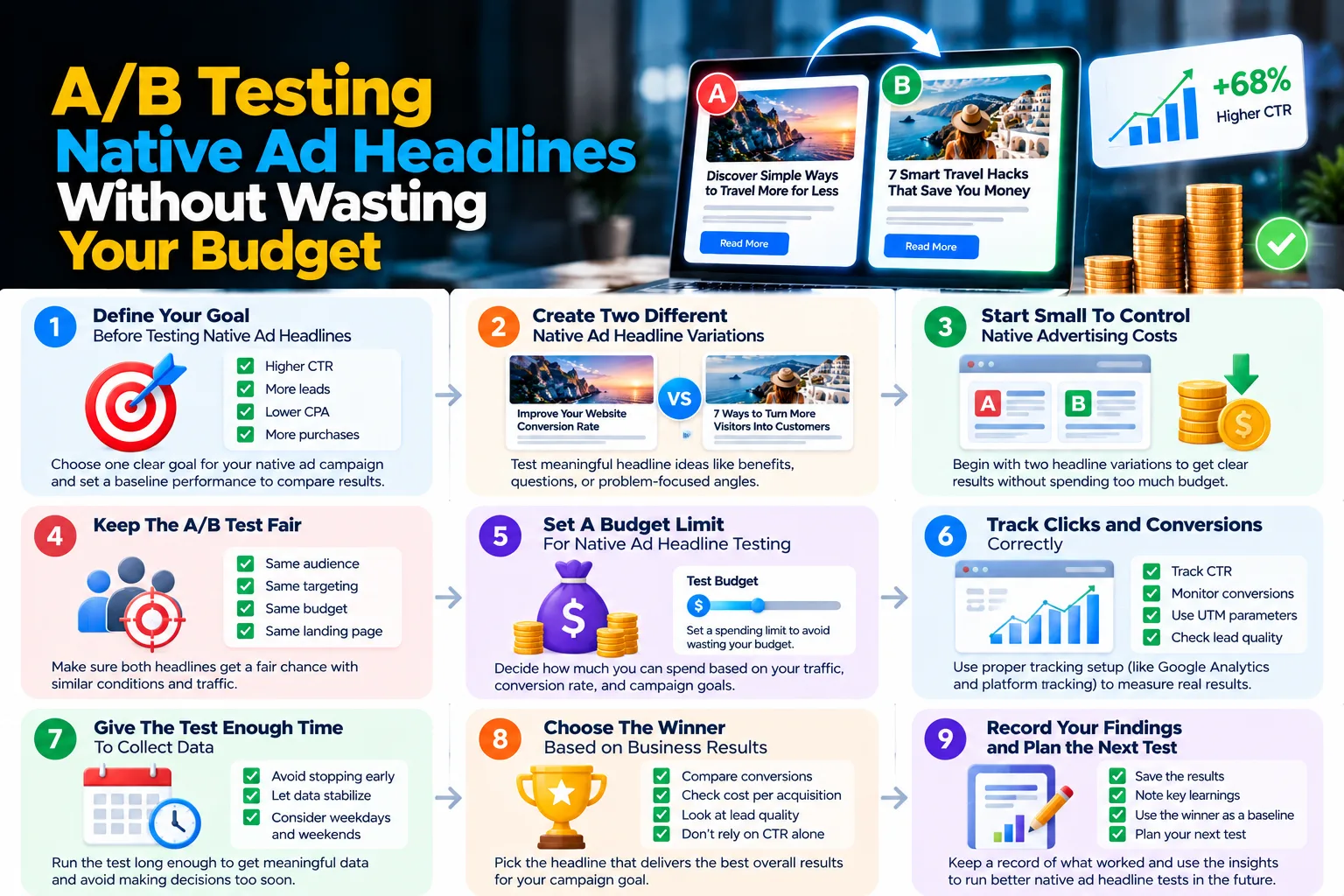
Step 1: Define Your Goal Before Testing Native Ad Headlines
Before writing alternative headlines, decide what you want to improve. You might want a higher click-through rate, more qualified leads, a lower cost per acquisition, or more purchases. Choose one primary metric that matches your campaign objective. For example, if you are running a native advertising campaign to generate leads, do not select a winner only because it has a higher CTR. Check whether those clicks lead to completed forms and whether the leads are relevant to your business.
Record the campaign's existing performance before starting the test. Depending on your campaign, this could include impressions, CTR, average cost per click, conversion rate, cost per lead, and return on ad spend. These numbers give you a baseline for comparison. Defining the goal first also prevents you from changing your decision later simply because a different metric makes one headline look better. A successful native ad headline test should answer a clear question about campaign performance.
Step 2: Create Two Different Native Ad Headline Variations
The next step in A/B testing native ad headlines is to create an alternative that tests a meaningful idea. Avoid writing two headlines that are almost identical unless you specifically want to test a small wording change. For example, if your original headline is “Improve Your Website Conversion Rate,” you could test it against “7 Ways to Turn More Website Visitors Into Customers.” The second version gives readers a more specific reason to click.
You can also compare a benefit-focused headline with a problem-focused headline. For a landing page optimization service, one headline might highlight faster page loading, while the other focuses on reducing the number of visitors who leave without taking action.
Keep the advertised offer, landing page, audience, and other major campaign settings consistent. If you change the headline, image, targeting, and landing page together, you will not know which change influenced the results. Make sure every headline accurately represents the content behind the ad. Misleading promises might attract clicks initially, but they can disappoint visitors and reduce conversion performance.
Step 3: Start Small To Control Native Advertising Costs
Testing a large number of headlines at once can make a small campaign difficult to manage. When traffic is limited, every additional variation divides the available impressions and clicks among more options. This can leave you without enough information to identify a reliable winner. For a campaign with a limited budget, start by comparing two meaningful headline variations. Once you have a clear result, use the better-performing version as the starting point for your next experiment.
For example, if a headline that promises a practical benefit performs better than a general headline, your next test could compare two different benefits. This helps you improve your native ad creative gradually instead of spending money on many unrelated ideas at the same time. There is no universal rule that every campaign must test only two headlines. Advertisers with sufficient traffic may test more variations. Taboola's creative best-practices guide recommends ongoing creative testing, but the appropriate number of variations depends on your traffic, budget, and experiment design.
Step 4: Keep The A/B Test Fair
A fair comparison is essential when testing native ad headlines. Ideally, both versions should receive comparable traffic from the same target audience under similar conditions. Use the platform's experiment or creative-testing controls when available, and check how traffic is allocated between the versions. Avoid making major changes to bids, targeting, budgets, or campaign schedules during the test unless the change is necessary. If one version runs under different conditions, the results may reflect those conditions rather than the headline itself.
Device performance also deserves attention. People browsing on mobile devices may respond differently from people using desktop computers. If you have enough data, compare the results by device to see whether the headline performs consistently. Taboola's creative best-practices guide recommends considering device differences when testing creatives. Still, do not assume every native advertising platform offers identical experiment controls. Check the current features available in your account before starting.
Simply placing two ads in one campaign does not always guarantee a randomized or evenly distributed test. Advertising platforms may deliver one creative more frequently than another based on their optimization systems. Understand how the platform allocates impressions before drawing conclusions.
Step 5: Set A Budget Limit For Native Ad Headline Testing
Before launching the experiment, decide how much you can afford to spend on testing. A predefined budget helps prevent a headline experiment from consuming money that should be reserved for profitable campaigns or other business activities. The amount you need depends on your normal traffic volume, conversion rate, advertising costs, and the size of the improvement you want to detect. A campaign that receives frequent conversions may produce useful results sooner than one that generates only a few conversions each week.
For example, if your campaign normally receives very few leads, a small amount of spending may not provide enough evidence to determine which headline produces a lower cost per lead. In that situation, the result should be treated as inconclusive rather than as proof that one headline is better.
Set clear rules for reviewing the test's spending and performance. If a variation is spending money but shows a serious technical problem or receives no meaningful engagement, investigate it. However, avoid pausing a version simply because it is temporarily behind during the early stages. The purpose of budget control is to manage risk while allowing the experiment to produce useful information. Cutting the test short every time the results fluctuate can make native advertising optimization less reliable.
Step 6: Track Clicks And Conversions Correctly
Accurate tracking is necessary for reliable native ad headline testing. Monitor impressions, clicks, CTR, cost per click, conversions, and cost per conversion where those metrics are relevant to your campaign. For lead generation, review lead quality as well. For ecommerce, look at completed purchases and revenue. Use the same conversion definition for both headline variations. For example, if your main goal is a completed lead form, do not compare that result with a page visit or button click and treat them as equal conversions.
You can use Google Analytics campaign URL parameters to help identify campaign traffic in analytics reports. Taboola also provides official documentation on URL parameters for tracking, including parameters that can help advertisers understand which creative or placement generated traffic. Before spending heavily, test your tracking setup. Taboola's conversion tracking testing tool explains how to verify that conversion events are working correctly.
Also review the landing page experience. A headline may attract the right visitors, but slow loading, confusing forms, or a mismatch between the ad promise and page content can prevent them from converting. Reliable native ad campaign optimization requires checking the entire journey, not just the headline.
Step 7: Give The Test Enough Time To Collect Data
One of the most common mistakes in A/B testing native ad headlines is declaring a winner too early. When a campaign has limited traffic, a small number of clicks or conversions can make one version look much better than it actually is. The right test duration depends on the amount of traffic, conversion frequency, expected difference between the headlines, and the method used to evaluate the results. Allow enough time to capture normal changes in audience behavior, including weekday and weekend differences when they matter.
Experimentation specialists at Optimizely explain how sample size affects A/B testing. Its sample size calculator can help you understand how the baseline conversion rate and the improvement you want to detect affect the amount of data required. Avoid checking the results repeatedly and stopping the experiment as soon as one headline moves ahead. If you are using a statistical testing method, follow its recommended stopping rules. If the available data does not support a reliable conclusion, continue the test when practical or record the result as inconclusive. An inconclusive test is not automatically a failure. It can show that the headlines perform similarly or that the campaign needs more data to distinguish between them.
Step 8: Choose The Winner Based On Business Results
Once the experiment has collected enough data, compare the headline variations using the primary metric you selected before launch. Look at the size of the difference and the quality of the results, rather than choosing the version with the largest number alone. Imagine Headline A has a CTR of 0.7%, while Headline B has a CTR of 0.9%. In this example, Headline B attracts more clicks per impression. However, if B generates very few qualified leads while A produces more useful leads at a lower cost, Headline A may be the better option for a lead generation campaign. The example illustrates why CTR optimization should not be separated from conversion performance. A headline can attract attention without delivering business value.
You should also consider how confident you are in the result. A small difference based on limited data may not justify a major change to your campaign. If one variation performs better and the evidence is strong enough, make it the new baseline and plan your next test. If neither headline produces satisfactory results, review the offer, image, audience, and landing page. Sometimes the problem is not the wording alone. A successful native ad headline testing process helps you identify what to investigate next rather than encouraging you to spend more on a weak campaign.
Step 9: Record Your Findings And Plan The Next Test
Every experiment should leave you with a useful lesson, even if neither headline wins. Record the test dates, headline variations, campaign settings, budget, impressions, clicks, conversions, and final result. Add a short explanation of what you learned. For example, you may find that a headline with a specific benefit attracts more qualified leads than one that uses a broad promise. Your next test could compare two different benefits. If a curiosity-driven headline generates clicks but few conversions, try making the offer clearer instead of adding more curiosity.
Keep each new experiment focused on one main question. Testing one major change at a time makes it easier to understand the outcome and apply the learning to future native advertising campaigns. Review the results regularly, but do not assume that a winning headline will remain the best option forever. Audience interests, competition, placement mix, and seasonal demand can change. Continued creative testing helps you notice when a previously successful message starts losing effectiveness.
Common Native Ad Headline Testing Mistakes To Avoid
A common mistake is choosing a winner based only on click-through rate. CTR is useful for understanding engagement, but it cannot tell you whether the traffic generates sales, qualified leads, or a positive return on ad spend. Always connect headline performance to the campaign's main objective. Another mistake is changing multiple variables at once. If you change the headline, image, landing page, and targeting together, you lose the ability to identify which change influenced the result. Keep the test as consistent as possible and make separate changes when you need to investigate different elements.
Testing too many variations with limited traffic can also waste money. Each version needs enough exposure to produce useful evidence. Starting with a smaller, focused experiment is often more practical for advertisers working with limited budgets.
Finally, do not ignore conversion tracking or the landing page experience. Incorrect tracking can make a good headline look unsuccessful, while a poor landing page can prevent interested visitors from becoming customers. Check both before making major budget decisions.
Final Thoughts On A/B Testing Native Ad Headlines
A/B testing native ad headlines does not need to be complicated or expensive. Start with a clear goal, create two meaningful variations, set a reasonable budget, and keep the rest of the campaign as consistent as possible. Track conversions accurately and give the experiment enough time to collect useful data. Most importantly, choose the winning headline based on the result your business needs, not simply the number of clicks it receives. If the evidence is unclear, do not force a decision. Record what you learned and use it to design a better experiment.
Over time, A/B testing native ad headlines can help you understand your audience, improve native ad creative optimization, and make smarter decisions about your advertising spend. The aim is not to find one perfect headline forever. It is to build a repeatable process that helps each campaign improve on the last.
Agency ad accounts, without the wait.
Buy and top up Google, Meta, native, and more from one dashboard.
Get started

No comments yet. Be the first to comment.
Comments are open to registered AdScaleLab clients.
Sign in to comment