





How To Track Conversions Across Native Ads Agency Accounts
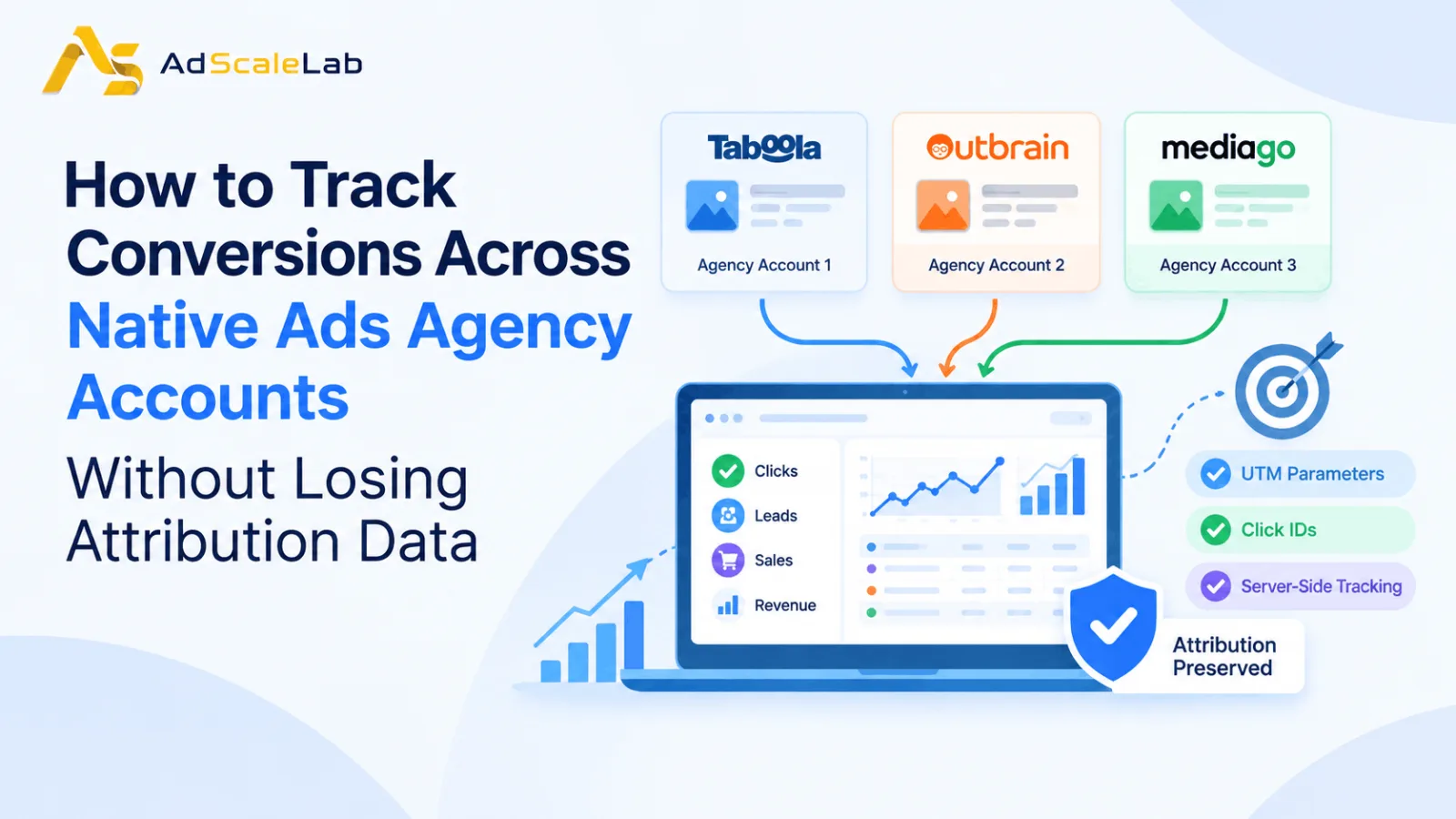
Running native advertising campaigns across multiple agency accounts can help advertisers reach more people, test different campaigns, and manage advertising budgets more efficiently. However, agencies need a reliable tracking system to track conversions across native ads agency accounts without losing important attribution data. When campaigns run through platforms such as Taboola, Outbrain, and MediaGo, missing tracking parameters, duplicate conversion events, or disconnected customer journeys can make it difficult to identify which campaigns generate real results. A proper conversion tracking setup helps agencies measure performance accurately, understand where leads and sales come from, and make better decisions about advertising budgets.
For advertisers who use Taboola, Outbrain, or MediaGo, conversion tracking is not just about counting sales or leads. It is also about understanding which campaign brought the visitor, which account generated the click, and whether that visitor eventually completed the desired action. If this information gets lost along the way, campaign reports may show incomplete results, and advertisers may make budget decisions based on the wrong numbers.
Knowing how to track conversions across native ads agency accounts is becoming an important part of campaign management, especially for agencies running multiple accounts for different clients or offers. The good news is that a consistent tracking setup can help preserve important campaign information without making the entire process unnecessarily complicated.
Why You Must Track Conversions Across Native Ads Agency Accounts
When an advertiser runs campaigns through one account, tracking may appear straightforward. A visitor clicks an ad, reaches a landing page, and completes an action such as submitting a form or making a purchase. The tracking system records the conversion and connects it to the available campaign information. The situation becomes more complicated when several accounts are involved. An agency might run one campaign through Taboola, another through Outbrain, and a third through MediaGo. It might also operate multiple accounts on the same network for different clients, websites, or advertising strategies.
Each account may have its own campaign structure, tracking settings, reporting interface, and conversion rules. If campaign names are inconsistent or tracking parameters disappear between pages, it becomes harder to identify where a conversion originated.
For example, a visitor might click a native ad, read a landing page, return the next day, and then complete a lead form. If the website does not preserve the original campaign information, the lead may appear as direct traffic or be assigned to a different source. The conversion still happened, but the advertiser may no longer have a reliable record of the campaign that first brought the visitor. This is why conversion tracking across multiple accounts needs to be planned before campaigns go live rather than repaired after reporting problems appear.
Step 1: Start With A Consistent UTM Tracking Structure
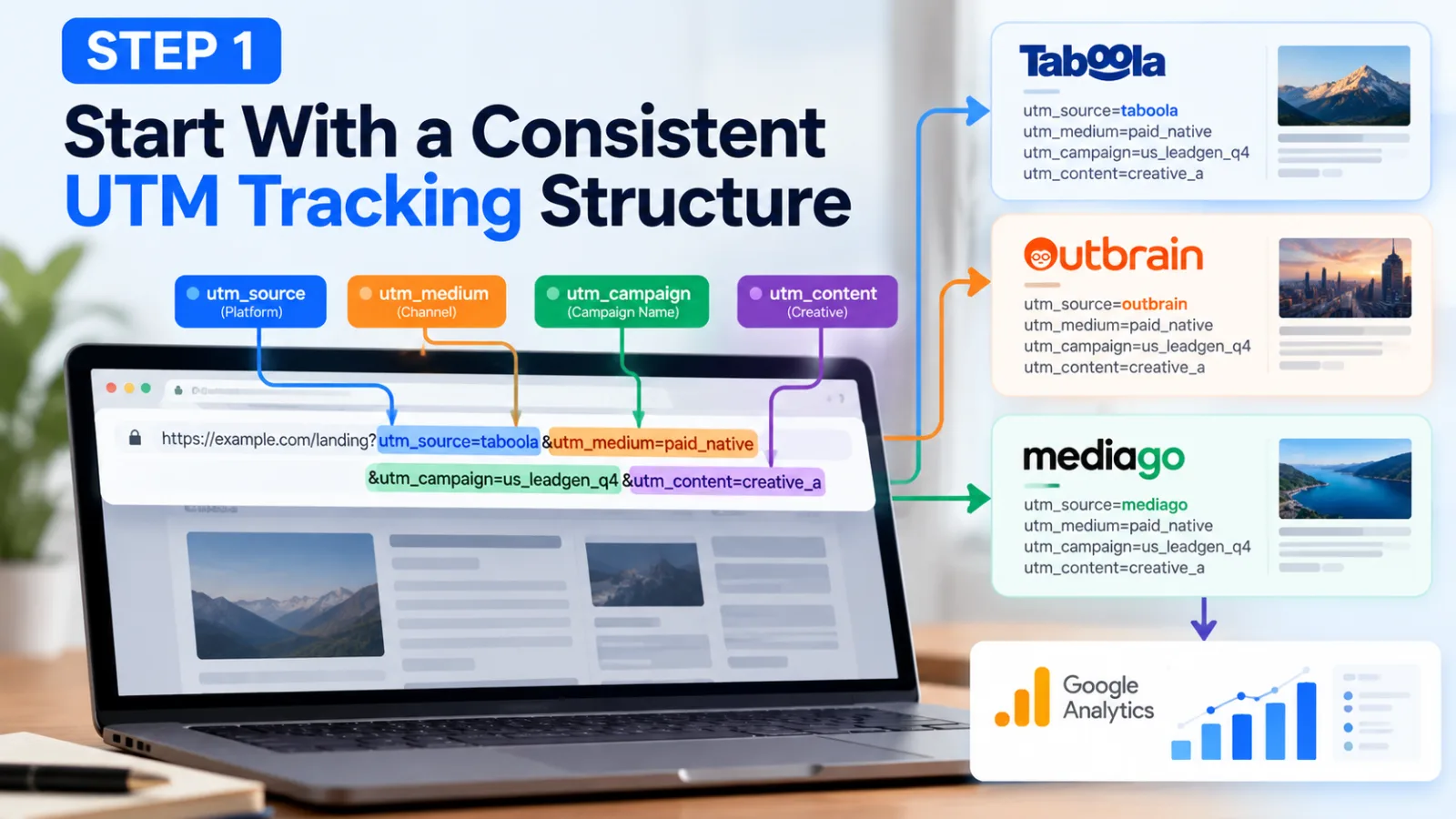
One of the simplest ways to improve native advertising attribution is to use consistent UTM parameters in campaign URLs. These parameters help analytics tools identify the source, medium, campaign, and other details associated with incoming traffic. Google Analytics documentation recommends using parameters such as utm_source, utm_medium, and utm_campaign to identify the campaigns that bring visitors to a website. Additional parameters, including utm_content and utm_id, can help distinguish creatives and campaign identifiers.
For native advertising, an advertiser could use a structure such as:
utm_source=taboola&utm_medium=paid_native&utm_campaign=us_leadgen_q4&utm_content=creative_a
For an Outbrain campaign, the source value could be outbrain, while a MediaGo campaign could use mediago. The exact naming convention matters less than applying it consistently across all accounts. Agencies should also include an internal account identifier and campaign identifier where appropriate. These can be stored as additional UTM parameters or as separate tracking fields supported by the analytics and attribution tools being used.
For example, two campaigns might have similar names but belong to different clients or agency accounts. A unique account ID helps the agency separate their results instead of combining both campaigns into one report. Google's official guide to campaign URL parameters explains how UTM values identify traffic sources and why consistent naming helps prevent campaign data from becoming fragmented.
Step 2: Preserve Click IDs And Original Campaign Information
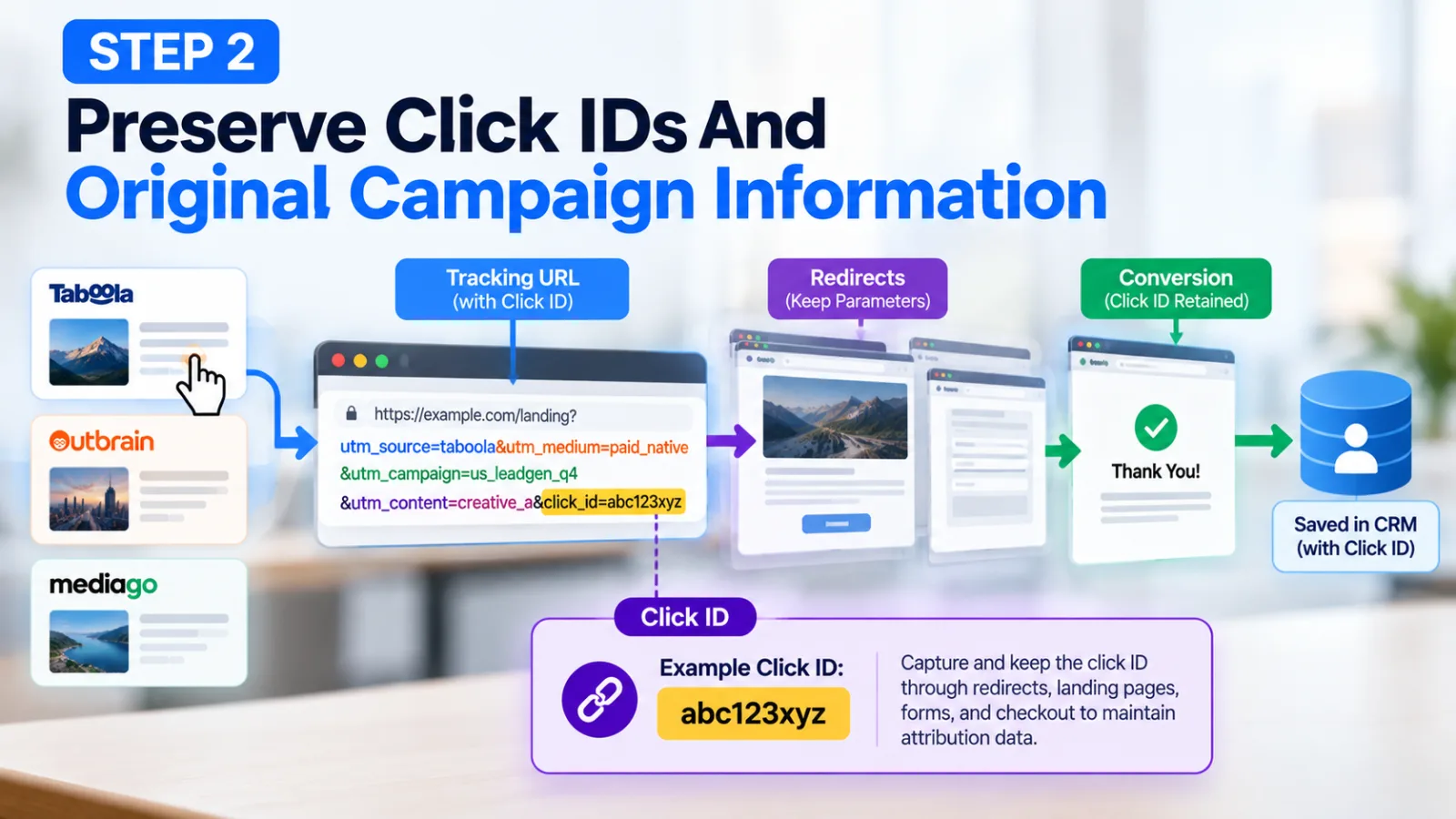
UTM parameters are useful, but they should not be treated as the only source of attribution information. Some advertising and tracking systems use click IDs or other identifiers to connect a conversion with an advertising interaction. A click ID can help identify a particular click or click context, depending on the advertising platform. When supported by the platform, the tracking system should capture the identifier at the landing page and retain it for the conversion process.
The important part is making sure these values are not accidentally removed. Redirects, landing-page scripts, form submissions, checkout pages, and third-party tools can all affect the information passed through a visitor's journey. Imagine that a visitor clicks an ad from one agency account and lands on a tracking URL. The tracking system records the campaign information, but the visitor is then redirected to another page that does not carry the required parameters. If the original values were not saved before the redirect, the conversion system may have difficulty connecting the eventual lead to the original click.
To prevent this, advertisers should capture the relevant tracking values as early as possible and pass them through the necessary parts of the website or lead-generation process. Where appropriate, the values can be stored alongside the lead record in a CRM or other first-party system. Click IDs should be handled according to the relevant platform's documentation. An advertiser should not assume that one network's click ID can be used as a universal identifier across every other advertising platform.
Step 3: Choose The Right Conversion Tracking Method
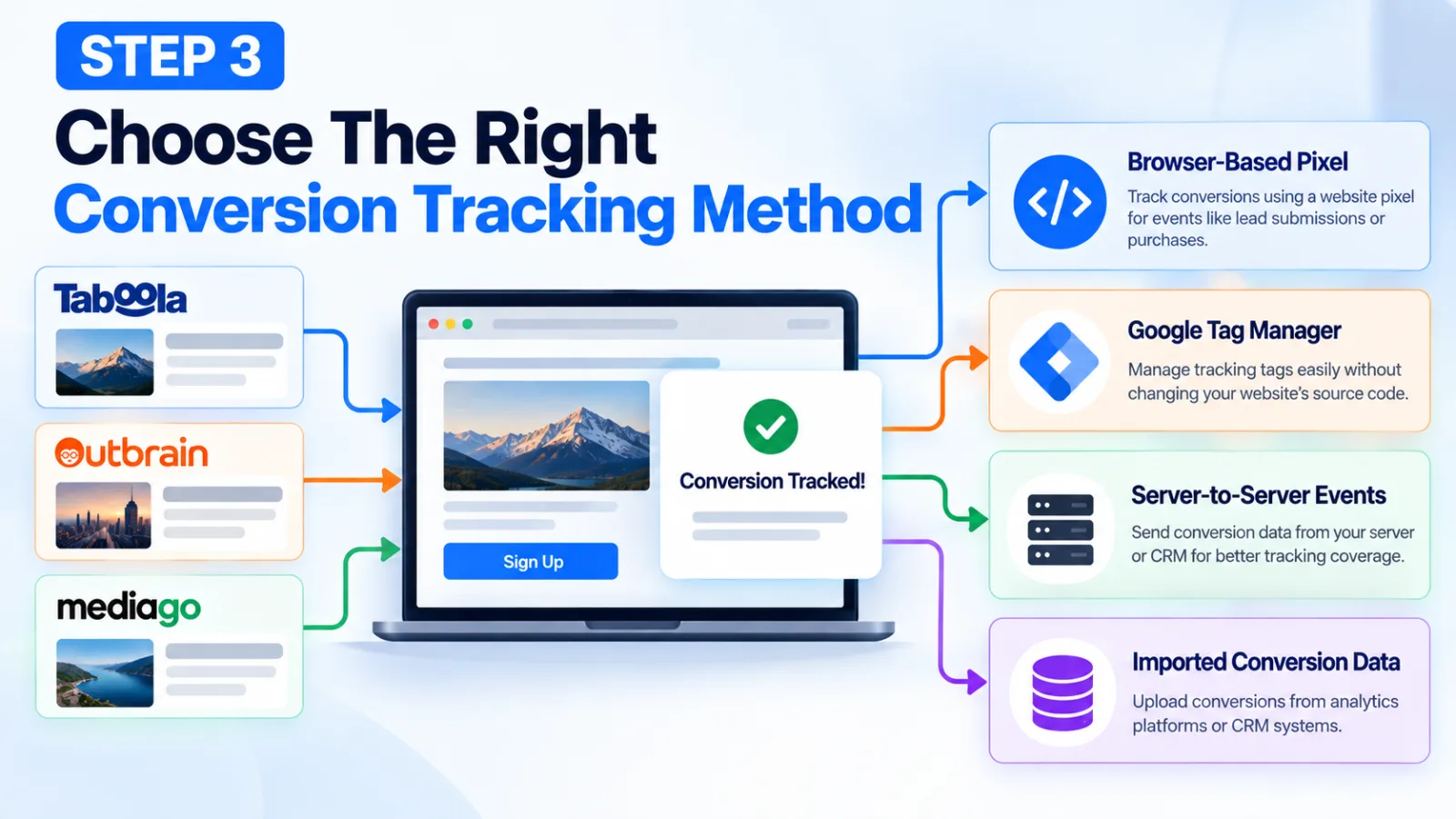
Native advertising platforms provide different ways to record conversions. Depending on the platform and the advertiser's setup, these methods can include browser-based pixels, Google Tag Manager integrations, server-to-server events, and imported conversion data.
Taboola's official tracking documentation describes both pixel-based tracking and server-to-server conversion tracking. Its guidance also recommends using both methods when possible to improve conversion coverage. Outbrain's advertiser help documentation similarly describes pixel-based tracking, Google Tag Manager, server-to-server conversions, and imported conversions from analytics platforms or customer relationship management systems.
The best approach depends on where the conversion happens and how much control the advertiser has over the website and its data. A browser pixel can be a suitable starting point for recording website events such as lead submissions or purchases. Google Tag Manager can help organize and manage tracking tags without requiring every change to be made directly in the website's source code.
Server-to-server tracking can be useful when a conversion is recorded outside the browser, such as when a lead is qualified later in a CRM or a purchase is confirmed by a backend system. However, sending an event from a server does not automatically guarantee that the advertising platform can attribute it correctly. The integration must pass the identifiers and other required information that the platform expects. Advertisers can review the relevant technical requirements in Taboola's conversion tracking documentation and Outbrain's conversion tracking guide.
Step 4: Understand Account-Level And Network-Level Tracking
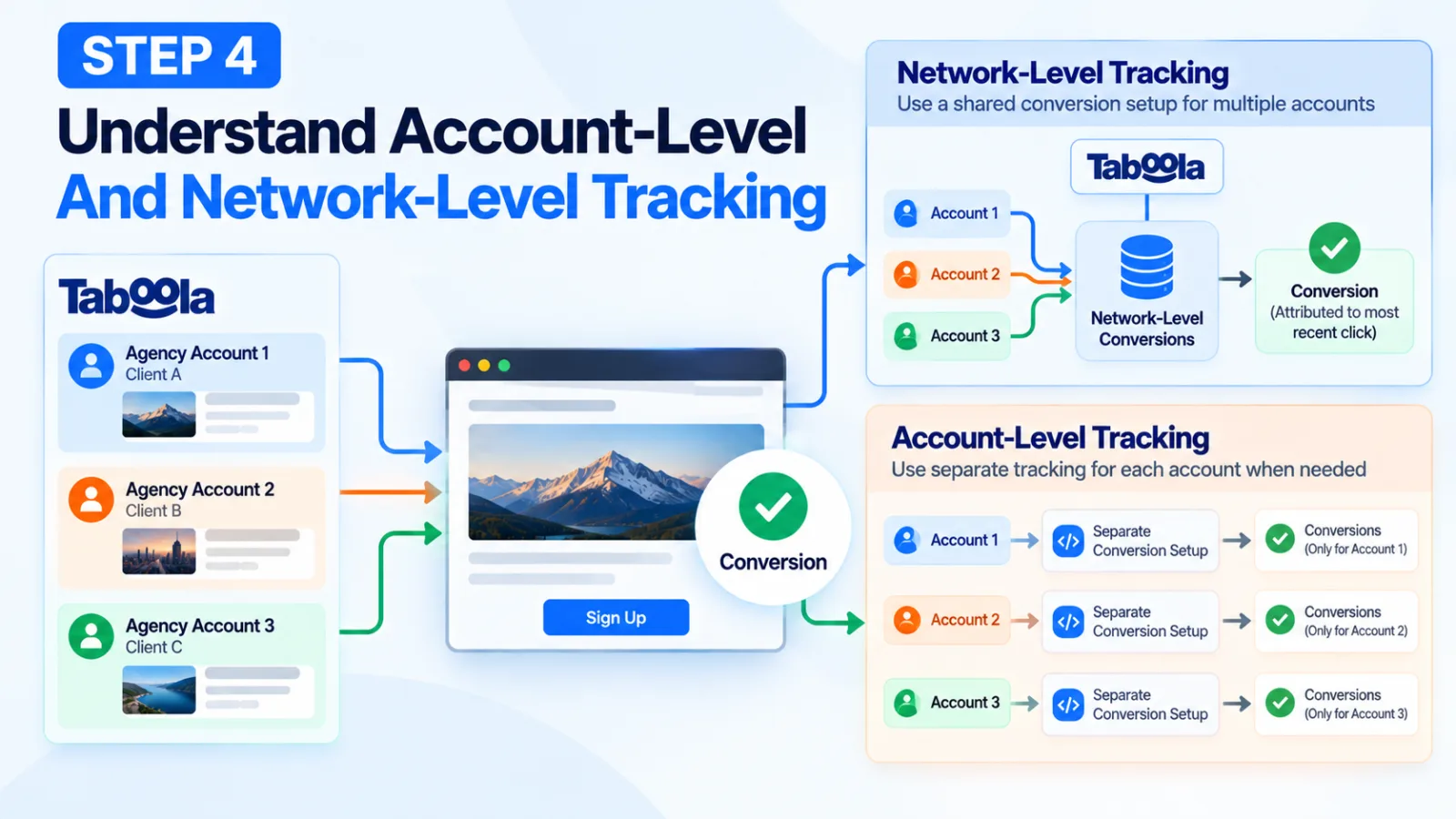
Agencies running several accounts on the same advertising platform should check whether the platform supports account-level or network-level conversion tracking. Taboola's official documentation describes different options for managing conversions across accounts within a network. Advertisers can use separate tracking setups for individual accounts, a network-level setup for accounts sharing a conversion funnel, or a mixed approach that combines both.
This distinction is important because having multiple accounts does not always mean that every account needs a completely separate tracking structure. When several accounts share the same website and conversion journey, a network-level setup may simplify management where the platform supports it. For example, an agency managing three Taboola accounts for campaigns that send visitors to the same lead-generation funnel may be able to use network-level conversion rules. The platform's documentation explains that network-level conversions can be attributed to the account whose campaign had the most recent click.
However, this setup should not be confused with combining unrelated clients into one shared conversion system. Different clients may have separate websites, consent requirements, conversion definitions, and reporting needs. Account-level tracking may be more suitable when the funnels are different or when data separation is important. Before choosing a setup, review the account hierarchy, confirm which tracking options are available, and ask the platform's account manager about any limitations that apply to the account. The technical details are available in Taboola's official guide to network-level conversions.
Step 5: Keep Attribution Data When Visitors Move Between Pages
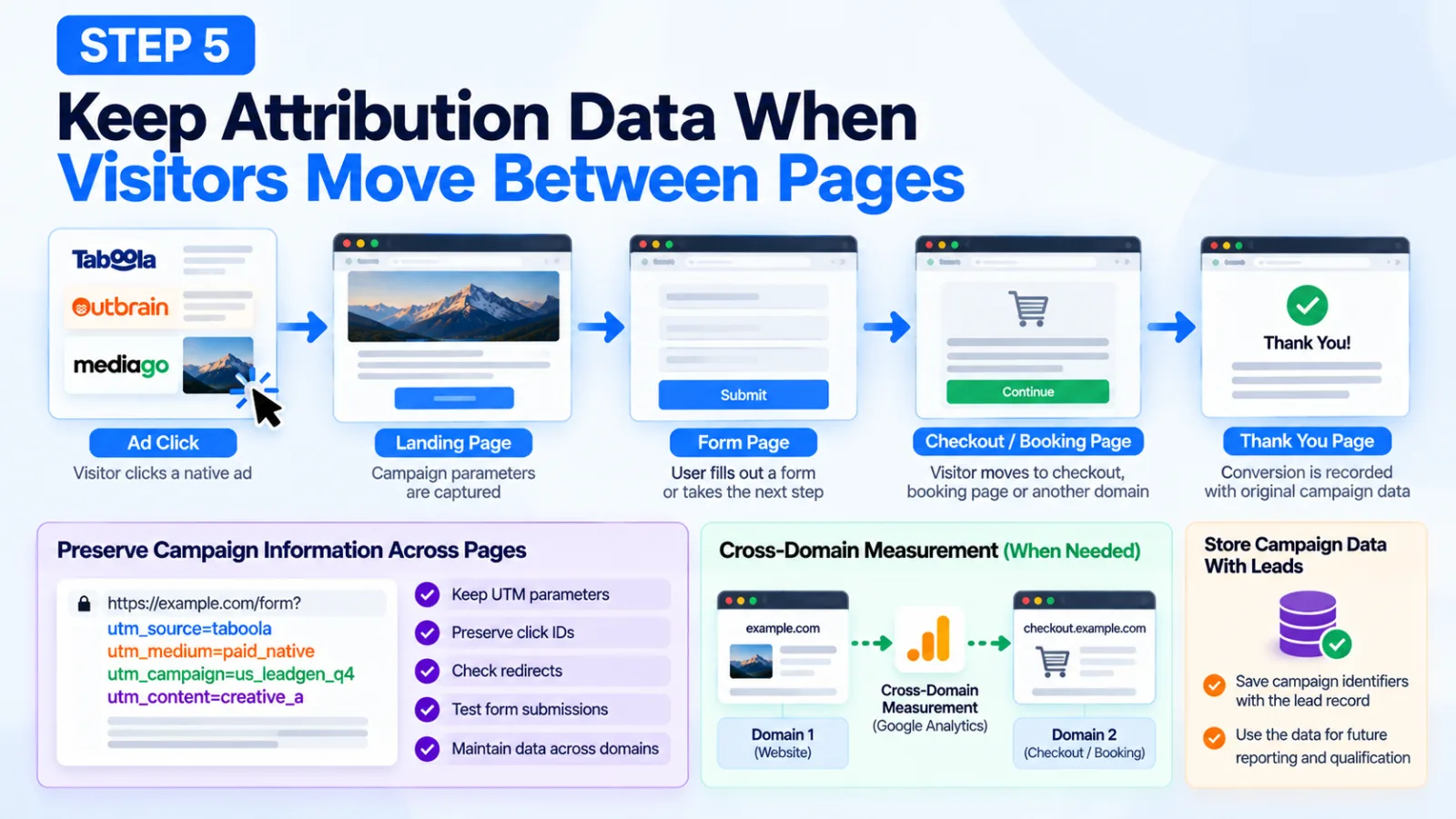
Another common problem appears when a visitor moves from the landing page to a form, checkout, booking page, or another domain. If the original campaign details are not preserved, the final conversion may no longer be connected to the original advertising interaction. This can happen even when the initial landing-page tracking appears to be working correctly. Agencies should map the complete conversion journey and check every step where information could be lost. This includes redirects, form submissions, third-party checkout services, subdomains, and external booking systems.
For websites that move visitors between related domains, cross-domain measurement may be necessary. Google's documentation explains how its tagging system can share measurement information between configured domains so that a visitor's journey can be measured more consistently. Cross-domain measurement is not the same as cross-account advertising attribution, and it does not automatically connect every advertising platform to every conversion. It addresses the specific problem of maintaining measurement across related domains when the correct configuration is in place.
Read Google's official cross-domain measurement guide before implementing this type of setup. For lead-generation campaigns, it is also useful to store campaign identifiers with the lead record. If a visitor submits a form today but becomes a qualified lead several days later, the agency can use the stored information to understand which campaign generated the original enquiry.
Step 6: Prevent Duplicate Conversions From Pixels And Server Events
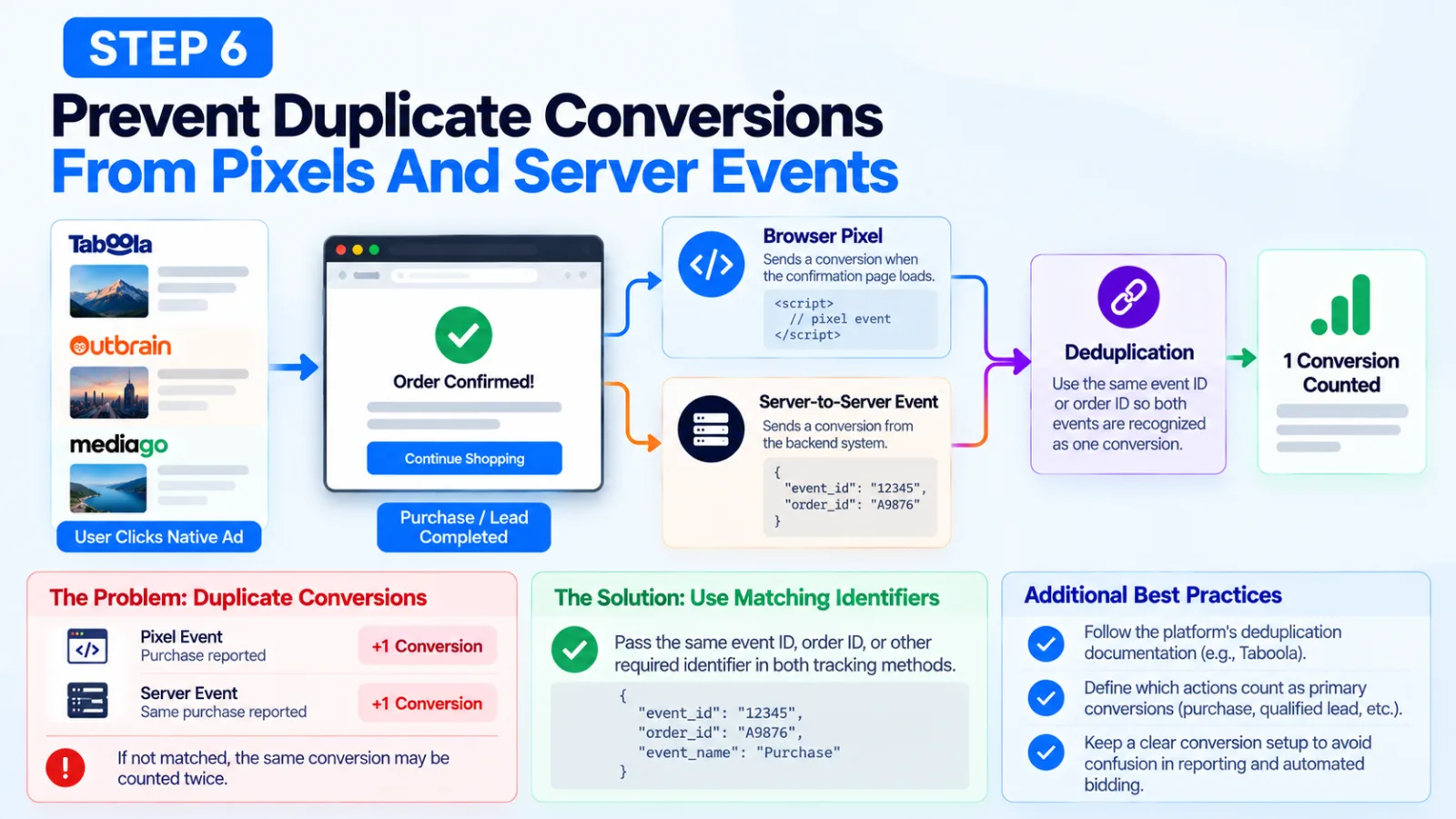
Using more than one tracking method can improve coverage, but it also creates another risk: the same conversion may be counted more than once. For example, a purchase might trigger a browser pixel when the confirmation page loads. The website's backend might also send a server-side conversion event for that same purchase. If the platform cannot identify the two events as the same conversion, reports may show two conversions instead of one. This can make cost per acquisition look lower than it really is and can send misleading signals to automated bidding systems.
The solution is to implement the platform's supported deduplication process. Depending on the integration, this may involve passing the same event identifier, order ID, or other required matching information through both tracking methods. Taboola documents its conversion deduplication logic and explains how pixel and server-to-server events can be handled when they relate to the same click context. Its documentation should be followed carefully because the exact rules depend on the tracking method and event information supplied.
Advertisers should also define which actions count as primary conversions. A purchase, qualified lead, form start, and newsletter signup are not necessarily equivalent business outcomes. If all of them are included in the same total without clear rules, campaign reports can become difficult to interpret. Review Taboola's official conversion deduplication documentation before combining pixel and server-side events.
Step 7: Build One Reporting System For All Native Ad Accounts
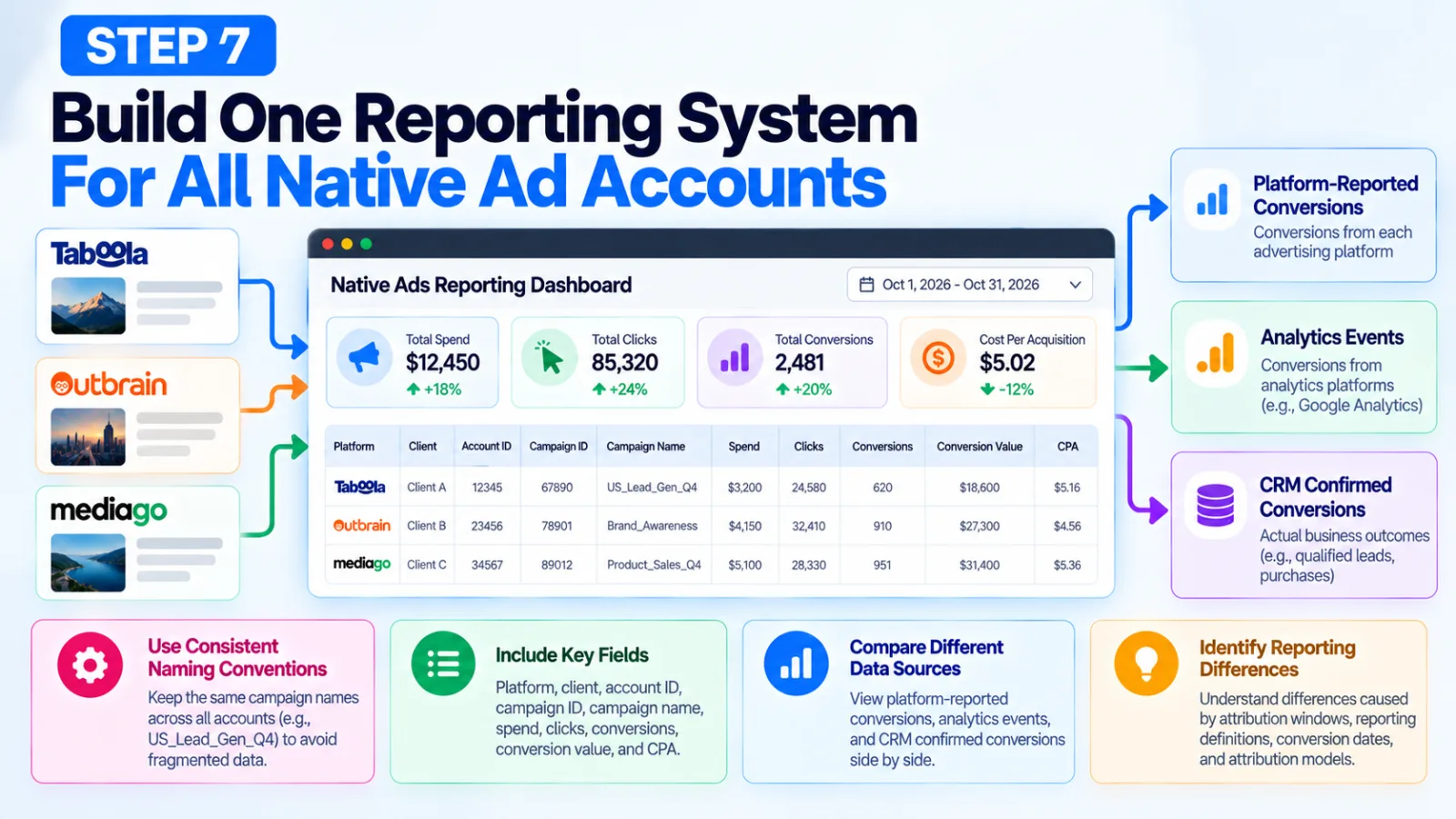
Advertising platforms report the conversions they can attribute according to their own tracking and attribution rules. As a result, the same campaign may show different conversion totals in the advertising dashboard and in an analytics platform or CRM. This does not always mean that the tracking setup is broken. Different attribution windows, reporting definitions, conversion dates, and attribution models can produce different results.
For this reason, agencies should create a central reporting view that includes the most important information from every account. Useful fields include the platform, client, account ID, campaign ID, campaign name, spend, clicks, conversions, conversion value, and cost per acquisition.
Where possible, reports should distinguish between platform-reported conversions, analytics events, and confirmed business outcomes recorded in the CRM. This makes it easier to identify whether a difference comes from attribution rules, missing tracking information, duplicate events, or a genuine reporting problem. The reporting structure should use consistent naming conventions so that the same campaign is not split into several rows because of small differences in capitalization or spelling.
For example, US_Lead_Gen_Q4, us-lead-gen-q4, and US Lead Gen Q4 might be treated as different campaign values in some reports. A shared naming convention reduces this risk and makes comparisons across accounts easier.
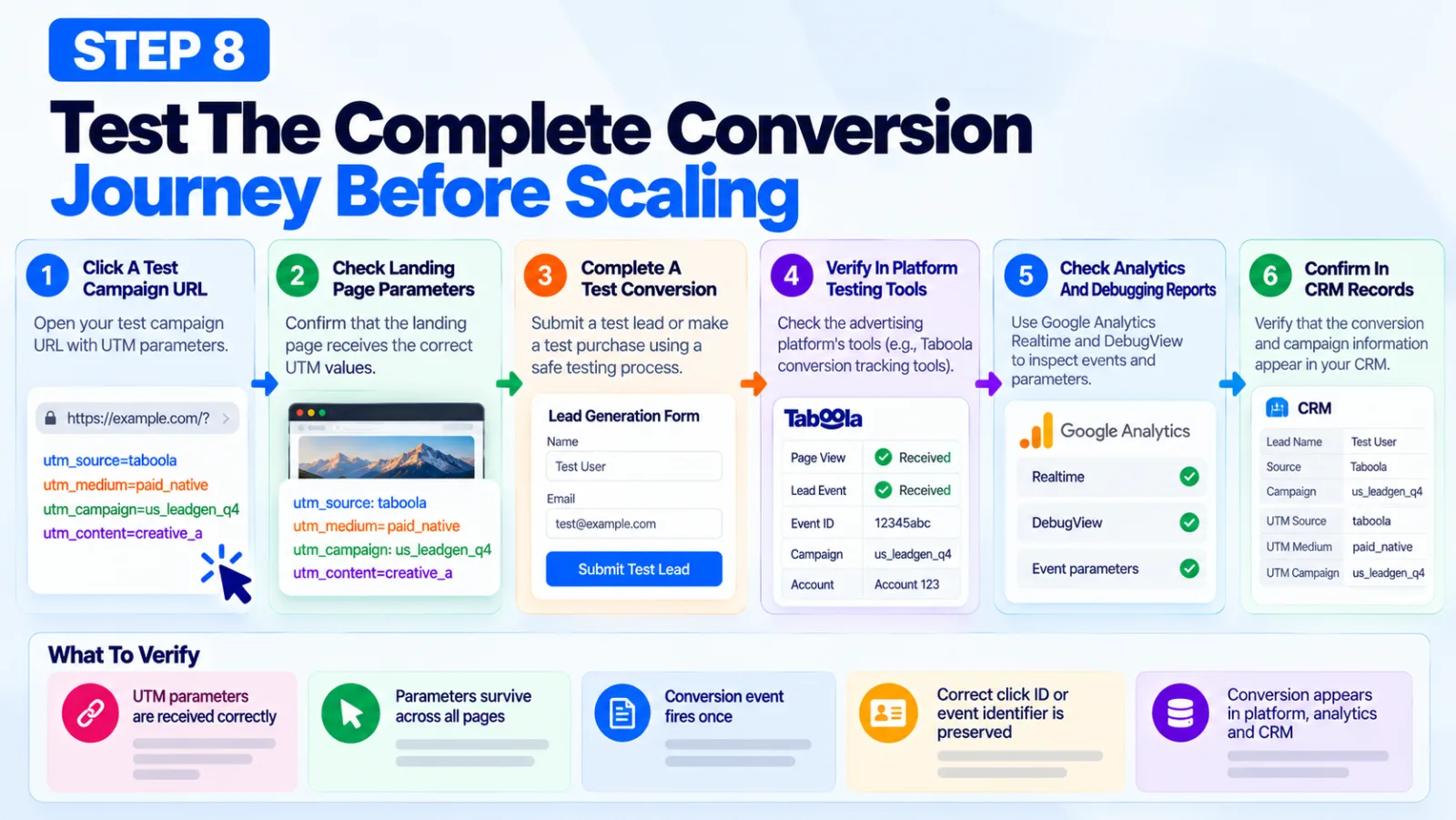
Step 8: Test The Complete Conversion Journey Before Scaling
A tracking setup should be tested before a campaign receives a large budget. Checking whether a pixel is installed is not enough. The agency also needs to confirm that the campaign parameters survive the visitor's journey and that the final conversion reaches the correct destination.
Start by clicking a test campaign URL and checking whether the landing page receives the expected UTM values. Then submit a test lead or complete a test purchase, using a safe testing process that does not create false business transactions. Next, check the relevant platform's testing tools, analytics debugging reports, server logs, and CRM records. Confirm that the correct campaign and account information is available where expected, that the conversion event fires once, and that any required click ID or event identifier is preserved.
Google Analytics provides Realtime and DebugView reports for inspecting incoming events and their parameters. Taboola also provides tools for verifying conversion tracking implementations. Use the relevant platform documentation to confirm how long reporting may take and what a successful test should look like. Testing should be repeated after major changes to landing pages, checkout flows, redirects, consent management, tag configurations, or server-side integrations.
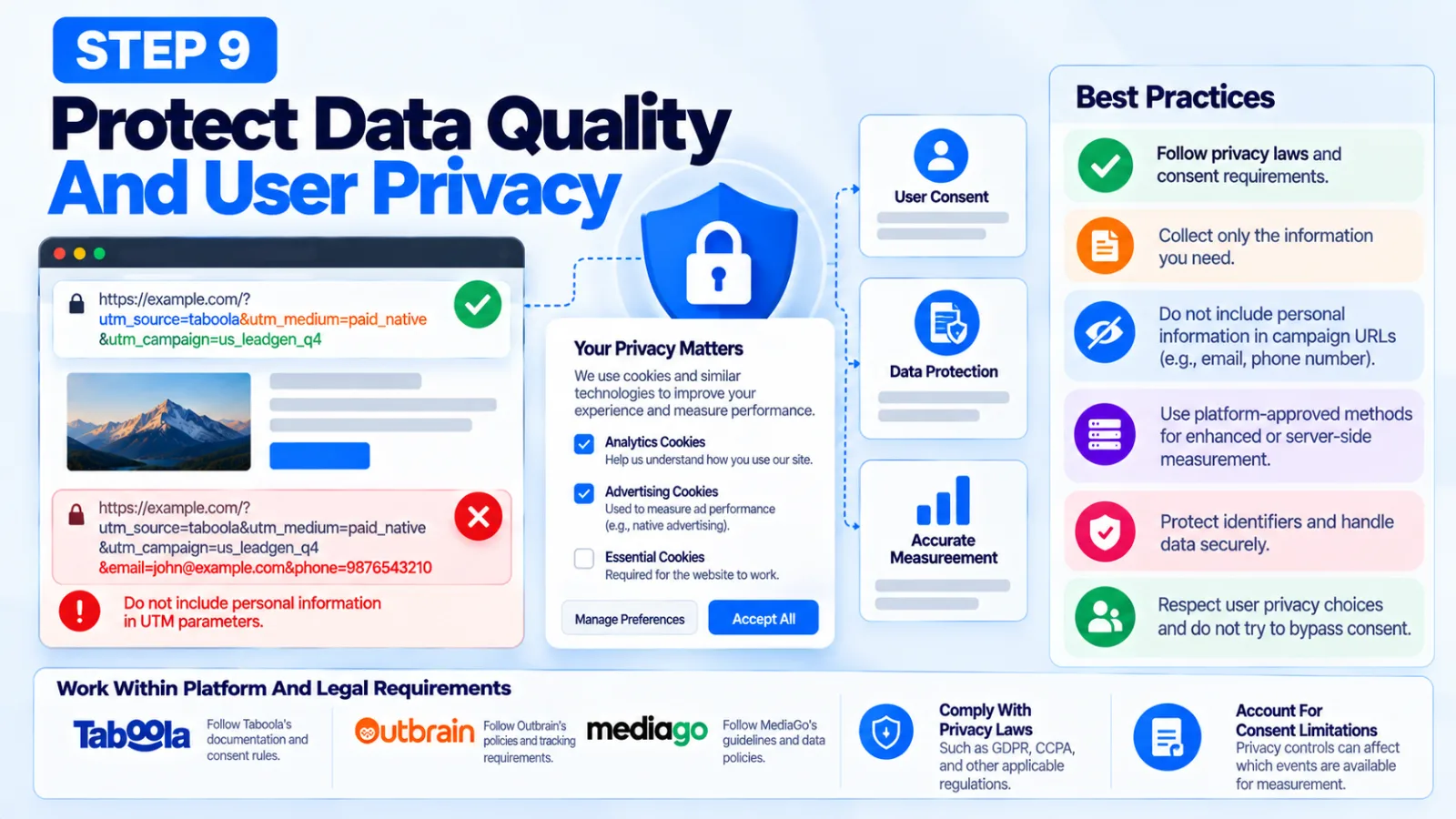
Step 9: Protect Data Quality And User Privacy
Conversion tracking should also follow applicable privacy laws, consent requirements, and the policies of the advertising platforms involved. Agencies should collect only the information they need, protect identifiers appropriately, and avoid sending personal information through campaign URLs.
Email addresses, phone numbers, and other sensitive details should not be placed in UTM parameters or exposed in URLs. If a platform supports approved methods for enhanced or server-side conversion measurement, the agency should follow its documented requirements and applicable consent rules.
Privacy controls can affect which events are available for measurement, so agencies should account for consent and data limitations when comparing results. A tracking system should not attempt to bypass a user's privacy choices simply to increase the number of recorded conversions.
Final Thoughts
Tracking conversions across multiple native advertising accounts is easier when the agency has a clear structure from the beginning. Consistent UTM parameters, properly preserved click identifiers, suitable pixel or server-side integrations, and reliable deduplication rules can all help protect attribution data.
The most important step is to connect the entire journey, from the original ad click to the final business outcome. Agencies should also remember that platform-reported conversions may differ from analytics and CRM totals because the systems do not always use the same attribution rules.
For advertisers using Taboola, Outbrain, and MediaGo, a shared reporting framework can make cross-account performance easier to understand while keeping individual account and client information organized. By testing the setup regularly and investigating differences before changing campaign budgets, agencies can make better decisions based on more reliable conversion data.
Agency ad accounts, without the wait.
Buy and top up Google, Meta, native, and more from one dashboard.
Get started

No comments yet. Be the first to comment.
Comments are open to registered AdScaleLab clients.
Sign in to comment