






Bing Copilot Ads Are Here With Years of Tests Adds Up To
On 31 August 2026, Sachin Patel at Search Engine Watch published a screenshot showing something nobody had seen before: a sponsored result sitting inside a Bing Copilot Ads. Not beside it, not below it. Inside the AI-generated response itself.
Within a day he could reproduce it on his own machine and see more examples. By 3 September the same placement was carrying shopping ads. Get bing ads agency account here

So that is the news. It is a bigger deal than it sounds, and the reason it is a bigger deal is the eight months of smaller changes that came before it. Microsoft has been quietly reworking how sponsored results look on Bing since late last year, one experiment at a time, with no announcements and no notice to advertisers. The Copilot placement is where that sequence was heading. So this article covers the whole run, including a very minor test from a week earlier that Search Engine Roundtable picked up and that turns out to matter more as context than as news.
The Bing Copilot Ads Placements And Timing Matters!
When Google launched AI Overviews, it launched them without ads. Sponsored results arrived several months later after the format had settled and the user complaints had been absorbed. Google took the slow road approach.
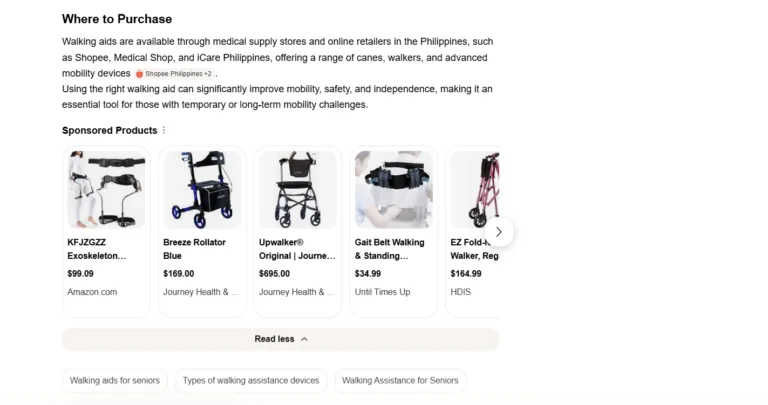
Bing has not. Copilot answers on Bing are the closest equivalent to Google's AI Overviews, and Microsoft has put paid results into them while the format is still evolving. Patel's first screenshot showed a single sponsored card in an answer. His update the next day showed several. The update after that showed shopping ads, which means product listings with images and prices, inside an AI response.
For advertisers, three things follow from that.
The inventory is new and it is reached through the same account you already have. There is no separate Copilot campaign type as of this writing. Ads that are eligible for Bing search appear to be eligible for the Copilot panel, which means a search campaign you set up last year may already be serving there.
The intent signal is different. Someone reading a Copilot answer has asked a question in natural language and is reading a synthesised response. It is a more considered moment than scanning a results page, and it may convert differently. Taboola's CEO said the same thing about ads inside its own AI answer engine, DeeperDive, earlier this year, claiming the highest conversion rate in the company's inventory. Whether Bing's placement performs the same way is not yet known. But the shape of the argument is identical.
And the reporting is not ready for it. Microsoft has not said how Copilot impressions will be broken out in the interface, or whether they will be. Until that is clear, a campaign gaining Copilot exposure will show it as a change in aggregate CTR and conversion rate with no obvious cause. This is the practical problem for anyone running spend right now, and it is the same problem every test in this sequence has created.
A year of experiments, in order
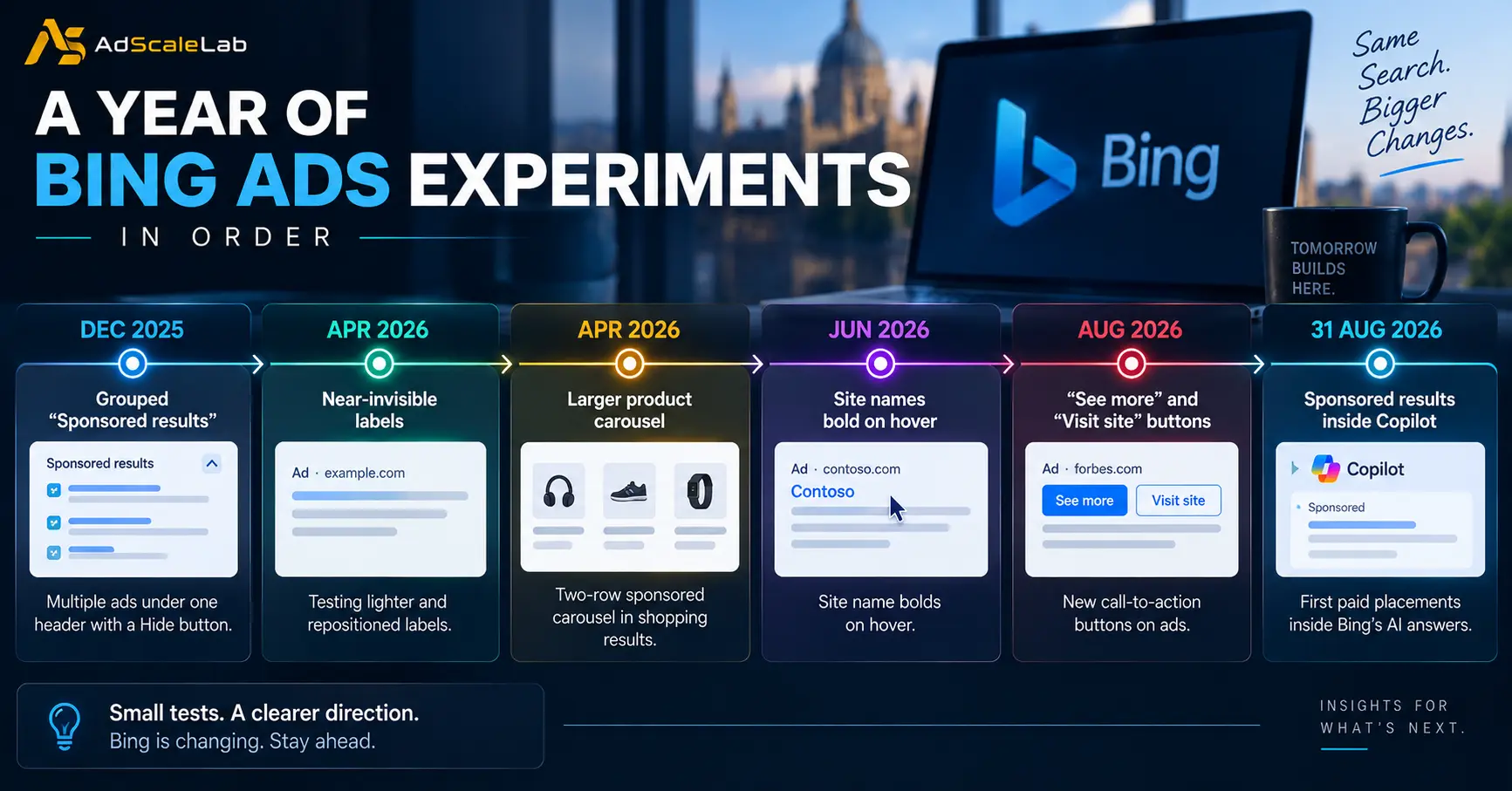
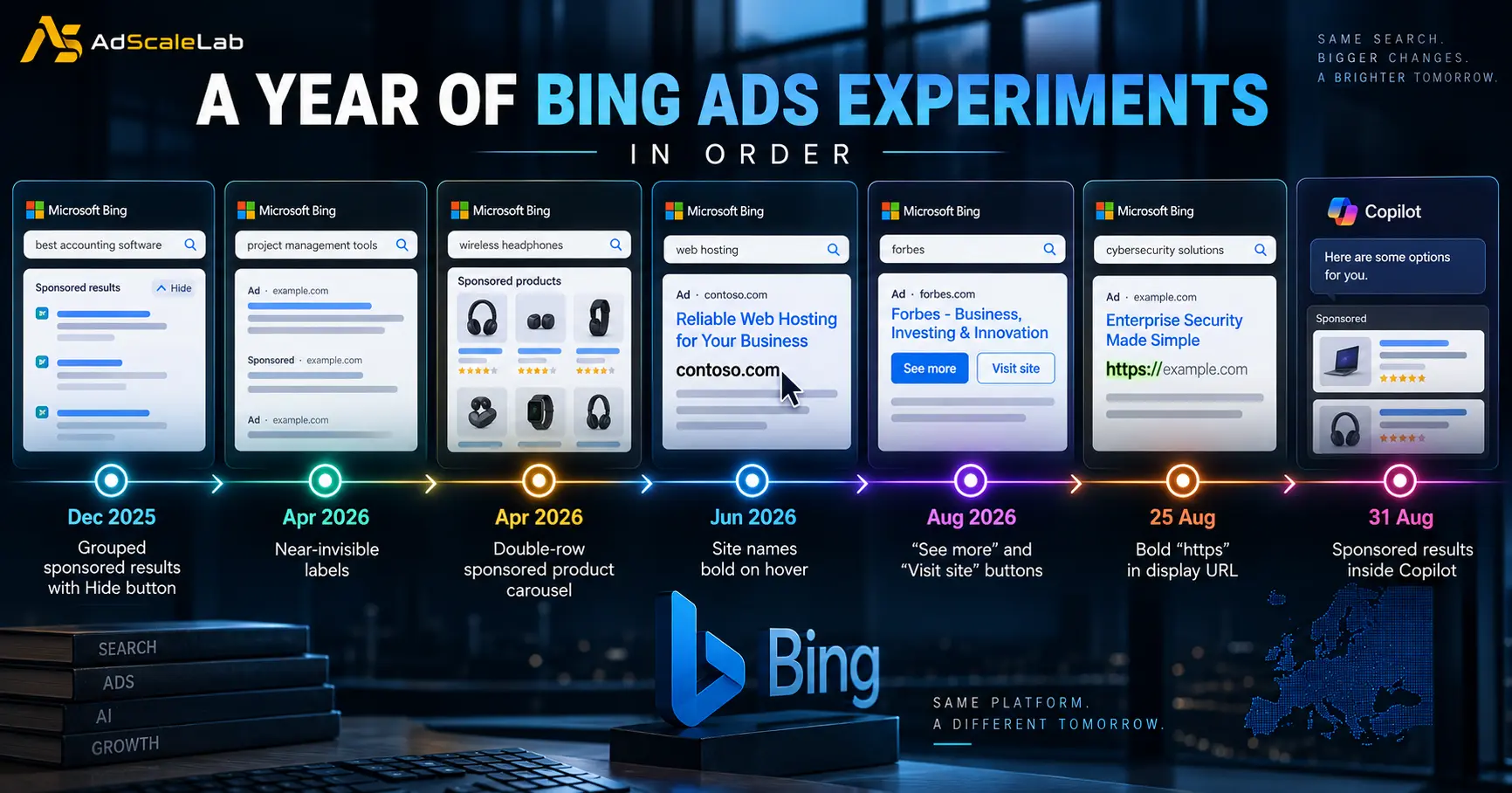
Every entry below was spotted by a practitioner and reported by trade press. None was announced by Microsoft. Several were seen by only a fraction of users and some may never ship. Taken together they show what Microsoft has been testing, and the direction the tests point in.
December 2025: grouped "Sponsored results" with a Hide button. Search Engine Land reported that Bing was testing a layout where several ads sit under a single "Sponsored results" header, with only the first one carrying an individual label and a button to collapse the whole block. Google had rolled out a near-identical design about two months earlier. When Barry Schwartz polled his audience on X about Google's version, 63 percent said they had clicked an ad by accident because of it. Bing adopting the same layout was the first sign that Microsoft was willing to follow Google into designs that blur the line between paid and organic.
Around April 2026: near-invisible labels. ALM Corp catalogued a run of tests on the sponsored label itself: lighter grey text, the label moved to after the domain where the eye does not land, the label shifted to the right side of the result, and the wording switched between "Ad" and "Sponsored". Some of these made the disclosure more visible and some made it less. Microsoft's ads liaison publicly acknowledged criticism of the hard-to-see versions and called it fair, and the company later clarified that it considers both advertisers and search users to be customers. That statement is the closest Microsoft has come to admitting there is a trade-off being tested.
April 2026: a double-row sponsored product carousel. Search Engine Land reported a shopping layout where the sponsored carousel took two rows and considerably more screen space than before, with organic product cards pushed below it. Mordy Oberstein saw a more compact variant at the same time, so this one was still being shaped.
June 2026: site names bold on hover. Spotted by Khushal Bherwani and written up by ALM Corp. Hovering over a sponsored result bolded its site name; hovering over the title or display URL bolded those elements independently. A small interaction change, but one that draws attention to ad components at the moment of decision.
August 2026: "See more" and "Visit site" buttons. Optimixed reported explicit call-to-action buttons appearing on some sponsored results, initially observed on ads for Forbes. Both buttons went to the same landing page as the title link. The purpose is plainly to raise click-through by giving the eye a button to land on.
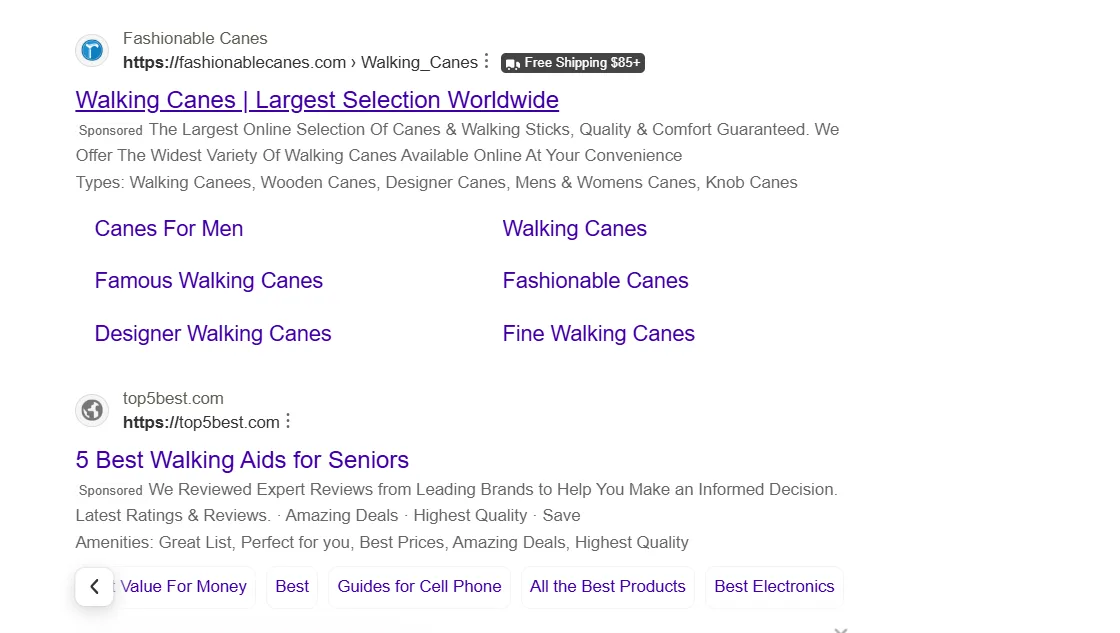
25 August 2026: bold "https" in the display URL. This is the test Search Engine Watch spotted and Search Engine Roundtable amplified ten days later. Only the "https" portion of a sponsored result's URL was bolded, with the rest of the URL unchanged. Bing had previously tested fully bold URLs, a "Sponsored" label variant, and light grey styling for sponsored URLs, and had tested HTTPS "secure" labels and lock icons in years past. Nobody has offered a convincing reason for bolding those five characters specifically, and Schwartz could not reproduce it. It may be a fragment of a wider styling test, or it may be gone already.
31 August 2026: sponsored results inside Copilot. Covered above. The first paid placement inside Bing's AI answers, expanded within days to include shopping ads.
SHOW IMAGE
What the sequence is actually testing
Line the seven up and a pattern shows. Microsoft is not trying one idea. It is testing the whole disclosure and presentation system around search ads: the word on the label, the contrast of the label, where the label sits, whether ads are grouped, whether ad elements react to the cursor, whether there are buttons, and now whether ads can live inside an AI answer at all.
The tests do not all push the same way. Grouping and faint labels make ads look more like organic results. Bold hover effects and call-to-action buttons make ads more obviously clickable. Bold HTTPS, if it means anything, makes the sponsored URL look slightly more trustworthy. Microsoft appears to be measuring user response and revenue across a spread of designs and keeping what works, which is exactly what a company would do if it were preparing to monetise a new surface and wanted to know which presentation converts before committing to it.
The Copilot placement is the new surface. Everything before it was calibration.
What each kind of change does to your numbers
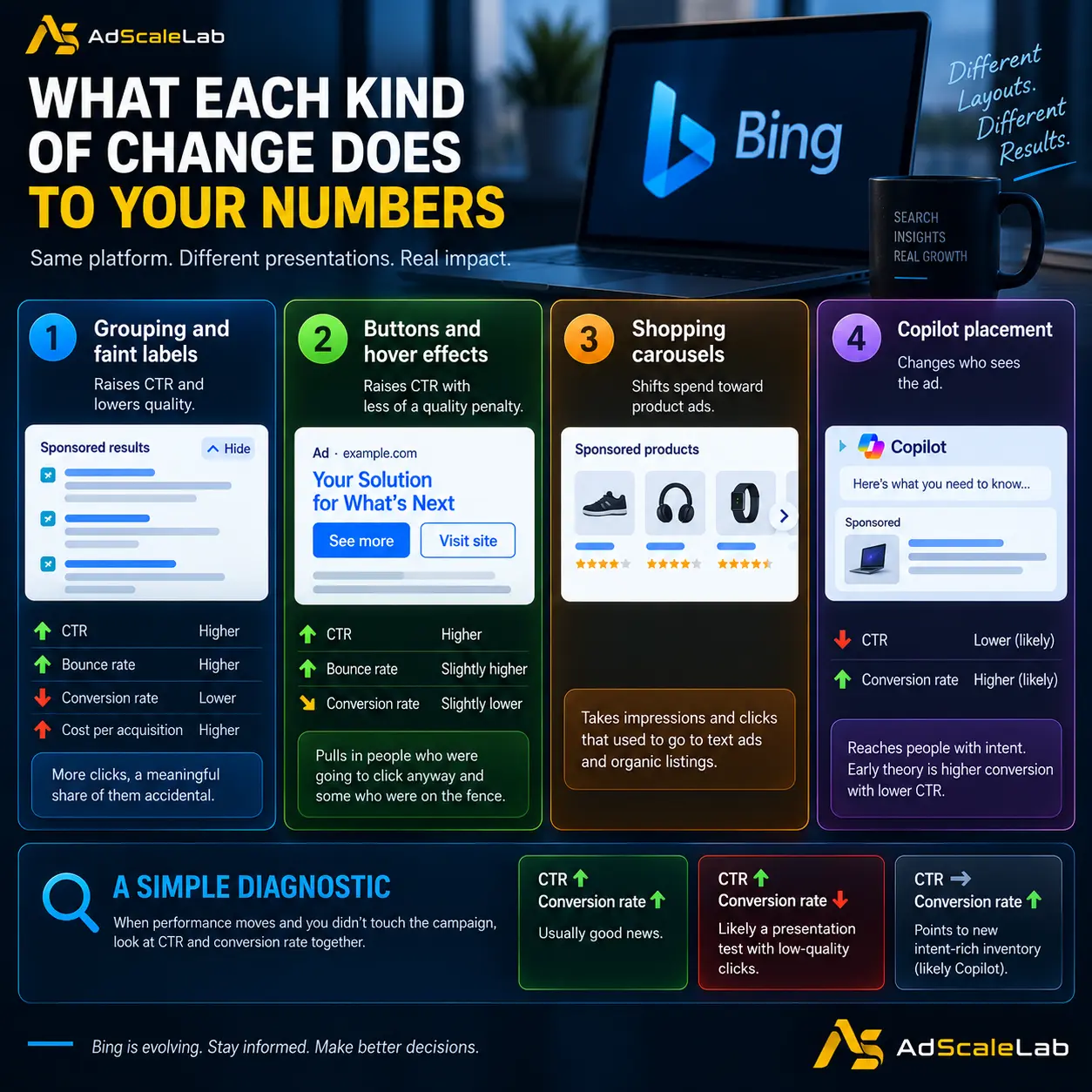
The reason to care about presentation tests is that they move performance metrics without any change on your side, and if you do not know a test is running you will misread the movement.
Grouping and faint labels raise CTR and lower quality. The Google precedent is the evidence: more clicks, a meaningful share of them accidental. On the advertiser side that shows up as higher click-through, higher bounce, lower conversion rate, and a worse cost per acquisition, all at once. If your Bing search campaigns saw that combination appear in a week where you changed nothing, a layout test is a likely explanation.
Buttons and hover effects raise CTR with less of a quality penalty. A "Visit site" button pulls in people who were going to click anyway and some who were on the fence. Bounce may rise slightly. The conversion rate hit is smaller than with accidental clicks because the person chose to press something.
Shopping carousels shift spend toward product ads. A double-row carousel takes impressions and clicks that used to go to text ads and organic listings. If you run both Microsoft Shopping and text campaigns, expect the balance between them to move.
Copilot placement changes who sees the ad. A Copilot reader has asked a question and is reading an answer. Early theory, unproven, is that conversion rates are higher and click-through is lower, because the person clicks with intent, not reflex. The first sign in your reports would be a rise in conversion rate with flat or falling CTR, which is the reverse of the grouping pattern.
Put those together and there is a diagnostic. When Bing performance moves and you did not touch the campaign, look at CTR and conversion rate together. Both up is usually good news. CTR up and conversion down points to a presentation test that is generating low-quality clicks. CTR flat and conversion up points to new intent-rich inventory, which right now means Copilot.
What to do about it
Microsoft will not tell you when these tests run. Practitioners spot them, trade press reports them, and by the time you read about it the test may have ended or shipped. So the response has to be built into how you run the account. Reacting to news is too slow.
Watch bounce rate as an early warning. It is the metric that responds fastest to accidental clicks, and it is the one most Bing advertisers ignore. A bounce rate that jumps without a landing page change is worth a look at the SERP.
Segment by device and check the SERP yourself. Most of these tests were seen on desktop first. Open Bing in a private window for your own keywords, on both desktop and mobile, and look at how your ads are being presented. It takes five minutes and it is the only way to know what your buyers are seeing.
Keep shopping and text campaigns separate and compare their trend lines. If the shopping carousel grows, it will show up as a divergence between the two.
Treat the Copilot placement as a reason to keep Bing search campaigns live even at modest spend. The inventory is new, it is reached through existing campaigns, nobody has good data on it yet, and the advertisers who have campaigns running when the reporting arrives will be the ones with a baseline.
And if you run Bing through an agency account, ask your rep what they know. Microsoft's account teams sometimes have visibility into tests before the trade press does, and an agency rep relationship is the one channel through which advertisers occasionally hear about a change before it hits their numbers. That is one of the practical differences between self-serve and a Bing Ads agency account, and this is the situation where it earns its keep.
The short version
Bing Copilot ads are live, ahead of where Google was at the same stage, and it got there through eight months of unannounced tests on how sponsored results look and behave. Some of those tests make ads harder to tell from organic results, and the Google precedent says that raises accidental clicks. Some make ads easier to click on purpose. The HTTPS bolding that Search Engine Roundtable covered last week is one of the smallest entries in the sequence and probably not one that will ship.
None of it comes with a notice. Read your CTR and conversion rate together, watch bounce, look at the SERP with your own eyes now and then, and keep a Bing campaign running so you are in the auction when the Copilot data starts to mean something.
Agency ad accounts, without the wait.
Buy and top up Google, Meta, native, and more from one dashboard.
Get started
No comments yet. Be the first to comment.
Comments are open to registered AdScaleLab clients.
Sign in to comment