



Taboola Stock News TBLA Lawsuit Draws Fresh Investor Attention

Taboola stock is back in the news on September 17, 2026, after fresh investor alerts reminded shareholders about an ongoing securities class action involving Taboola.com Ltd. The new notices are focused on an October 20 deadline for investors who want to ask the court to appoint them as lead plaintiff. The lawsuit itself is not new today. Court records show that the case, Fortin v. Taboola.com Ltd. et al., was filed on August 21, 2026, in the U.S. District Court for the Southern District of New York. The renewed attention comes as law firms continue to issue notices about the case and the events that caused Taboola stock to fall sharply in August.
The story is important for the advertising industry because the legal dispute is connected to issues around Taboola’s publisher network, revenue guidance and the quality of inventory available to advertisers. Taboola operates a large open-web advertising business and has been expanding its focus beyond traditional native advertising through its Realize platform. At the same time, the company has been making changes to its publisher network and has been dealing with the impact of Google policy changes on one of its products. These developments help explain why Taboola stock, rather than simply the lawsuit itself, has become a topic of interest for the ad-tech market.
Why Taboola Stock Is In the News Today
The immediate reason for the September 17 attention is a new investor notice from SueWallSt concerning Taboola securities. The notice reminds investors who purchased Taboola securities between May 6 and August 4, 2026, about the pending securities class action and the October 20 deadline to seek lead-plaintiff status. Another September 17 notice from Bronstein, Gewirtz & Grossman also discusses the same lawsuit and identifies the same class period.
That distinction matters because it would be inaccurate to say that Taboola suddenly announced a new lawsuit on September 17. The court docket shows that the complaint was filed on August 21. What is new on September 17 is the renewed public attention around the case and the approaching deadline for investors who may want to participate in the lead-plaintiff process. The case is listed as Fortin v. Taboola.com Ltd. et al., Case No. 1:26-cv-07170.
The case covers investors who purchased or otherwise acquired Taboola securities during the May 6 through August 4 period. According to the notices, the lawsuit alleges that Taboola and certain executives made materially false or misleading statements, or failed to disclose information, concerning the quality of its publisher relationships and the potential financial impact of exiting publishers that did not meet its standards. These are allegations made in the lawsuit and should not be presented as established findings by a court.
What Happened To Taboola Stock In August
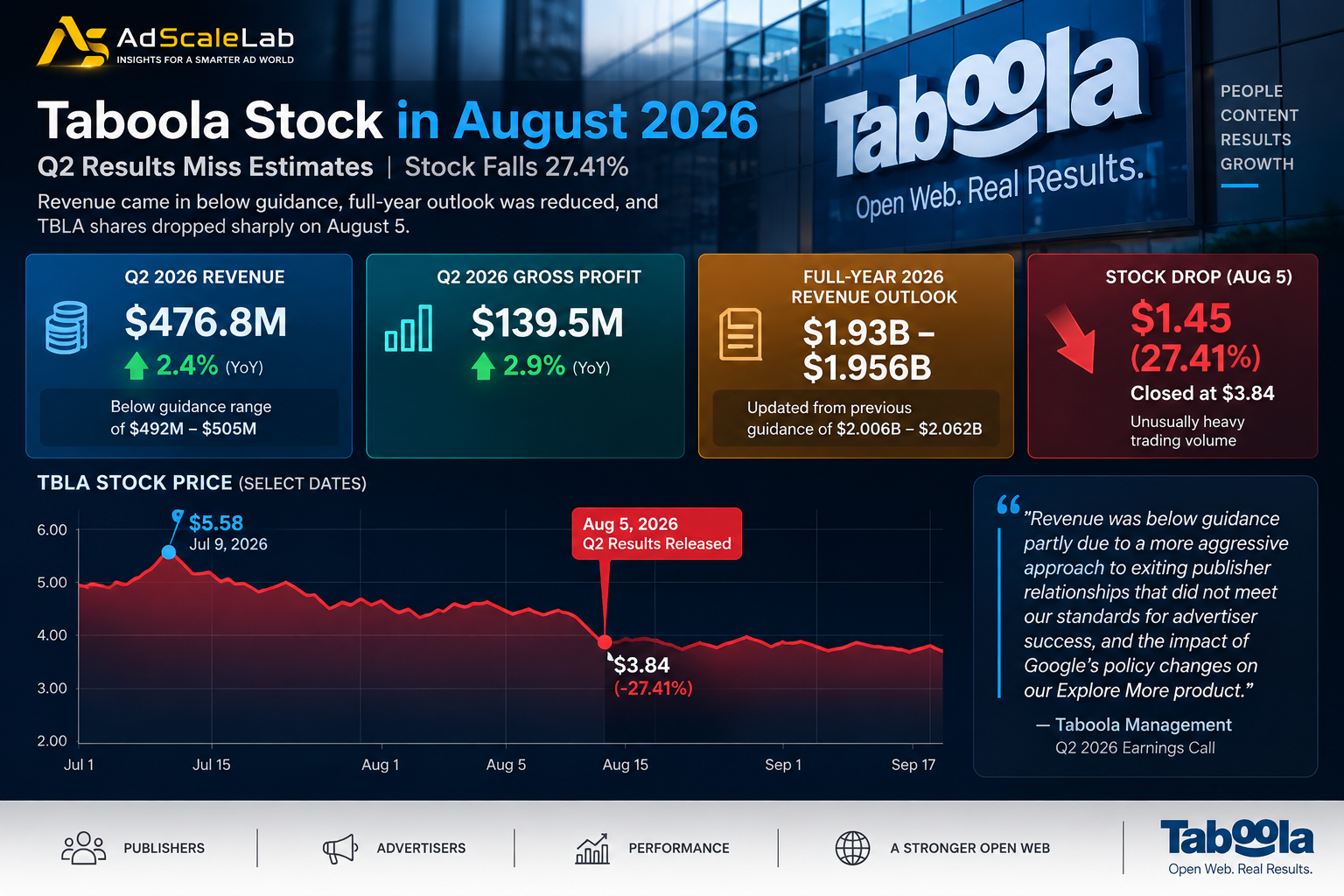
The major market event behind the lawsuit happened on August 5, when Taboola released its second-quarter 2026 financial results. The company reported revenue of $476.8 million for the quarter, which was below the previously provided guidance range of $492 million to $505 million. Taboola also changed its full-year revenue outlook to a range of $1.93 billion to $1.956 billion.
According to the investor notices, Taboola stock fell $1.45, or 27.41%, on August 5 and closed at $3.84. The notices say the decline happened on unusually heavy trading volume. That single-day move became an important part of the later securities lawsuit because the complaint links the stock-market reaction to information disclosed around the company's second-quarter results.
However, the company's own financial release also provides important context. Taboola reported that its second-quarter revenue increased 2.4% year over year to $476.8 million, while gross profit increased 2.9% to $139.5 million. The company therefore did not report a complete breakdown of its business. Instead, the key issue was that revenue came in below its earlier guidance, while management also changed parts of its full-year outlook.
This is one reason the current Taboola stock story needs to be explained carefully. The market reaction, the company's financial results and the allegations in the lawsuit are connected, but they are not the same thing. Taboola reported its own operating results, management gave its explanation for the revenue shortfall, and plaintiffs subsequently made allegations about what they believe investors should have been told earlier.
What Taboola Said About Publisher Quality
One of the most important parts of the story involves the quality of Taboola's publisher network. During its second-quarter earnings discussion, management said that Taboola had taken a more aggressive approach to exiting publisher relationships that did not meet its standards for advertiser success. The company said this contributed to the revenue shortfall in the quarter.
This is particularly relevant to the advertising business because publisher inventory is a central part of how open-web advertising platforms operate. Advertisers do not only care about the number of impressions available to them. They also care about where ads appear, the quality of the surrounding environment, audience engagement and whether the inventory can produce useful business outcomes.
Taboola said its publisher-network cleanup could reduce revenue in the short term while improving advertiser success over time. The company therefore presented the changes as part of its effort to improve supply quality and the performance of its advertising network. The lawsuit takes a different view of the situation, alleging that Taboola had not adequately disclosed the extent of the publisher-quality issue and the potential financial impact of addressing it. Those claims remain allegations in a pending case.
For anyone following Taboola stock, this difference between management's explanation and the plaintiffs' allegations is one of the most important parts of the story. The company says its actions were part of an effort to improve the network, while the lawsuit alleges that investors were not given enough information about the problems and their potential effect on the business.
Google Policy Changes Also Affected Taboola's Revenue
Publisher quality was not the only issue mentioned in Taboola's explanation for the revenue miss. Management also pointed to changes in Google's policies that affected Taboola's Explore More product. According to the company's earnings-call discussion, Explore More allowed users to discover additional sponsored content from a publisher's website after returning to the page. Taboola said the product was affected by Google's policy changes and that the resulting impact was included in its updated outlook.
This gives the Taboola stock story another important layer. The company's lower revenue guidance was not described as being caused by only one factor. Taboola discussed both the publisher-network cleanup and the impact of Google's policy changes. Its updated revenue guidance reflected the expected effects of these changes.
For advertisers and publishers, this is also a useful reminder of how dependent open-web advertising businesses can be on changes outside their direct control. A platform can change its own supply strategy, but it can also be affected by policies from major technology companies, changes in traffic patterns and shifts in how users interact with publisher websites.
Taboola's Q2 Results Put The Current Story In Context
Taboola's official second-quarter results provide a broader picture than the stock decline alone. The company reported $476.8 million in revenue and $139.5 million in gross profit for the second quarter. Its official release also said that the company raised its full-year guidance for ex-TAC gross profit and adjusted EBITDA while updating its revenue outlook.
That combination is important because it shows that Taboola's financial situation cannot be described accurately by looking only at the headline stock move. Revenue expectations were reduced, but the company also reported growth in revenue and gross profit and increased certain profitability targets. These different measures tell different parts of the story.
The company's investor-relations page also shows that Taboola continues to position itself as a performance advertising technology company operating beyond traditional search and social channels. Taboola says Realize is used by thousands of advertisers and that its network reaches approximately 600 million daily active users. That figure is a company-reported network figure and should not be interpreted as the audience of any individual publisher.
Taboola Is Still Expanding Beyond Traditional Native Advertising
The current Taboola stock story is happening at the same time that Taboola is trying to expand its advertising business beyond its traditional native-advertising roots. That strategy has become increasingly visible through Realize, the company's broader advertising platform.
One recent example came on August 19, when Taboola announced an expanded partnership with NBC News. According to Taboola, Realize would power global programmatic display advertising on NBC News digital properties, including NBCNews.com and TODAY.com. The company described the partnership as a major step in its effort to expand beyond native advertising.
This development is relevant because it shows where Taboola wants the business to go even while the company is dealing with the current legal and financial questions. Taboola is no longer presenting Realize simply as a traditional content-recommendation platform. It is positioning the technology as a broader performance advertising system for the open web.
For AdScaleLab readers who follow native advertising, programmatic advertising and open-web media buying, this creates an interesting connection between the company's product strategy and the current Taboola stock story. The company is trying to expand its advertising reach and formats while also working on the quality of the publisher supply behind that advertising network.
What The Taboola Lawsuit Actually Alleges
The lawsuit focuses on statements and disclosures made during the class period from May 6 through August 4, 2026. According to the complaint-related notices, plaintiffs allege that Taboola was experiencing an increase in low-quality publishers and that the company would need to take a more aggressive approach to ending those publisher relationships. The lawsuit further alleges that this situation affected earnings and that the value of Taboola's publisher relationships was overstated.
Again, these points should be described as allegations rather than established facts. The filing of a securities lawsuit does not itself prove that the allegations are correct. The case is now part of the legal process, and the claims will be handled through that process.
The underlying court record confirms the existence of the case and identifies Taboola.com Ltd., Adam Singolda and Stephen Walker as defendants in the action. The docket identifies the matter as a securities case in the Southern District of New York.
The distinction between an allegation and a proven finding is especially important when writing about Taboola stock because investor-alert articles are often written by law firms representing or seeking to represent investors. Those notices naturally focus on the allegations and potential rights of investors. For a balanced news article, the company's own financial disclosures and explanations should be considered alongside those claims.
What The October 20 Deadline Means
The October 20, 2026 date is now one of the main reasons the Taboola lawsuit is receiving renewed attention. Kirby McInerney's case page identifies October 20 as the deadline for seeking appointment as lead plaintiff in the action. The same page identifies the case number, court and class period.
A lead plaintiff is the investor or group of investors appointed by the court to represent the interests of the broader class during the litigation. The deadline therefore does not mean that every investor must file something by October 20 simply to remain part of the potential class. Investor notices make a distinction between seeking lead-plaintiff status and remaining an absent class member. Investors considering their individual legal position should rely on the court documents or qualified legal counsel rather than treating a news article as legal advice.
For the broader advertising industry, the deadline matters mainly because it keeps the legal dispute active. It also means that Taboola stock may continue to receive attention from financial media and investor-rights firms while the case moves through the legal process.
What Comes Next For Taboola
The next part of the story will involve both the legal process and Taboola's operating performance. Investors will be able to watch how the company handles its publisher-network changes, how Realize develops, and whether the company can continue expanding its performance advertising business while dealing with the revenue effects discussed in its second-quarter results.
Taboola's investor-relations calendar also shows a Benchmark Annual TMT Conference scheduled for September 17, 2026. That means the company is continuing its investor communications while the lawsuit receives renewed attention.
From an advertising perspective, the publisher-quality issue may be just as important as the legal case itself. Advertisers using open-web platforms need inventory that can deliver useful audiences and measurable outcomes. If Taboola continues removing publisher relationships that do not meet its standards, the short-term effect on supply and revenue will be something worth watching alongside the company's longer-term performance.
At the same time, Taboola's expansion into programmatic display and its growing focus on Realize show that the company is trying to build a broader role in open-web advertising. The NBC News partnership is one example of that strategy, giving Realize access to programmatic display opportunities across NBC News digital properties.
What The Taboola Stock Story Means For Ad-Tech Readers
For people working in advertising rather than investing, the biggest lesson from the current Taboola stock story is that publisher quality remains closely connected to advertising performance. A large network can provide scale, but advertisers also need quality inventory, appropriate placements and measurable results.
Taboola's recent actions show how changes in supply can affect the financial side of an advertising platform. The company said it exited publisher relationships that did not meet its advertiser-success standards, even though doing so contributed to lower revenue in the short term. At the same time, Google policy changes affected another source of revenue. These events show how publisher relationships, traffic sources, platform policies and advertiser performance can all influence an open-web advertising business at the same time.
The current legal dispute adds another layer, because the plaintiffs argue that the market was not properly informed about some of these risks. That claim is still being litigated. What is already documented is that Taboola reported a Q2 revenue figure below its earlier guidance, changed its full-year revenue outlook, disclosed the publisher-network cleanup and discussed the impact of Google's Explore More policy changes.
Final Takeaway
The latest Taboola stock news is not about a brand-new lawsuit being filed today. The underlying securities case was filed on August 21, while September 17 brought another round of investor alerts focused on the October 20 lead-plaintiff deadline. The case centers on allegations concerning publisher quality, publisher relationships and disclosures made during the May-to-August class period. Those allegations have not been established as facts by a court.
The financial events behind the case are clearer. Taboola reported $476.8 million in Q2 2026 revenue, below its previous $492 million to $505 million guidance range, and updated its full-year revenue outlook. Management attributed part of the difference to a more aggressive cleanup of publisher relationships and part to Google's policy changes affecting Explore More.
At the same time, Taboola continues to push Realize into a broader performance advertising role, including programmatic display. Its August partnership with NBC News shows that the company is still expanding beyond its traditional native advertising model.
For now, the Taboola stock story combines three separate but connected developments: a pending securities lawsuit, a meaningful change in the company's revenue outlook, and an ongoing attempt to expand its position in open-web performance advertising. The coming weeks will bring further developments in the legal process, while Taboola's operating results and Realize expansion will provide additional information about the direction of the business.
Agency ad accounts, without the wait.
Buy and top up Google, Meta, native, and more from one dashboard.
Get started


No comments yet. Be the first to comment.
Comments are open to registered AdScaleLab clients.
Sign in to comment