






Google Paying Publishers For AI Content What It Means
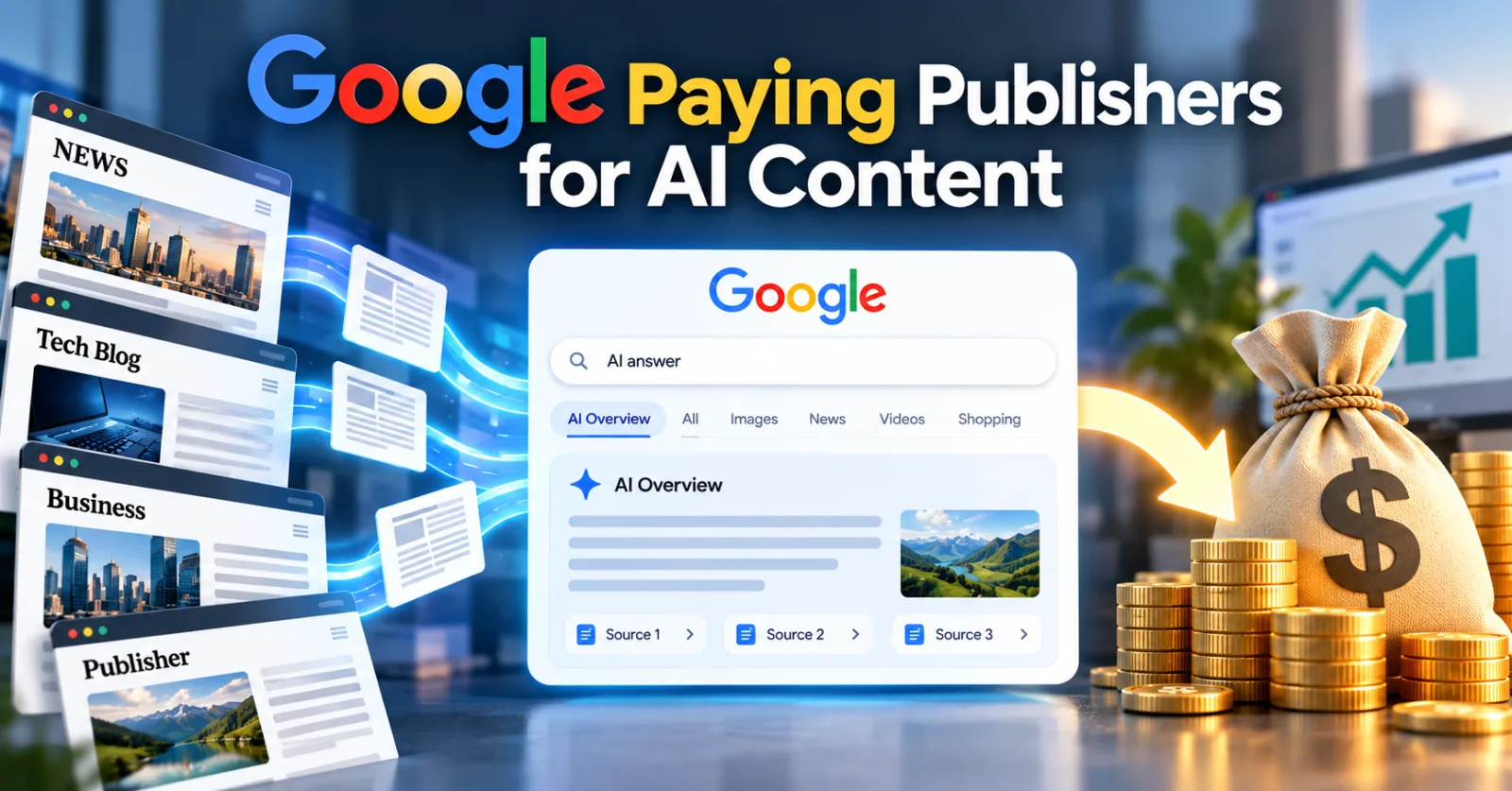
Google paying publishers for AI content is becoming a new part of the changing relationship between search engines and digital publishers. Google is testing a program called the AI Contribution Pilot, which pays selected publishers when their content makes a significant contribution to AI-generated responses across products such as AI Overviews, AI Mode in Search and Gemini. The latest reporting says around 100 publishers are involved in the pilot, although Google has not published a public list of participants.
The idea is important because the way people use search is changing. In the traditional search model, a person types a question into Google, sees a list of results, clicks a website and then reads the article. The publisher gets a visitor, and that visitor can create advertising revenue, subscription opportunities or other business value. AI search changes that journey.
A person can now ask a longer question and receive an answer directly inside the search experience. The answer may use information from several websites without requiring the user to open each one. That creates a difficult question for publishers: if their reporting helps create the answer but the reader does not visit their website, how should that content be valued? Google's AI Contribution Pilot is one attempt to test an answer.
What Is The Google AI Contribution Pilot?
The Google AI Contribution Pilot is an invitation-based test in which participating publishers can receive payments when their content significantly contributes to the creation of an AI-generated response.
The important part is that the program is based on the value of the contribution, rather than simply counting every time a publisher's page is mentioned.
Digiday reported in September that publishers participating in the program receive an additional AI earnings section inside Google Search Console. The dashboard shows a monthly earnings amount, while Google has not publicly explained every detail of the calculation. Google described the program as an early-stage learning pilot intended to explore ways to reward high-quality content.
That makes the Google AI Contribution Pilot different from traditional search advertising and different from ordinary referral traffic. Google is not simply paying a fixed amount every time a publisher receives an impression. Instead, the company is trying to determine whether a particular piece of content meaningfully helped produce an AI response. That sounds simple, but measuring it is much harder.
Why Google Is Paying Publishers For AI Content
The reason behind the experiment is connected to the growing importance of AI-generated search.
Google has been adding more AI features to Search, while other companies are also building AI systems that answer questions directly. Google says its AI search systems can help users explore complicated topics and discover information from different sources.
For publishers, however, there is a difference between being discovered and receiving a click. A traditional result can send a person to an article. An AI response can summarize useful information before that person ever reaches the article.
That does not mean publishers automatically lose all of their traffic. Google still says its Search products connect users with web content, and its Search Console now gives site owners reporting about impressions from generative AI features. Google says the generative AI performance report includes AI Overviews and AI Mode and was rolled out worldwide to websites on August 31, 2026.
But the economics are changing enough that Google is experimenting with a different form of value exchange. In other words, Google paying publishers for AI content is not really about replacing Search traffic overnight. It is about testing whether AI-generated answers require a new relationship between Google and the publishers that produce the information behind those answers.
How Much Are Publishers Actually Getting?
This is where the story gets more complicated. Recent reporting says the payments vary dramatically.
Search Engine Roundtable, citing reporting from The Information, said some small and midsize publishers participating in the pilot receive payments equal to less than one-tenth of 1% of their advertising revenue. At the same time, the reported range is much wider for some participants. One early participant was said to be on track to earn more than $1 million per year, while another publisher that joined later had reportedly earned around $50,000 to $60,000.
Ars Technica also reported that several smaller publishers were seeing payments that were extremely small compared with their existing advertising revenue. The article noted that some publishers participating in the pilot were skeptical because the payments did not come close to replacing lost or changing traffic value.
These figures need to be read carefully. They are reported examples, not a standard Google payment rate.
Google has not published a public formula that says a publisher will receive a certain amount of money for every AI impression, citation or article. That means publishers cannot look at these examples and assume they will receive the same amount. The variation itself may be one of the most interesting parts of the experiment.
Google Is Not Paying For Every Citation
Another important point is that the pilot is not simply a payment system for links.
According to reporting on the program, Google is looking at whether a publisher's content makes a meaningful contribution to the answer being generated. A page that is only linked as a source after the answer has already been produced does not necessarily have the same value under the pilot. This is a very different way of thinking about content value.
Imagine a person asks Google an unusual question about a niche technology product. One website may have an original article that contains information not easily found elsewhere. If that article becomes an important source for an AI-generated response, Google can potentially identify it as more valuable than a page that simply repeats widely available information.
That is one reason some publishers have reportedly seen stronger results from specialist subjects such as gaming and anime. Ars Technica cited publisher feedback suggesting that highly focused topics with strong reader interest could perform better within the pilot. The exact formula remains unclear, though.
The Transparency Problem
The biggest criticism of the Google AI Contribution Pilot is not simply about how much money publishers receive. It is about how the money is calculated.
Digiday reported that participating publishers can see a monthly earnings amount through Search Console, but the program does not provide a detailed public explanation of how every payment is determined. One publisher executive described the system as a black box. That matters because publishers need predictable revenue.
If a publisher knows that one million advertising impressions usually generate a certain range of revenue, it can plan around that. But if an AI contribution payment changes from month to month without a clear explanation, it becomes much harder to forecast. It also makes content strategy more difficult.
A publisher may want to know which articles are contributing to AI answers and why. Is original reporting more valuable? Are specialist articles worth more than general news? Does the number of questions matter? Does the length of the article matter? Does the number of AI systems using the content matter?
At the moment, there is not enough public information to answer those questions confidently.
Google Has Been Building More AI Tools For Publishers
The payment pilot is only one part of Google's broader response to the changing search environment.
Google said in June that it was exploring new ways to support the information ecosystem as AI changes how people discover content. The company said it was looking at additional partnerships and value-exchange models for content that helps keep generative AI responses fresh and accurate. Google has also added new reporting and controls in Search Console.
The Generative AI performance report allows site owners to see how their pages perform inside Google's AI search features, including AI Overviews and AI Mode. Google says publishers can use the report to see changes in generative-AI impressions and identify which pages are receiving the most exposure.
Google also introduced a Search generative AI control that allows website owners to manage whether their content is included in AI search features. Google says the control applies to AI Overviews, AI Mode and generative AI features in Google Discover. This creates an interesting combination.
Publishers are getting more information about AI visibility, more control over inclusion, and now, for a limited group, a possible payment for valuable content contributions.
What This Means For Publisher Monetization
For publishers, the AI Contribution Pilot raises a much bigger issue about the future of publisher monetization.
For years, advertising was connected closely to website traffic. More visitors generally meant more page views and more opportunities to sell advertising. That relationship is becoming less straightforward.
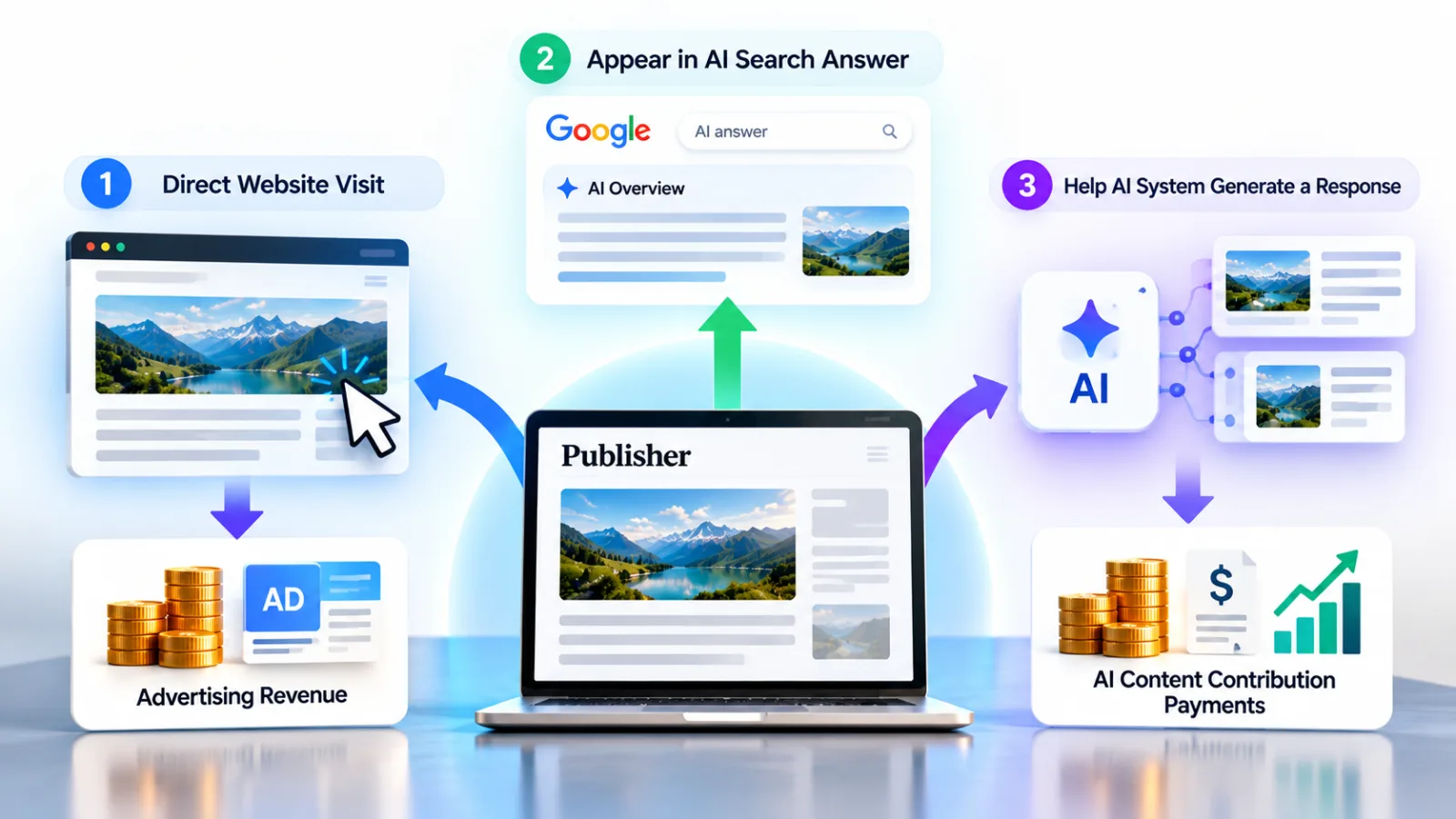
A publisher can now create content that is valuable in at least three different ways. It can bring a user directly to the website, it can appear as part of a search answer, or it can help an AI system generate a response. Those three types of value do not necessarily produce the same revenue. That is why Google's experiment matters.
It suggests that content could eventually be monetized not only when a user visits the original website, but also when the content is used somewhere else to generate information for that user. This is still an experiment, but the underlying idea could become important for the whole web.
What Advertisers Should Watch
At first glance, Google paying publishers for AI content may seem like a publisher-only issue. It is not.
Advertisers depend on publishers for audiences and inventory. If AI search changes how much traffic publishers receive, it can eventually affect advertising inventory, page views and audience behavior. That makes the topic relevant to programmatic advertising, native advertising and open-web advertising as well.
A publisher that loses traffic may have fewer opportunities to monetize through advertising. A publisher that keeps more users engaged could create more valuable inventory. This is one reason why the growth of AI-powered experiences inside publisher websites is worth following alongside Google's changes.
For example, Taboola's DeeperDive is another approach to the same broad problem. Instead of moving the AI experience completely outside the publisher's website, DeeperDive places a conversational AI experience inside publisher environments. We covered the product and its publisher monetization strategy in our article on Taboola DeeperDive and the AdExchanger Award. The approaches are different, but both point toward the same industry question: how can publishers create value from AI without losing their relationship with readers?
Google AI Search Is Also Changing The Role Of SEO
The rise of AI answers is changing what it means to be visible online.
A normal Google result might send a reader to a webpage. An AI answer can use information from a webpage without making that page the main destination. That means publishers and brands need to understand not only traditional rankings but also how their information appears within AI-driven search.
The basic SEO foundations still matter. Google's own documentation says websites need to be accessible and eligible to appear in Search in order to appear in its generative AI features. For brands, this makes AI search visibility an increasingly useful area to watch.
For publishers, the question is slightly different. It is not simply, “How do I get more traffic?”
It is increasingly, “How do I make sure my content continues to create value even when people consume information through an AI interface?”
Google Faces A Bigger Publisher Problem
The timing of the payment pilot is important because Google is already facing criticism from publishers over AI-generated search.
On October 1, 2026, a US federal judge dismissed lawsuits brought by Chegg and Penske Media against Google over AI Overviews. The companies argued that Google used their content in AI-generated summaries while affecting traffic to their websites. The judge ruled that their antitrust claims did not establish the required legal violation. The legal ruling does not settle the underlying economic debate.
Publishers are still trying to understand what AI search means for their businesses. Google's pilot is therefore not happening in isolation. It is part of a broader period in which search, AI, content and publisher revenue are all being reconsidered. That makes the payment experiment worth watching even if the current payouts remain relatively small for many publishers.
Is This A New Business Model For Publishers?
It is too early to say.
The Google AI Contribution Pilot is still an experiment, and the company has not announced that it will become a permanent system available to every publisher. It is also not a replacement for normal advertising.
Most publishers will continue to depend on some mixture of display advertising, native advertising, subscriptions, sponsorships, commerce and other revenue sources. The interesting possibility is that AI contribution payments could eventually become another layer of publisher revenue.
A future publisher might receive money from a normal website visit, advertising, a subscription and AI usage of its content. That model would be very different from the traditional search economy.
What Happens Next?
The biggest thing to watch is whether Google expands the pilot and becomes more transparent about its payment system. If the number of publishers grows, publishers will likely want clearer information about how contribution value is measured. They may also want better reporting in Search Console showing which pages generated AI earnings and how those earnings were calculated. The size of payments will matter too.
If most participants continue receiving very small amounts compared with advertising revenue, publishers may see the program as an interesting extra income source but not a major business change. If Google eventually creates a larger and more predictable system, the situation could become very different. That could also encourage other AI companies to create their own publisher payment systems.
For now, Google paying publishers for AI content is best understood as an early experiment in a rapidly changing web economy.
Google is trying to understand how to compensate content creators when their work contributes to AI-generated answers rather than simply producing a traditional search click. Publishers are trying to understand whether that compensation can become meaningful. Advertisers are watching because changes in publisher traffic, engagement and monetization can eventually affect the advertising ecosystem.
The most important point is that the old search model was based largely on clicks. The AI search model is creating a new question: what is content worth when it helps answer a question even if the reader never visits the original page?
Google's AI Contribution Pilot is one of the first major attempts by a major search and AI company to put a number on that value. For publishers and advertisers across the open web, that makes it a development worth following.
Agency ad accounts, without the wait.
Buy and top up Google, Meta, native, and more from one dashboard.
Get started


No comments yet. Be the first to comment.
Comments are open to registered AdScaleLab clients.
Sign in to comment