






Taboola DeeperDive Wins AdExchanger Award
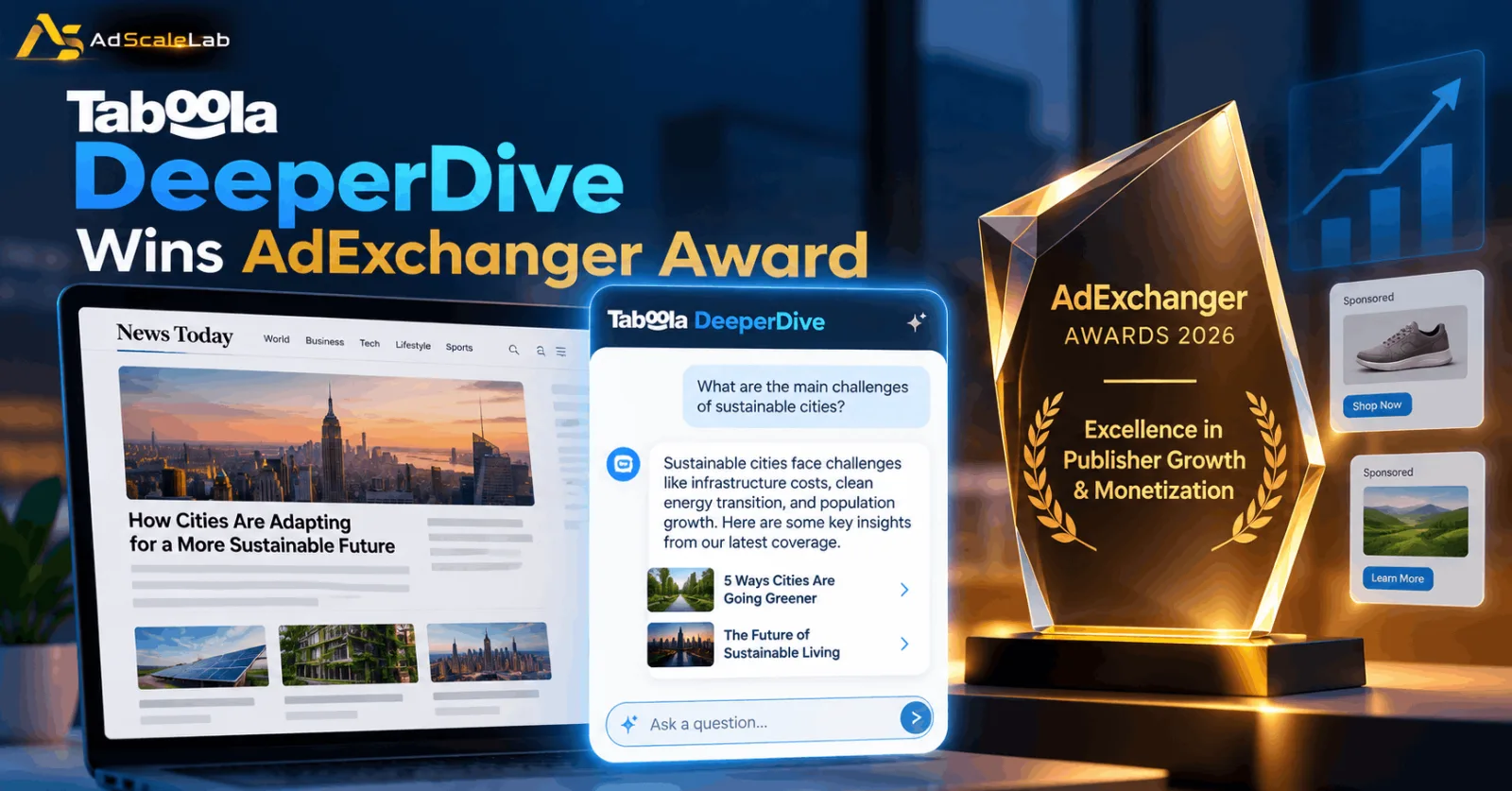
Taboola DeeperDive has won the 2026 AdExchanger Award for Excellence in Publisher Growth & Monetization, giving Taboola another important recognition for its work around generative AI and digital publishing.
The award was presented during the AdExchanger Awards Gala on September 28, 2026, in New York City, held during Programmatic I/O New York. Taboola announced the win publicly on September 30, 2026. AdExchanger’s own winners page confirms DeeperDive as the winner in the publisher growth and monetization category.
The recognition is interesting because DeeperDive was created around a problem that many publishers are facing right now. Readers are increasingly using AI tools to ask questions and find information. At the same time, publishers are looking for ways to keep their audiences on their own websites and create new revenue opportunities from those interactions.
Taboola’s approach is to bring an AI answer experience directly onto the publisher’s website rather than sending that reader somewhere else.
Why Taboola DeeperDive Is Getting Attention
Taboola DeeperDive is a generative AI answer engine designed for publisher websites. Instead of only showing a normal search box or content recommendation list, it lets readers ask questions in natural language and receive an answer based on the publisher’s own content.
Taboola first introduced DeeperDive publicly in June 2025, with Gannett’s USA TODAY Network becoming its first US publisher deployment and The Independent becoming the first UK deployment. Taboola said the system was built to help publishers respond to the growing impact of generative AI search while keeping readers connected to trusted publisher content.
The basic idea is quite simple. A reader visits a news or content website, has a question about the topic they are reading, and can ask that question without leaving the site. DeeperDive can then provide an answer and connect the reader to more relevant articles from that publisher. That creates a different experience from a traditional search journey.
A user may normally go from a publisher website to Google, then from Google to another website or an AI tool. DeeperDive tries to keep more of that discovery process inside the original publisher environment. This matters because the relationship between publishers and AI is complicated. AI search can help people find information, but it can also reduce the need to visit the websites that produced the original reporting.
DeeperDive Was Designed Around The AI Search Problem
The award entry itself is titled “DeeperDive: How Taboola Turned AI’s Biggest Threat to Publishers Into a Growth Platform.” That title explains a lot about why the product fits the publisher-growth category. The problem is not only about search traffic.
Publishers also have to think about time spent on their websites, article discovery, reader loyalty, advertising opportunities and the value of first-party audience information. When someone gets a quick answer somewhere else, the publisher can lose several of those things at the same time.
DeeperDive is designed to address that problem by placing the conversational AI experience directly on the publisher’s site. Taboola says DeeperDive can provide answers grounded in a publisher’s journalism and then direct readers toward additional stories. Its product materials describe the experience as a way to turn reader questions into deeper content discovery and new monetization opportunities.
That makes DeeperDive more than a chatbot. At least from Taboola’s product strategy, it is being positioned as a new layer between a publisher’s content, its readers and advertising.
How Publishers Can Use DeeperDive
The publisher use case is one of the most important parts of the story.
Readers do not always want to search for one exact article. Sometimes they have a broad question. A sports reader may want to understand a team's recent results. Someone reading a finance story may have a follow-up question about a company. A person reading political news may want more background on an issue. Traditional related-content modules can recommend more articles, but they do not always answer the reader's exact question. DeeperDive adds a conversational layer to that process.
Taboola says readers can receive an AI-generated response, see suggested questions and then continue exploring related coverage on the same publisher website. That means one reader question can potentially become several additional content interactions.
For publishers, that can be valuable because every additional page view can create another opportunity for engagement and advertising. It also gives publishers something else that ordinary traffic reports may not provide: information about what readers are actually asking.
Early Publisher Results Give More Context
The award itself is important, but the performance information around DeeperDive makes the story more interesting.
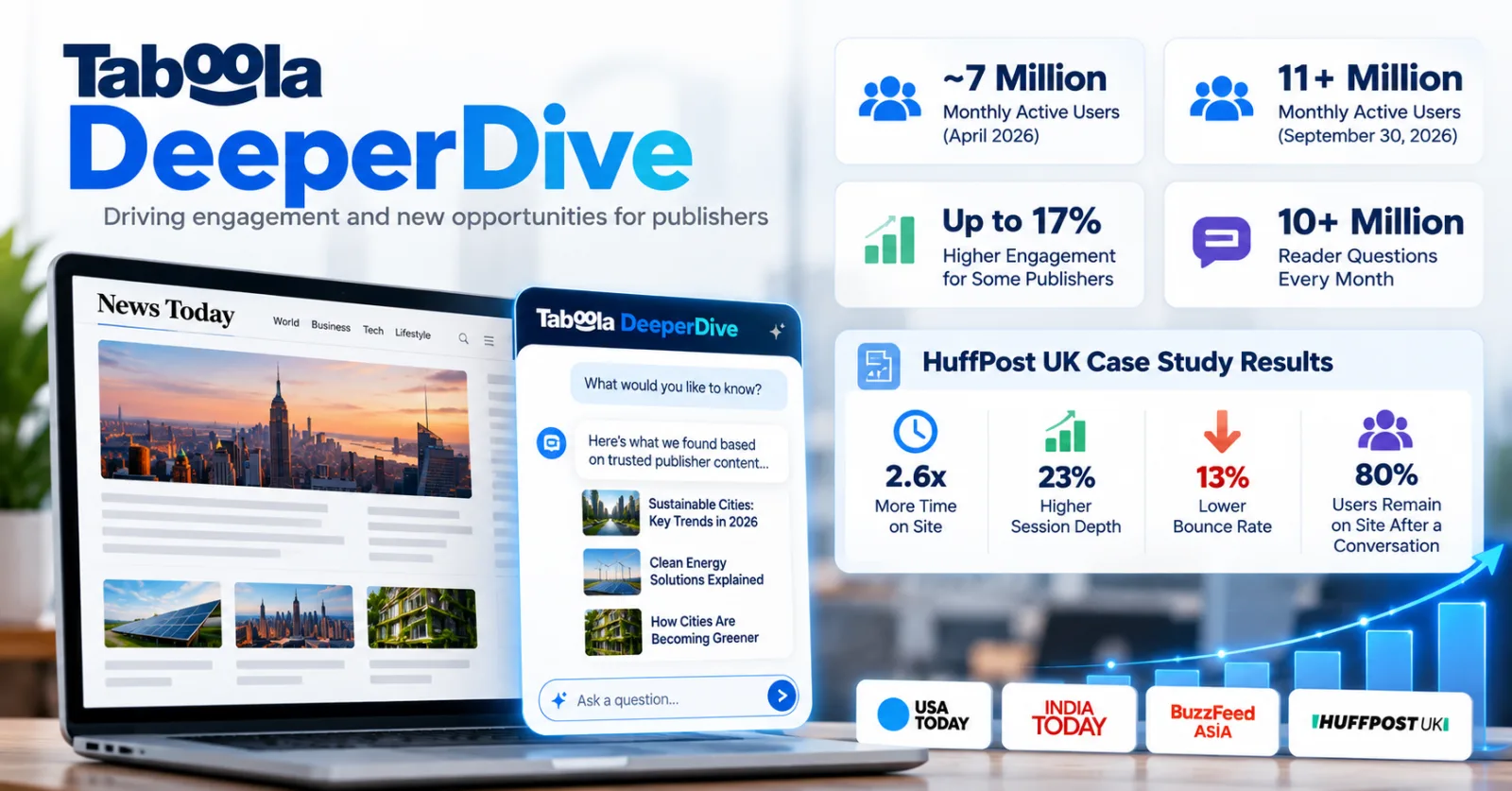
In April 2026, Taboola said DeeperDive had reached nearly 7 million monthly active users and was being used by publishers including USA TODAY, India Today and BuzzFeed Asia. Taboola also said that some publishers were seeing engagement of up to 17% and that the platform was handling more than 10 million reader questions each month. These are company-reported figures.
By September 30, Taboola said DeeperDive had grown to more than 11 million monthly active users worldwide. Again, this is a figure reported by Taboola rather than an independently audited industry measurement. There are also more detailed results from Taboola's HuffPost UK case study.
According to Taboola, users who engaged with DeeperDive spent 2.6 times more time on the site, had 23% higher session depth, and were associated with a 13% reduction in total site bounce rate after the product was launched. Taboola also reported that 80% of DeeperDive users remained on the site after a conversation. These figures should be read as case-study results from Taboola and HuffPost UK, not as a guarantee that every publisher using the product will see the same outcome.
Still, they help explain why publisher monetization is such an important part of the DeeperDive story.
The Advertising Side Is Also Important
Reader engagement is only one side of the equation.
Taboola has been building advertising opportunities around DeeperDive from the beginning. In its original 2025 product announcement, the company said the AI-powered results experience could create a new monetization channel through contextually relevant, high-intent advertisements.
In June 2026, Taboola went further and opened the monetization technology behind DeeperDive to external generative AI companies, including companies developing conversational AI products, chatbots and virtual assistants. The company said Realize would supply advertiser demand and that relevant ads could be integrated into AI answers.
This is an important development for the wider advertising industry. Search advertising has traditionally worked because a user expresses an intent, a platform understands that intent and an advertiser can place a relevant message next to the search experience.
AI answer engines are changing that process. A reader might now ask a complete question instead of typing a few keywords. That question can reveal more context and potentially stronger commercial intent.
For Taboola, DeeperDive creates an opportunity to bring some of that search-like behavior into publisher environments.
Publishers Are Trying To Keep Control Of Their AI Future
The larger issue behind DeeperDive is control.
Publishers have spent years building websites, producing journalism and developing audiences. Generative AI has changed how people discover information, and publishers have been experimenting with different ways to respond.
Digiday reported in May that publishers including USA TODAY Co., Reach and HuffPost UK were using DeeperDive as they experimented with AI-powered search and chatbot experiences on their own websites. USA TODAY had already received more than 25 million questions through the product by that point, according to a company spokesperson cited by Digiday.
Press Gazette also reported in April that ads associated with DeeperDive were producing higher conversion rates than traditional website ad slots, according to Taboola CEO Adam Singolda. The publication noted that publishers receive a share of advertising revenue connected to the experience. Again, these are reported results and statements, but they show why the technology is attracting attention from publishers.
Instead of thinking about AI only as a tool that sends readers away, publishers can experiment with putting AI inside their own products.
What The AdExchanger Award Actually Means
The award is genuine and independently listed by AdExchanger.
AdExchanger says more than 250 senior leaders from advertising, media and ad tech gathered for the 2026 awards gala in New York. Its official winners page lists DeeperDive as the winner of the Excellence in Publisher Growth & Monetization category.
AdExchanger also says the awards were judged by an independent panel of senior industry practitioners and evaluated across areas including innovation, measurable impact and technical execution. The judging panel included executives and leaders from companies and organizations such as Tinuiti, The Trade Desk, Advertiser Perceptions, OMD, OpenAP and Dstillery.
That makes the award more meaningful than simply saying Taboola gave itself a product award. At the same time, an award should not be confused with an independent performance audit. The award recognizes a submitted case and the judges' assessment of its work. It does not independently verify every performance number published by Taboola.
That distinction is important for advertisers and publishers reading the story.
What This Means For The Open Web
The DeeperDive story is part of a much larger change in digital advertising.
For many years, publishers mainly competed for attention through search rankings, social distribution, direct traffic and recommendations. AI is adding another layer to that competition.
Now publishers also have to think about what happens when readers ask an AI system for an answer instead of clicking through several articles. DeeperDive represents one possible response: bring the AI experience into the publisher's own environment.
For publishers, that could mean more opportunities to keep readers engaged, learn what audiences are interested in and create new advertising formats.
For advertisers, it could eventually create another environment where high-intent questions become signals for contextual advertising. And for the open web, it raises a much bigger question: can publishers build AI experiences that keep content discovery, user relationships and advertising revenue closer to the original source? That question is still being worked out.
Taboola DeeperDive Is Becoming More Than An AI Search Tool
The 2026 AdExchanger Award does not mean the future of publisher AI has been decided. But it does show that DeeperDive has moved beyond being an experiment inside Taboola's product portfolio.
The technology now has a growing publisher footprint, millions of reported monthly users and an advertising model connected to reader intent. Taboola's strategy is also becoming broader. The company is using DeeperDive inside publisher websites while also opening its underlying monetization technology to other AI platforms. That combination could become important as the advertising industry moves from traditional search toward conversational discovery.
For AdScaleLab readers, the most interesting part is not simply that Taboola won an award.
The bigger story is that publishers are looking for ways to use AI without giving up their audience, their content relationship or their monetization opportunities.
DeeperDive is one of the clearest examples of that strategy in action.
Agency ad accounts, without the wait.
Buy and top up Google, Meta, native, and more from one dashboard.
Get started

No comments yet. Be the first to comment.
Comments are open to registered AdScaleLab clients.
Sign in to comment