






Never Send Traffic Straight to Native Ads Landing Page
Never Send Native Traffic Straight to a Product Page
A person who spent four years selling native advertising at Taboola put a number on this that stuck with everyone who read it. Pointing a native ad directly at a product page, in his experience, failed in something like ninety-nine percent of cases.
That is the single most important thing to understand about a native ads landing page, and it is not a tuning problem. You do not fix a ninety-nine percent failure rate by adjusting bids. It is a structural mismatch between what a native click is and what a product page asks of it, and once you understand the mismatch the fix is obvious.
What A Native Click Actually As
Start with the person on the other end of the click.
They were reading an article. Underneath it, or beside it, sat a row of headlines with thumbnails. One caught their eye and they clicked. That is the whole transaction.
Notice what did not happen. They were not searching for your product. They have never heard of your brand. They were not in a buying mood, they were in a reading mood, and your headline interrupted that mood just enough to earn a click. The click was cheap because it is cold, and it is cold because the person is curious rather than interested.
Now put that person on a product detail page. Product name, price, three photos, a buy button. You have asked someone who was reading the news thirty seconds ago to make a purchase decision about a product they did not know existed.
They leave. Not because the traffic was fake, and not because your product is bad, but because you skipped every step between curiosity and purchase and asked them to jump the gap themselves.
The Funnel That Works
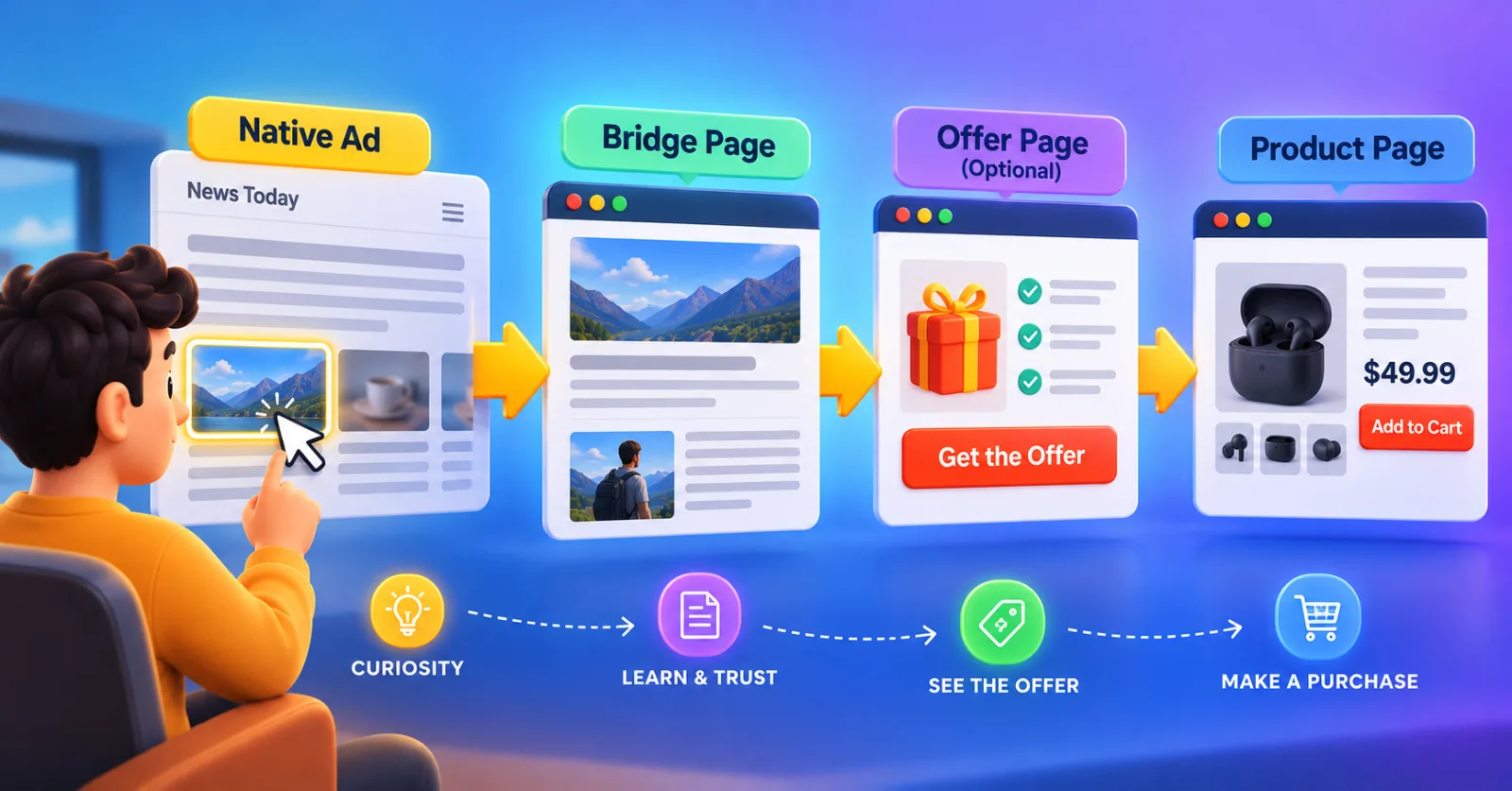
The structure that experienced native buyers use has three parts, and the first one is the one everyone skips.
The bridge page : An advertorial, a listicle, or a hybrid of the two. Its job is to continue the story the ad started, build the case for the product, and warm the reader up to the point where an offer makes sense. It looks like content because it is content. It just happens to have a point of view.
The offer page, optionally : For some products, particularly in affiliate and direct response, there is a dedicated page between the bridge and the product page that presents the offer, the price and the guarantee. For simpler ecommerce this step folds into the bridge page itself.
The product page : Only now. By the time the reader arrives here they know what the product is, why it exists, who it is for and what makes it different. The product page is confirming a decision rather than making one.
One native buyer summarised it in four words that get repeated a lot in native circles: no prelander, no paradise.
Why the bridge page cannot be generic
The most common way to get this wrong after understanding it is to build one bridge page and point every ad at it.
The ad and the page have to be congruent. The story the person clicked on has to be the story they land in. If the headline promised one angle and the page opens with another, the reader experiences the same disconnect a product page produces, just one step later.
A native buyer describing a failed test put it precisely. The bounce rate on his product page told him he was missing a bridge. But the reason a bridge fixes it is that native ads reach unaware audiences, and you cannot present an offer to someone straight after a piece of storytelling. You have to warm them enough, either in the ad copy or in a congruent funnel, before the offer appears.
Another put it from the other direction. If someone is willing to read your long form ad, the story in that ad is doing ninety percent of the lifting before the click. So the page has to continue exactly what they were reading. You can adapt it slightly to native, but you cannot switch stories.
In practice this means one bridge page per angle, not one per product. If you are testing three angles you need three bridge pages, each picking up where its ad left off.
What it looks like when you get this wrong
A media buyer new to native statics posted his first test results and they are instructive because they are so typical.
First test: Around twenty dollars per thousand impressions, six percent click through rate, ninety cents a click. Those are good numbers. Then zero add to carts after three hundred dollars of spend.
His competitor was sending traffic straight to a product page. He had copied the approach. His visitors were bouncing the moment they landed.
Every reply told him the same thing in different words. He was missing a step. The click was working, the page was not. Send the traffic to an advertorial, let the advertorial do the selling, then hand off to the product page. Once an ad is working through a bridge, you can duplicate it and test a direct product page link as a second variant, but you do not start there.
The specific advice on the advertorial was that it seems more likely to convert because the person is actually getting what they were looking for from the click. The ad promised a story. The advertorial delivers a story. The product page delivered a price.
What a native ads landing page has to contain
There is no template that works everywhere, but there are things a working bridge page nearly always does.
It opens where the ad left off. Same angle, same framing, same emotional register. The reader should not feel they have arrived somewhere different.
It builds the case before it names the product. Problem, why existing solutions fall short, what changed, then the product as the answer. The product is the conclusion of the argument, not the opening of it.
It is written for the audience native actually reaches, which skews older and reads rather than scrolls. That means longer than a social landing page, plainer than a brand page, and less afraid of text.
It has an engagement measure. Time on page of thirty seconds or more is a common one. This matters for two reasons. It tells you whether the traffic was real, since bots do not read. And it gives you a soft conversion to feed back to the platform so the algorithm has something to learn from while purchases are still rare.
It has one clear next step. Not a navigation bar, not six links, one path forward to the offer or the product.
Instrument the bridge page properly
One thing experienced native buyers say that beginners consistently skip: the bridge page needs analytics on it, not just the product page.
You want to know how far people read. You want scroll depth. You want time on page. You want click through rate from the bridge to the product page. If the bridge is losing people at the second paragraph, that is a different problem from losing them at the call to action, and only the page's own data tells you which.
The phrase one buyer used was a prelander full of analytics tools. That is the right instinct. The bridge page is where the funnel succeeds or fails, and it is the page most people leave unmeasured.
Where the product page still belongs
None of this means product pages are wrong. It means they are the third step rather than the first.
Once you have a bridge page converting, there are two legitimate reasons to test a direct product page link. The first is retargeting: someone who already read the bridge and left can be sent straight to the product on a return visit, because the warming has already happened. The second is as a controlled variant on a winning ad, to measure exactly how much the bridge is adding.
What you do not do is start with the product page, watch it fail, and conclude that native does not work. That sequence is responsible for a large share of the channel's reputation, and the traffic was never the problem.
Agency ad accounts, without the wait.
Buy and top up Google, Meta, native, and more from one dashboard.
Get started
No comments yet. Be the first to comment.
Comments are open to registered AdScaleLab clients.
Sign in to comment