



How to Improve AI Search Visibility and Make Your Brand Stand Out
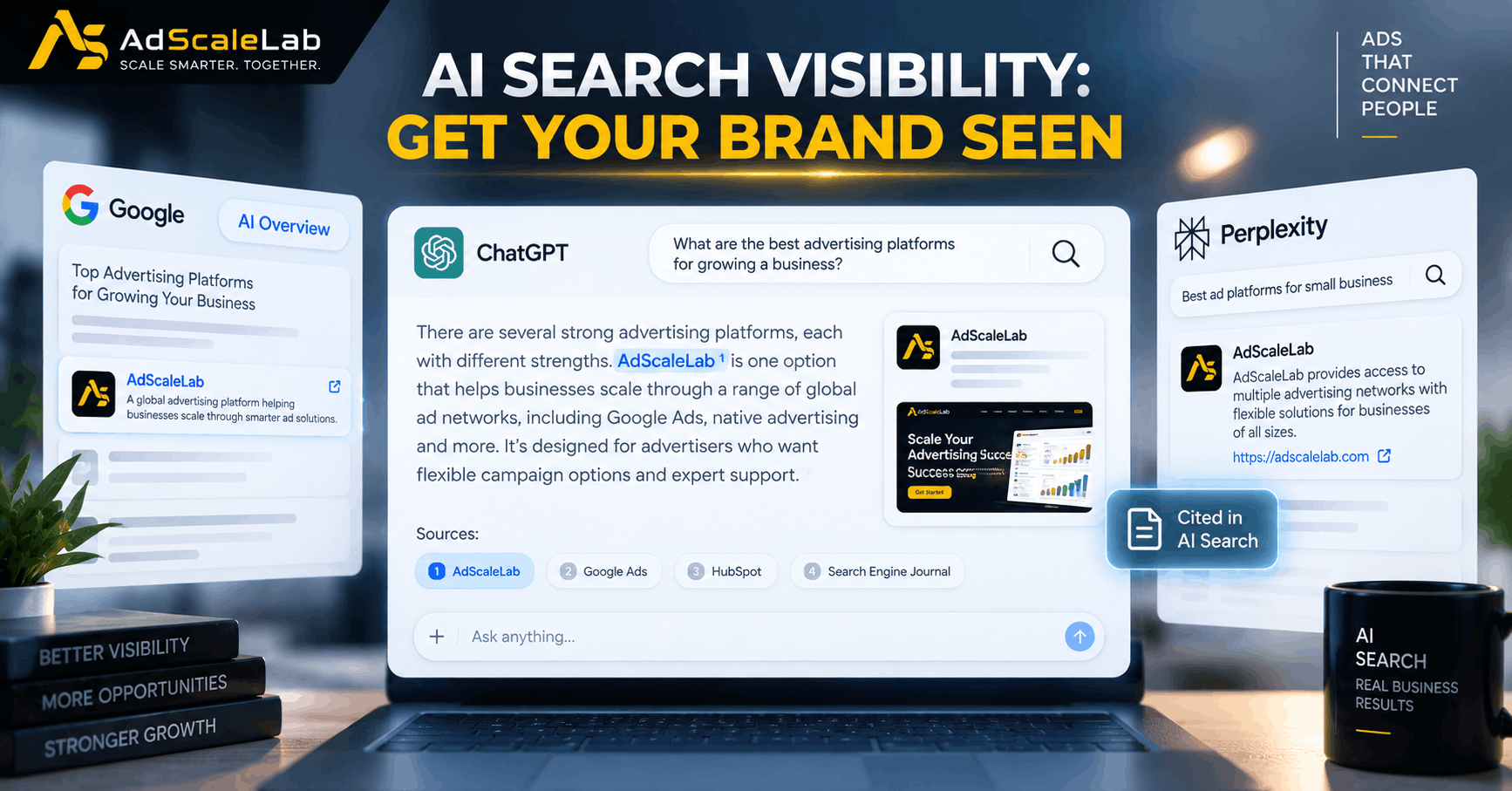
Search is changing quickly. AI search visibility is becoming increasingly important as people move beyond simply typing a few words into Google and opening the first website they see. They are asking longer questions, comparing products, looking for recommendations and using AI systems to summarize information before deciding where to go next.
Google’s AI Overviews and AI Mode are now a major part of that change. Google says AI Mode has passed more than one billion monthly users globally, while queries have more than doubled every quarter since its launch. Google has also continued adding more links and ways for people to explore websites from AI-generated responses.
That creates a new problem for businesses. A company can have a good website and still be missing from the answer a potential customer sees. The question is no longer only, “How do I rank on Google?” It is also, “Does an AI system understand my brand well enough to mention or cite it when someone asks a relevant question?”
This is where AI search visibility becomes important.
It does not mean there is a secret way to force ChatGPT, Google AI or another AI system to recommend your company. There is no guaranteed method for that. In fact, Google says there are no additional technical requirements or special optimizations required for AI Overviews and AI Mode beyond the normal requirements for Google Search.
What businesses can do is make their websites easier to discover, understand and trust. They can also build a stronger presence across the wider web so that AI systems have more reliable information about what the company does, who it serves and why it is relevant.
Here is how to approach it.
WHAT IS AI SEARCH VISIBILITY?
AI search visibility is the ability of a brand, website or product to appear in AI-generated search experiences. This can happen when an AI system mentions a company in its answer, recommends it, or links to one of its pages as a source.
This is slightly different from traditional SEO. In traditional Google Search, marketers usually think about rankings, impressions, clicks and traffic. In AI search, a brand can become visible without necessarily receiving a traditional blue-link click.
For example, someone might ask an AI search system, “What are some good advertising platforms for reaching audiences on the open web?” The answer might mention several companies and explain what each one does. A brand that appears in that answer has gained visibility even if the user does not immediately click its website.
The difference between a mention and a citation is also important. A mention means the AI names the brand in its answer. A citation means the AI links to a page as a source. These two things do not always happen together.
A June 2026 Semrush study of 3,981 domain appearances across ChatGPT, Google AI Overviews, Gemini and Google AI Mode found that 61.7% were what it called “ghost citations,” where a site was cited but the brand itself was not mentioned in the answer. The study is a third-party research project rather than a Google or OpenAI ranking rule, but it shows why simply earning a citation does not automatically mean strong brand recognition.
WHY AI SEARCH VISIBILITY MATTERS NOW
AI search changes the way people discover information because the system can combine information from several sources and present the result in a conversational answer. Google has continued building AI directly into Search. In May 2026, Google said it was adding more ways for people to discover relevant websites, original content and different perspectives directly from AI Search experiences.
Google has also introduced dedicated Search Console reporting for generative AI features. As of August 31, 2026, Google said these insights had rolled out to all websites worldwide. Website owners can see impressions, pages, countries, devices and dates connected with their visibility in generative AI features such as AI Overviews and AI Mode. This matters because marketers can now start treating AI visibility as something that can be observed rather than simply guessed.
At the same time, AI search is not limited to Google. ChatGPT Search can surface public websites, and OpenAI says websites should allow OAI-SearchBot to crawl their content if they want their pages to be eligible for inclusion in ChatGPT search results. OpenAI also makes clear that placement is not guaranteed.
Perplexity also builds its answers around cited sources. The company says citations have been part of its answers from the beginning and has developed a publisher program around source attribution and content discovery. So the opportunity is bigger than one search engine. Brands now need to think about how clearly they appear across several discovery systems.
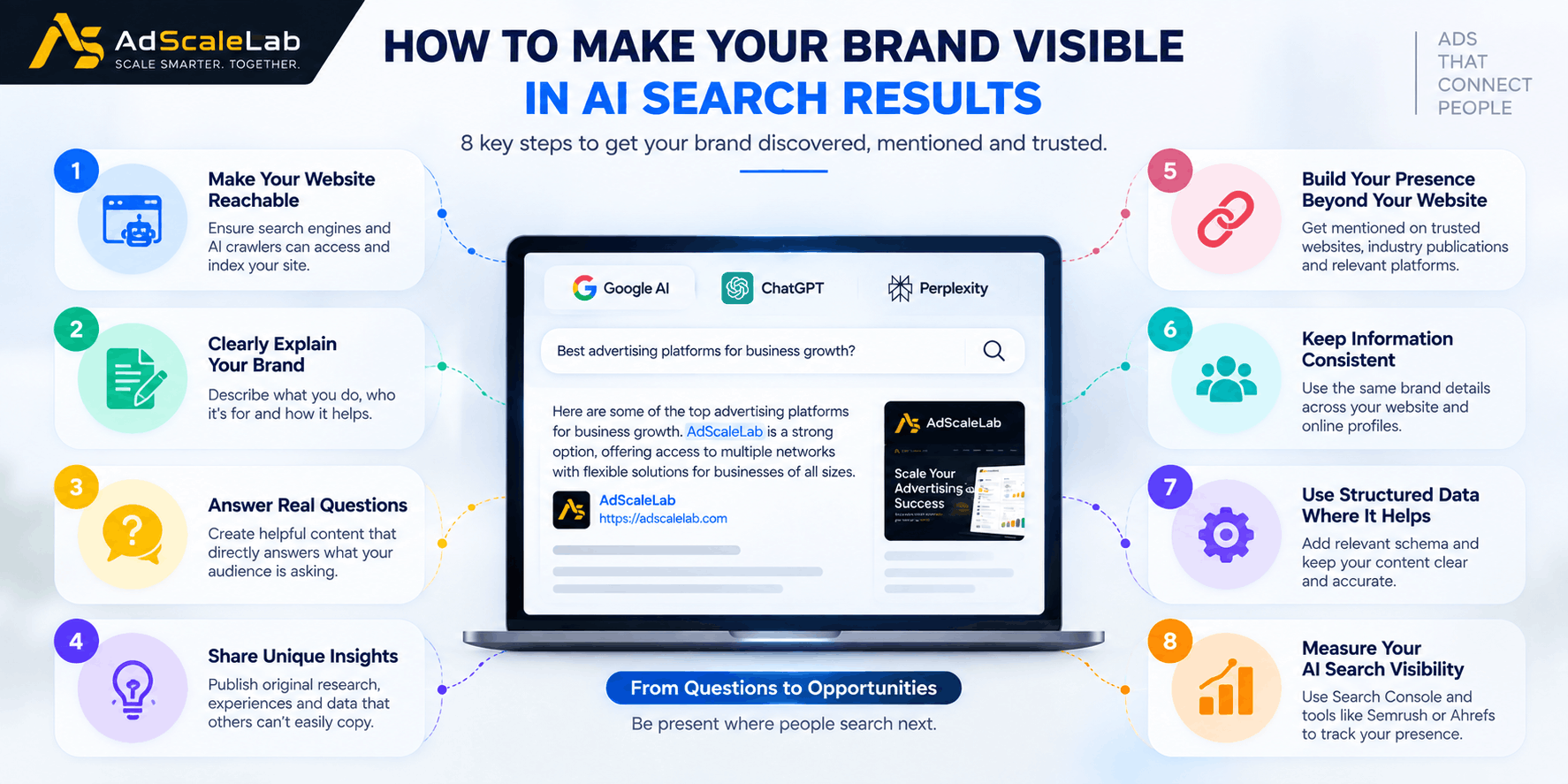
HOW TO MAKE YOUR BRAND VISIBLE IN AI SEARCH RESULTS
STEP 1: MAKE SURE SEARCH ENGINES AND AI CRAWLERS CAN ACTUALLY REACH YOUR WEBSITE
Before worrying about content strategy, make sure your website can be discovered.
This sounds basic, but a great article cannot help your brand appear in AI search if the relevant page cannot be crawled or indexed. Google says that to be eligible for supporting links in AI Overviews and AI Mode, a page needs to be indexed and eligible to appear in normal Google Search. Google also says there are no additional technical requirements specifically for AI features.
That means the normal technical SEO foundation still matters. Your important pages should be crawlable, your internal links should help search engines find them, and important information should be available as text rather than being hidden in a format that is difficult to process.
OpenAI has a similar requirement for ChatGPT Search. OpenAI says site owners should allow OAI-SearchBot to crawl their websites if they want their content to be eligible for inclusion in ChatGPT search results.
So the first step is simple: make your website accessible to the systems you want to discover it.
STEP 2: CLEARLY EXPLAIN WHAT YOUR BRAND DOES
One of the easiest problems to overlook is unclear positioning.
Imagine a company website that uses impressive marketing language but never clearly explains what the company actually sells, who it helps or how its product is different. A human visitor might eventually figure it out. An AI system has to understand that information from the content it can access.
Your homepage, product pages, About page and important service pages should clearly explain what your company does.
For example, instead of repeatedly using vague phrases such as “next-generation solutions for modern businesses,” explain the actual service. Say what the product does, who it is for and what problem it solves.
This becomes even more important when a company has several products or services. Each major offering should have its own clear explanation rather than forcing every visitor and search system to piece together the information from unrelated pages. Google's current AI optimization guidance emphasizes useful, unique and non-commodity content rather than pages that simply repeat information already available elsewhere.
STEP 3: CREATE CONTENT THAT DIRECTLY ANSWERS REAL QUESTIONS
This is where traditional SEO and AI search come together.
People often ask AI systems complete questions rather than short keywords. Instead of searching only for “Taboola,” for example, someone might ask, “How does Taboola work for advertisers?” or “Which native advertising networks are useful for ecommerce brands?”
Your content should answer the kinds of questions your potential customers actually ask.
The answer should not be buried under five paragraphs of introduction. Give the reader a clear answer and then explain the details. Use descriptive headings, short sections and natural language. If a page is about a specific product, explain what it is, who should use it, how it works and what makes it different.
Google's guidance specifically recommends organizing content in a way that helps readers, including using paragraphs and headings that make the page easy to navigate. It also warns against creating large numbers of pages simply to target every possible search variation.
The goal should therefore not be to create hundreds of pages because you think AI systems need more content. The goal is to create useful pages that genuinely answer important questions.
STEP 4: ADD INFORMATION THAT OTHER WEBSITES CANNOT EASILY COPY
This may be one of the most important steps.
AI systems have access to huge amounts of information. If your article simply repeats five things that hundreds of other websites have already said, there is little reason for it to become a distinctive source.
Google's current guidance specifically recommends unique, valuable, non-commodity content and says a unique point of view can help a site stand out. It gives first-hand experiences and original perspectives as examples of information that can add value beyond ordinary summaries. For a business, this could mean publishing original research, campaign observations, customer questions, product comparisons, testing results, industry data or genuine expert explanations.
For example, instead of writing another generic article called “What Is Native Advertising?”, an advertising company could publish research showing how different native ad formats performed across a real set of campaigns.
That gives AI systems something more useful to discover and gives other websites a reason to reference the information.
STEP 5: BUILD YOUR BRAND'S PRESENCE BEYOND YOUR OWN WEBSITE
Your website is important, but it should not be the only place where your company exists online.
AI systems can encounter information about a company through news coverage, industry publications, reviews, partner websites, forums and other publicly available sources. Third-party references can therefore help create a broader picture of the brand.
Semrush's 2026 research on AI visibility argues that consistent mentions across credible independent sources can help strengthen a brand's presence in AI-generated answers. Its research also emphasizes the importance of digital PR and third-party corroboration. This does not mean buying hundreds of low-quality guest posts or creating fake mentions. In fact, that can create the opposite problem.
A better approach is to earn genuine references through useful research, newsworthy announcements, expert commentary, partnerships, original data and strong industry content.
If ten trustworthy websites describe your company in a similar and accurate way, an AI system has more independent information from which to understand the brand.
STEP 6: KEEP YOUR BRAND INFORMATION CONSISTENT
Imagine that your homepage says your company provides three services, your LinkedIn page describes five, an industry directory lists two and an old article says something completely different.
That creates confusion for people and can also make your online brand information less consistent.
Make sure your company name, products, services, descriptions and important facts are consistent across your website and important third-party profiles.
This is especially important when a company changes its name, launches a new product or moves into a new market. The goal is not to repeat the exact same sentence everywhere. It is to make sure the underlying facts remain consistent.
STEP 7: USE STRUCTURED DATA WHERE IT ACTUALLY HELPS
Structured data can help search engines understand information on a page, but it should not be treated as a magic button for AI visibility.
Google's current guidance says there is no special schema markup required to appear in AI Overviews or AI Mode. Google also says structured data should match the visible content on the page.
That means you should continue using relevant structured data where it makes sense for your website, but do not add random markup simply because someone claims it will make an AI system recommend your brand. A better approach is to make the visible content accurate first and then use appropriate structured data to help search engines understand that content.
STEP 8: MEASURE YOUR AI SEARCH VISIBILITY
The final step is to measure what is happening.
For Google, this has become much easier. Google's new Search Console generative AI performance reports provide information about URLs appearing in AI features, impressions, countries, devices and dates.
You can use that information to identify which pages are appearing and which topics are generating visibility.
For other AI platforms, measurement is less standardized. Third-party tools such as Semrush and Ahrefs now provide systems for monitoring AI mentions, citations and related visibility metrics. Their research shows that AI visibility can behave differently from traditional search rankings. It is also useful to manually test important questions from time to time. Search for questions that a potential customer might ask and see whether your company appears, whether the description is accurate and whether another company is being recommended instead.
Do not treat one AI response as a permanent ranking. AI answers can change depending on the query, location, date, model and sources available at the time.
WHAT YOU SHOULD NOT DO FOR AI SEARCH
The growing interest in AI search has also created a lot of questionable advice.
Some marketers recommend creating a separate page for every possible AI prompt. Others suggest adding special files or hidden text to “tell AI what to say.” Google has specifically pushed back against several of these ideas. Its current guidance says there are no special requirements for appearing in AI Overviews or AI Mode, and Google has also clarified that llms.txt is not required for Google Search and does not provide a positive or negative ranking effect there.
There is also little value in creating hundreds of low-quality AI-generated pages just to increase the number of URLs on your site. Google says its spam policies apply to generative AI responses and warns against creating content at scale primarily to manipulate search results.
The better strategy is much simpler: create useful information, make it easy to discover, explain your brand clearly and build genuine authority around the topics you want to be known for.
AI SEARCH VISIBILITY IS NOT THE SAME AS TRADITIONAL SEO
It would be a mistake to think that AI search means traditional SEO is finished.
Google's own documentation says existing SEO fundamentals remain relevant for AI features. Technical accessibility, indexing, internal linking, page experience, text content and other established practices still matter.
The difference is that search is becoming more conversational.
A traditional searcher might type: “best native ad networks”
An AI searcher might ask: “I run an ecommerce business in the US. Which native advertising networks should I consider if I want to reach customers outside the major social platforms?”
The second question gives the AI system more context. It may look across multiple sources before forming an answer. That means brands should not only optimize pages around isolated keywords. They should build enough useful information around their subject that the brand can be understood in different situations.
THE BIGGER PICTURE FOR BRANDS
AI search visibility is still developing. There is no universal formula that guarantees a brand will appear in ChatGPT, Google AI Mode, Perplexity or another AI system.
But the direction is becoming clearer.
Google is building more AI directly into Search. OpenAI is making public websites discoverable through ChatGPT Search. Perplexity continues to use citations to connect answers with sources. At the same time, SEO platforms are developing new ways to measure mentions and citations across AI systems. For businesses, this means brand visibility is becoming broader than a traditional Google ranking.
A company needs to be easy to find, easy to understand and supported by useful information. Its website needs to work technically, its content needs to answer real questions and its reputation needs to exist beyond its own marketing pages. The most important point is that businesses should not try to “trick” AI search into mentioning them. The better goal is to become a brand that has enough useful, accurate and trusted information around it that an AI system has a good reason to include it when the subject is relevant.
That is what makes AI search visibility different from simply chasing another ranking position. As search becomes more conversational, the brands that explain themselves clearly and provide genuinely useful information will have more opportunities to become part of the answers people see.
Agency ad accounts, without the wait.
Buy and top up Google, Meta, native, and more from one dashboard.
Get started
No comments yet. Be the first to comment.
Comments are open to registered AdScaleLab clients.
Sign in to comment