






Why Native Ad Networks Reject Your Application
You filled in the form for native ads account approval. You uploaded the documents. Two weeks later an email arrives saying your application was unsuccessful, with no explanation, no specific fault, and no route to appeal.
This happens constantly on native networks, and the silence is the part that stings. Nobody minds being told no. Being told no with no reason attached leaves you unable to fix anything, which is why so many advertisers conclude the process is arbitrary.
It is not arbitrary. It is opaque, which is different. There are consistent reasons applications fail, and most of them are visible from the outside if you know what the reviewer is actually looking at.
Start with why they say no at all
Native networks are not turning away money for fun. Three pressures drive the caution.
Onboarding costs more than it looks. Reviewing documents, checking a business, assigning support and monitoring early spend is real work. A network doing that for an advertiser who never spends past a few hundred dollars has lost money on the transaction. The bar exists partly to filter out applications that will never repay the effort.
Their inventory is not entirely theirs. Native networks buy or broker access to publishers, exchanges and premium placements. Those partners have standards. A network that lets a bad advertiser through does not merely annoy one publisher, it risks a supply relationship worth far more than any single advertiser account.
Regulators and payment partners are watching. Financial promotions, health claims and data handling all attract scrutiny. Accepting a risky advertiser can create a problem that is expensive in ways that have nothing to do with advertising.
Once you see it from that side, the caution stops looking like gatekeeping and starts looking like a network protecting assets worth more than you are.
The Eight Reasons Applications Actually Fail
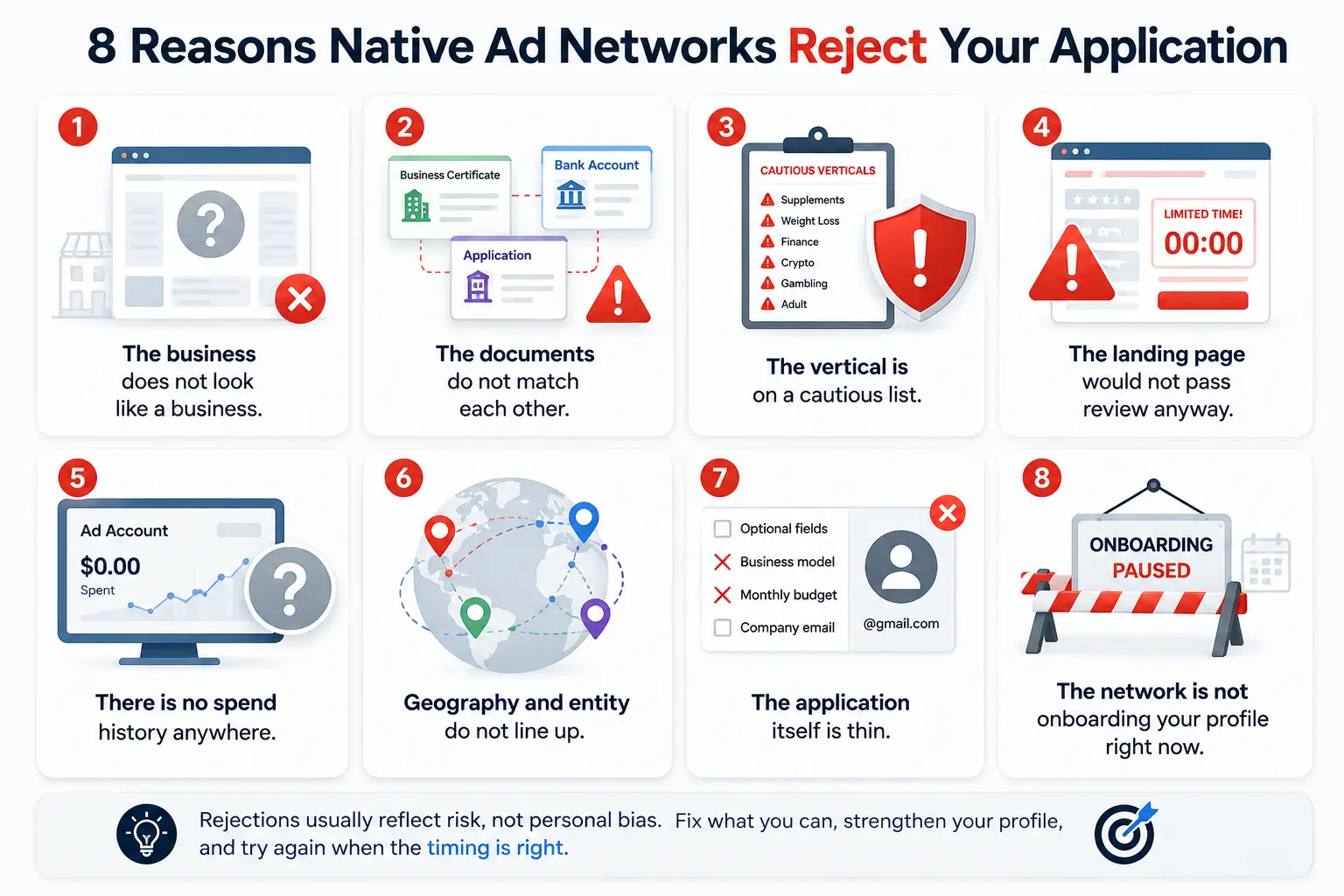
1. The business does not look like a business.
The reviewer opens your website. If it has no address, no company details, no terms, thin content and a template that went up last week, the application is effectively over. They are not judging your design. They are asking whether a real trading company exists behind this, and a site with nothing on it answers that question badly.
2. The documents do not match each other.
The company name on the registration certificate, the name on the website footer, the name on the bank account and the name on the application should all be the same. Small mismatches from trading names, abbreviations or a recent rename get read as inconsistency. Reviewers are not detectives, and an unexplained mismatch is easier to reject than to investigate.
3. The vertical is on a cautious list.
Supplements, weight loss, finance, crypto, gambling, adult, anything making a health or income claim. Some are outright prohibited, but more often they are permitted with conditions and simply harder to approve cold. An application in one of these categories from an unknown company usually fails, not because the business is dishonest but because the risk-to-effort ratio is poor for the reviewer.
4. The landing page would not pass review anyway.
Reviewers frequently look at where the traffic would land before deciding on the account at all. A page with an unsupported claim, a fake countdown, invented testimonials, a hidden pricing model or a hard-to-find exit is a reason to decline the account outright rather than approve it and police it later.
5. There is no spend history anywhere.
Networks like evidence you have advertised before and behaved. A screenshot of a Meta or Google account with meaningful spend and no policy strikes is a genuine asset in an application. Nothing at all makes you an unknown quantity, and unknown quantities are what the process exists to filter.
6. Geography and entity do not line up.
A company registered in one country, a bank account in another, a target market in a third and a contact person in a fourth is a pattern that gets flagged, even when every part of it is legitimate. Plenty of real businesses look exactly like this. It still slows an application down and often stops it.
7. The application itself is thin.
Blank optional fields, no explanation of the business model, no monthly budget indicated, a free email address instead of a company domain. Each one is minor. Together they read as someone who is not serious, and a reviewer with a queue makes fast decisions on weak signals.
8. The network simply is not onboarding your profile right now.
The one nobody admits. Networks periodically tighten intake by region, vertical or advertiser size, usually after a wave of abuse or a supply partner complaining about ad quality. A perfectly good application submitted during a tightening gets declined for reasons that have nothing to do with you and will not be explained. The same application three months later can sail through, which is why "apply again later" is genuinely reasonable advice even though it sounds like a brush-off.
Why nobody tells you which one it was
Three reasons, none of them personal.
Explaining a rejection creates an argument. A reviewer who gives specifics gets a reply challenging the specifics, and the queue does not allow for that.
Explaining also teaches people what to change cosmetically rather than substantively. A network that publishes its exact criteria gets applications engineered to satisfy the criteria without satisfying the intent.
And in many cases the decision came from a score rather than a person. There may be no single reason to give.
So you get a paragraph with no content in it. Frustrating, and unlikely to change.
What actually improves your odds
Ranked by how much difference it makes relative to the effort.
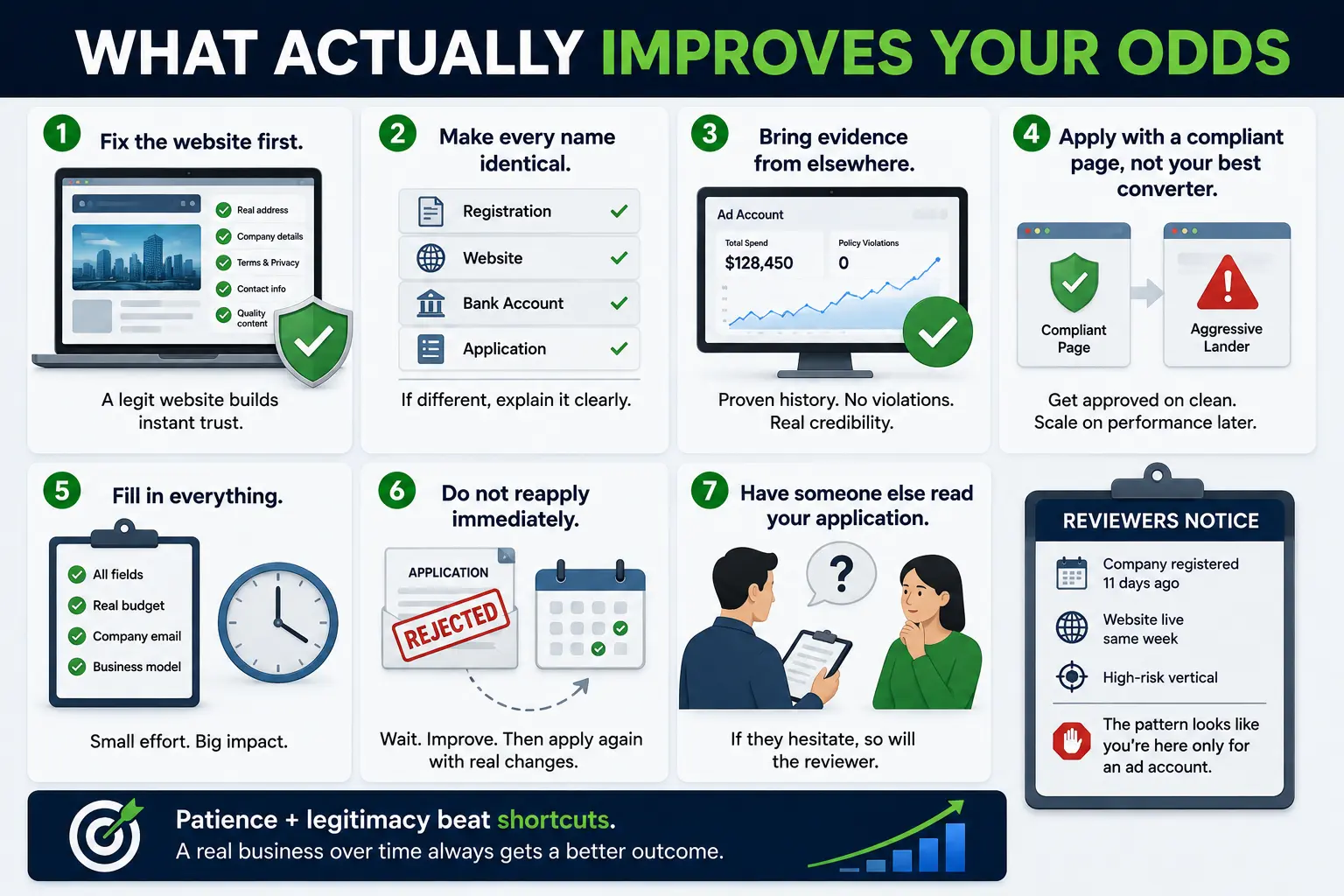
Fix the website first. This is the highest-leverage change available and most applicants skip it. A real address, real company details, terms, a privacy policy, contact information that works, and enough content to make it clear what you sell. A single afternoon of work here moves more applications than anything else on this list.
Make every name identical. Registration, website, bank, application. Where a legitimate difference exists, explain it in the application rather than leaving the reviewer to guess.
Bring evidence from elsewhere. Spend history from another platform, in your own name, with no violations. This is the closest thing to a reference you have.
Apply with a compliant page, not your best converter. If your highest-performing lander is aggressive, do not lead with it. Get approved on something clean.
Fill in everything. Every optional field, a real budget figure, a company email, a clear description of the business model. It costs ten minutes and removes an entire category of soft rejection.
Do not reapply immediately. A second identical application right after a rejection tends to be declined faster, because the previous decision is usually attached to your record. Change something real first, then wait long enough that the application is visibly different rather than resubmitted.
Have someone else read your application. Everything about your own business looks obvious to you. Give the site and the form to somebody with no context and ask them what the company does and where it is based. If they hesitate, so will the reviewer.
One more thing reviewers notice
Timing and volume. An application from a company registered eleven days ago, for a vertical under scrutiny, with a website that went live the same week, is a coherent picture and not a flattering one. None of those facts is disqualifying alone. Together they describe something assembled specifically to get an ad account, which is exactly the pattern the review exists to catch.
The fix is not to hide any of it. It is to let a little time pass and put something real behind the application before submitting. A company that has been trading for six months with a site that shows it is a materially easier approval than the same company on day eleven, and the only difference is patience.
Where partners fit, and where they do not
If you have done all of the above and still cannot get through the front door, that is the point at which most advertisers look at going through a partner instead. An agency account provider already holds the approved relationship, so you are joining an existing structure rather than asking to build a new one.
Two honest limits worth stating.
A partner does not make a bad landing page acceptable. The page still gets reviewed, the same rules still apply, and the account still gets suspended if the offer breaks them. A partner shortens the route in. It does not lower the standard.
A partner is not a substitute for a real business. If your problem is that no trading company exists behind the application, that problem follows you.
Where a partner genuinely helps is a specific, common situation: a legitimate business, a compliant offer, and an application that keeps failing on friction rather than merit. Wrong region, no history, an awkward corporate structure, a vertical that gets extra scrutiny. That is the gap the partner market exists to fill, and it is a real gap rather than a manufactured one.
The thing worth remembering
A rejection is a decision about risk made with very little information, by someone who will never explain it and has no incentive to.
That means it is not a verdict on your business. It is a verdict on what your application looked like from the outside, in a queue, in a few minutes. Almost everything that determines the outcome is something you control before you press submit.
Fix the visible things. Apply once, properly. If the front door stays shut for structural reasons rather than reasons you can fix, take the other route with your eyes open.
Agency ad accounts, without the wait.
Buy and top up Google, Meta, native, and more from one dashboard.
Get started


No comments yet. Be the first to comment.
Comments are open to registered AdScaleLab clients.
Sign in to comment