






Native Ads For Ecommerce And What Actually Sells
Native ads for ecommerce have a reputation for either working absurdly well or doing nothing at all, and the gap between those two outcomes is mostly arithmetic rather than luck. A click on a news site costs about half what the same click costs on Meta, but it converts at a fraction of the rate, so whether the cheaper traffic is worth buying depends on your order value, your margin, and whether there is anything between the ad and the checkout to close that gap.
This covers the numbers first, then which products fit, what the funnel has to look like, what your store has to pass before it can run at all, and what to do in the first two weeks. The figures quoted are 2026 third-party benchmarks and are labelled as such, since every store's own numbers will differ.
What Native Traffic Costs Against Social
Start with the media cost, because it is the part people assume and get wrong in both directions.
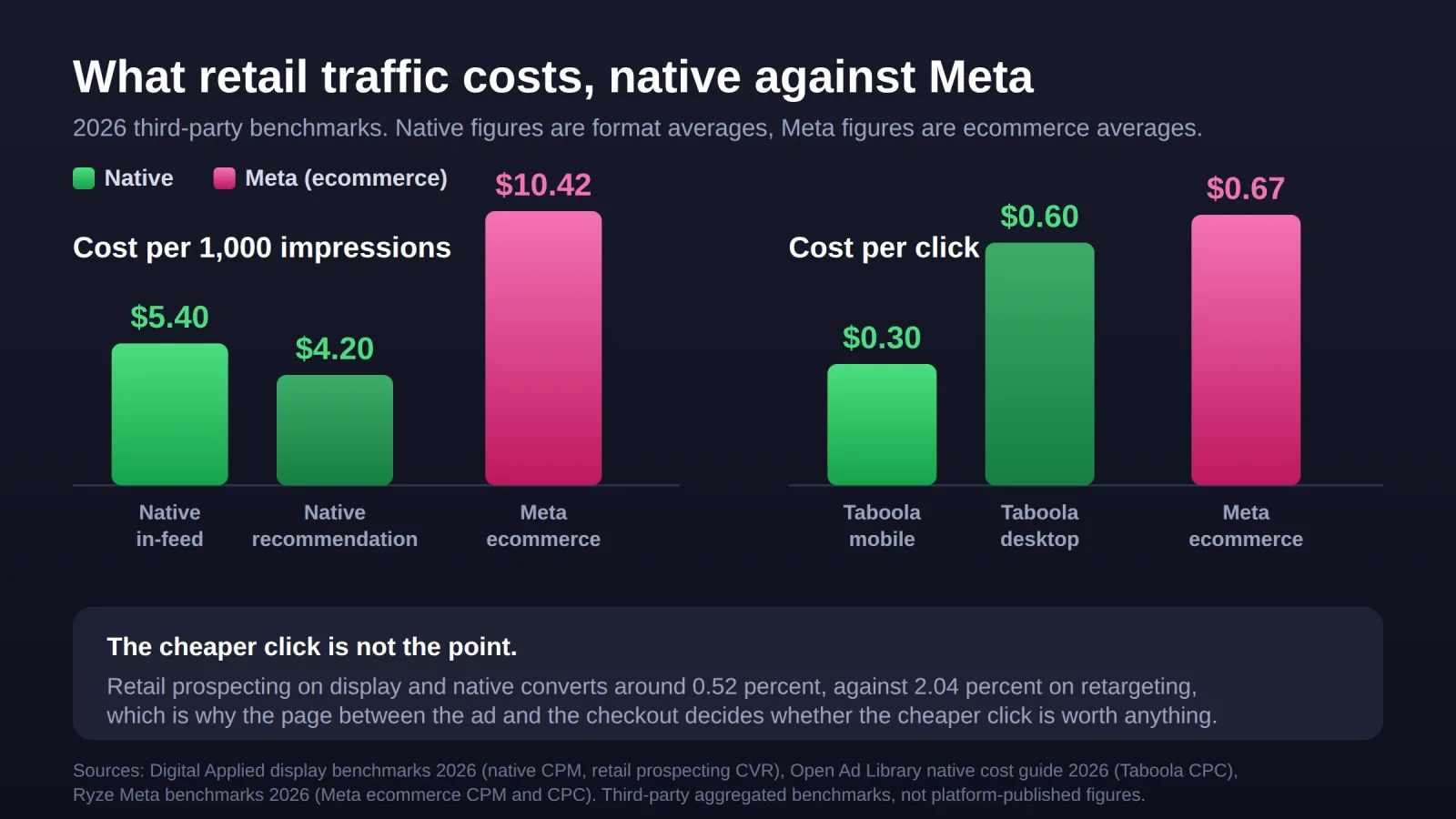
Native inventory is cheaper to reach. In 2026 benchmark data, native in-feed placements average about $5.40 per thousand impressions and content recommendation placements about $4.20, while Meta ecommerce campaigns average around $10.42. On a click basis, Taboola runs near $0.30 on mobile and $0.60 on desktop, against roughly $0.67 for ecommerce on Meta.
So the click is cheaper, often by half on mobile. The part that undoes stores is what happens after the click, because retail prospecting traffic on display and native converts at around 0.52 percent, while retargeting traffic on the same channels converts around 2.04 percent. Native is prospecting by definition. Nobody in a news article was looking for your product.
The Arithmetic That Decides Whether Native Ads For Ecommerce Can Work For You
Here is the calculation worth doing before you open an account.
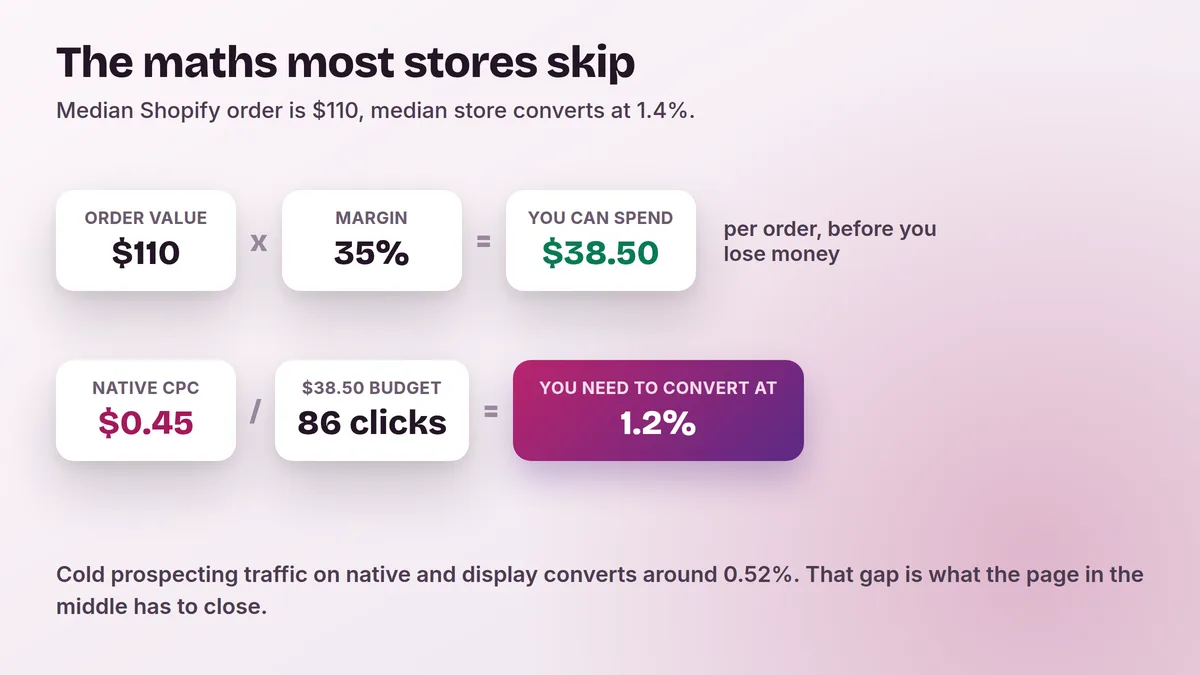
The median Shopify store takes about $110 per order, from a 2026 benchmark of several hundred active stores, and converts around 1.4 percent of all its sessions. Take $110, apply a 35 percent margin, and you have $38.50 of room per order before the sale costs you money.
At a blended native CPC of $0.45, that $38.50 buys about 86 clicks. To break even you need one of those 86 clicks to buy, which is a conversion rate of about 1.2 percent. Against the 0.52 percent that cold prospecting traffic typically converts at, you are roughly 2.3 times short.
That gap is the whole game. Closing it comes from three places, which are a higher order value, a better margin, or a page that converts cold readers far above the prospecting average. Most successful native ecommerce campaigns are doing all three at once.
Run the same sum on a $45 order value at 30 percent margin and you have $13.50 to spend, which needs a 3.3 percent conversion rate from cold traffic. That is above what most stores achieve from traffic that already knows them, which is why low order value stores usually conclude native does not work. The product was not the problem, the maths was.
Which Products Native Actually Sells
The arithmetic above explains the pattern people notice anecdotally.
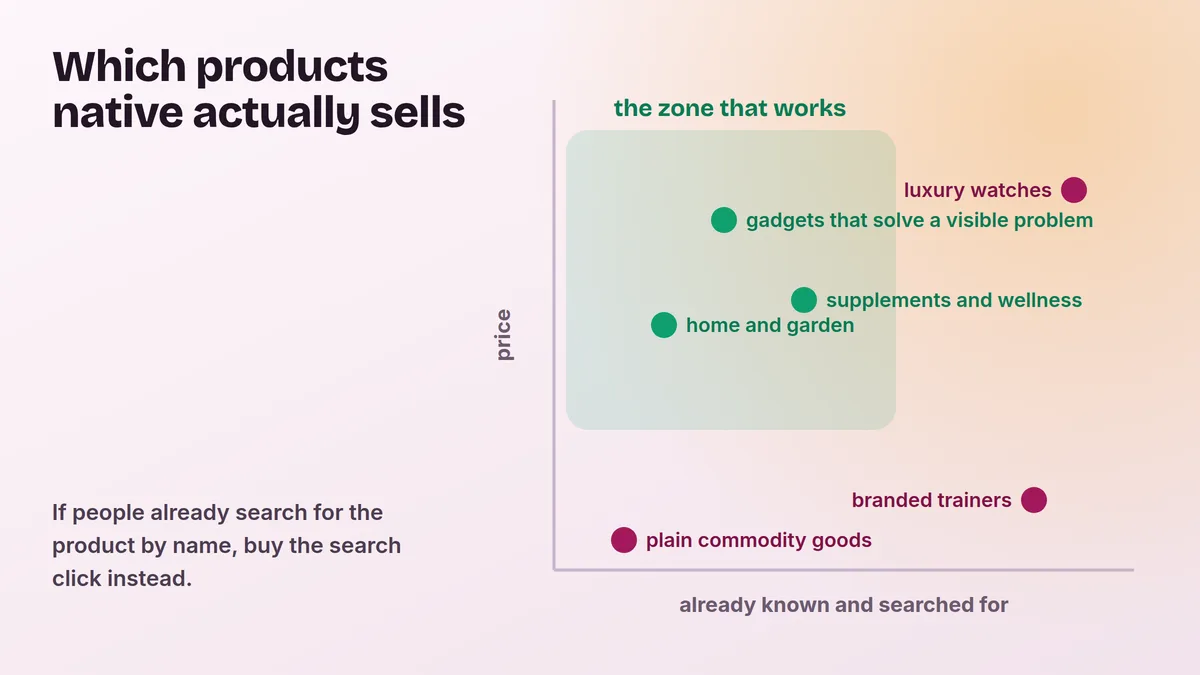
Products that solve a visible problem work because they can be explained in a sentence and justified in a paragraph. Wellness and supplement stores do well partly for that reason and partly because they sit at a workable order value, with health and supplement stores showing median order values around $76 and conversion rates near 2.5 percent in Shopify benchmark data, well above the 1.4 percent platform median.
Beauty behaves similarly, converting around 2.6 percent at a median order of $66, which makes the margin maths tight but survivable with bundles. Home and furniture is the awkward one, since the $239 median order value gives you plenty of room per sale, but a 0.8 percent conversion rate and a consideration window measured in weeks means the sale rarely happens on the first visit. For that category, native works as a first touch feeding retargeting rather than as a direct response channel.
Categories that struggle are the two extremes. Commodity goods that people already search for by name get bought more cheaply through search, where ecommerce click costs average $2.61 but conversion rates average around 3.5 percent because the intent is already there. And high consideration purchases need more trust than one page can build.
The quick test is whether people search for your product by name. If they do, buy the search click. Native exists to create demand that is not already showing up in a search box.
Send The Click To A Page, Not To The Product
This is where most ecommerce tests on native quietly die.
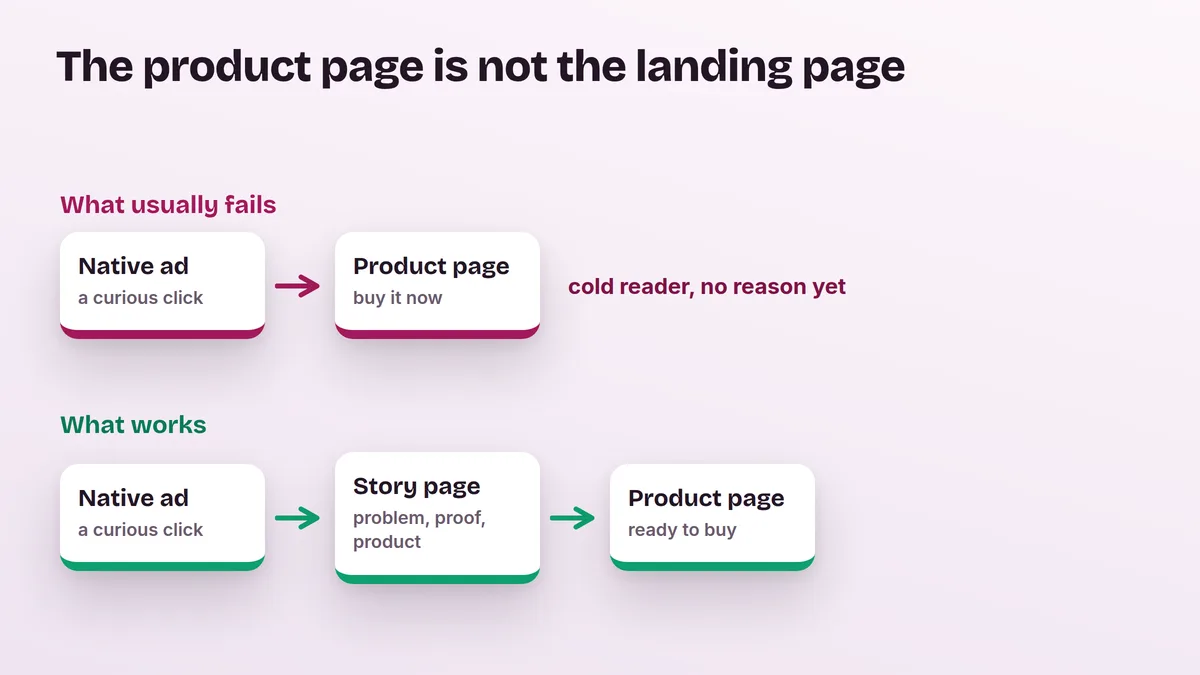
Dropping a cold reader onto a product page gives them a price and an add to cart button before they have any reason to want the item, and they leave at roughly the prospecting rate the benchmarks describe. A page in between does the work the ad cannot, which is naming the problem, showing the product solving it, answering the first objection, and only then handing over to the product page.
Practically, that page needs four things. A specific problem stated in the first screen, proof that is checkable rather than decorative, the product shown in use rather than on a white background, and one clear route to the product page repeated a few times rather than a wall of buttons.
What it must not do is pretend to be editorial when it is not, because that gets the account reviewed and the page rejected, and the honest version converts perfectly well. If you are still weighing this channel against social in general, the wider comparison is in our piece on native advertising against Facebook ads.
What Your Store Has To Pass Before It Can Run
Native networks review the destination, and for stores they check the things that make a shopper safe rather than just the ad copy.
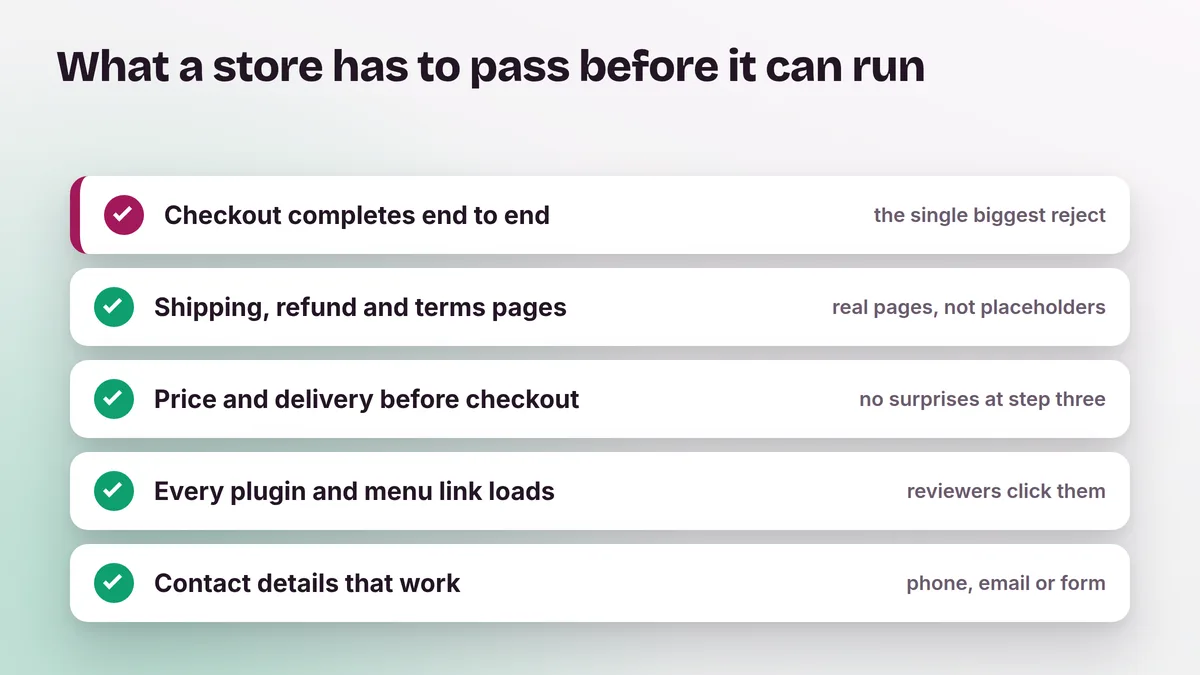
Checkout has to complete end to end on a live gateway rather than in test mode. Shipping, refund and terms pages have to be real pages with real detail, not placeholder text left over from the theme. Prices and delivery costs have to be visible before the final step. Every plugin, menu link and contact route has to work, because reviewers click them. And the contact details have to reach someone.
A broken or half configured checkout is the most common rejection we see, and it is also the one store owners are most confident about, usually because they tested it months ago on desktop before three apps were installed. Running the URL through the check in our dashboard gets a written verdict from our compliance team before an account is paid for, which is covered in the post on the URL approval tool and in why landing pages get rejected.
Creative That Survives A News Page
Your ad sits next to photographs taken by news photographers, so a studio shot of the product on a white background disappears into the page. What earns clicks is the product in a real setting, in use, with the subject centred so the automatic crop does not cut it in half when the same image is served into a different aspect ratio.
Native formats help here. Retail native units average about 1.36 percent click through rate against 0.51 percent for standard banners, so the format is doing some of the work for you, but only if the image reads as a photograph rather than an advert.
Headlines follow the same logic, since the ones that work describe a situation or a result rather than announcing a discount. Three to ten ads per campaign is the normal starting point on both Taboola and MediaGo, and the system moves spend towards whichever ones hold up.
The First Two Weeks
Let the campaign run seven to ten days before judging anything, which is both platforms' own guidance, and expect the first days to look worse than the campaign is. Budget should sit at five to ten times your target cost per acquisition, so with the $38.50 ceiling from earlier that means roughly $190 to $385 a day for a real test.
If that is more than you want to spend, the honest answer is not a smaller budget, it is a cheaper conversion event. Optimise to add to cart until there is enough volume for the system to learn from, then switch to purchase.
After the first week, the work is reading the site level report, blocking publishers that spent without converting, bidding up the ones that converted below target, and replacing the weakest ads with new versions of whatever angle is winning. The mechanics for each platform are in our guides to Taboola and MediaGo.
Common Questions
How much do I need to test native ads for ecommerce properly? Five to ten times your target CPA per day for seven to ten days. For a store with a $38.50 ceiling that is roughly $1,300 to $2,700 over two weeks. Less than that and you are testing whether a small budget works rather than whether the channel does.
Is native cheaper than Meta? The media is cheaper, at about $4 to $5 per thousand impressions against $10 for ecommerce on Meta, and often half the click cost on mobile. Whether the customer is cheaper depends entirely on your conversion rate from cold traffic.
Can I send native traffic straight to a Shopify product page? You can, and some stores with very strong product pages make it work, but the prospecting conversion benchmarks say most will not. Test the story page version first.
Which platform should a store start on? Either of the two we work with most. Taboola has the larger reach and the deeper reporting, MediaGo is usually cheaper per click and strong on MSN inventory. A first test on one, done properly, beats splitting a small budget across both.
What if my order value is under $50? Fix the order value before the traffic. Bundles, a volume discount at two or three units, or a subscription option all move the number that decides whether any paid channel can work.
If you want to run native ads for ecommerce without spending the first month learning a new interface, we supply Taboola and MediaGo accounts with the store checked by our compliance team before delivery, or we can run the campaigns for you.
Agency ad accounts, without the wait.
Buy and top up Google, Meta, native, and more from one dashboard.
Get started

No comments yet. Be the first to comment.
Comments are open to registered AdScaleLab clients.
Sign in to comment