





AI Industry Backs a Lighter-Touch Approach To Ai Safety Regulation
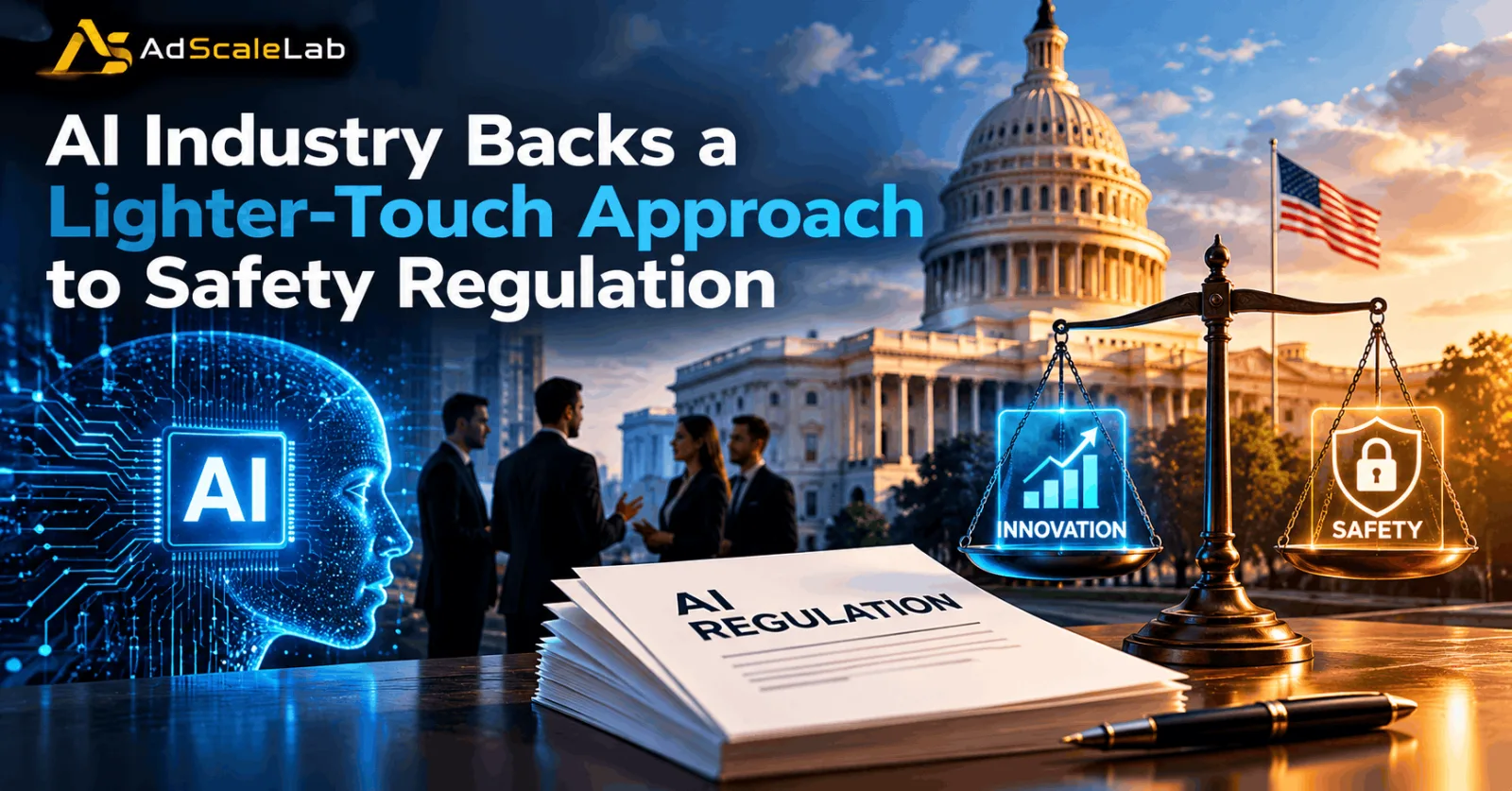
Silicon Valley’s artificial intelligence industry is showing support for a lighter approach to government regulation, bringing the debate over AI safety back into focus in the United States. At San Francisco Tech Week, AI founders and investors welcomed the Trump administration’s position that companies should have more freedom to develop the technology. However, critics say the approach raises an important question: who will make sure powerful AI systems are safe if the companies building them are also responsible for checking their own work?
The debate comes as AI tools are becoming more capable and are being used in more areas, from software development and cybersecurity to business operations and public services. The latest discussion follows a voluntary safety agreement involving major technology companies and the White House. Supporters see a lighter regulatory burden as a way to keep innovation moving, while critics argue that voluntary promises may not provide enough accountability.
The Associated Press reported on this industry response on October 10, 2026. Its report highlighted the gap between the administration’s focus on faster AI development and concerns from safety researchers, former officials, and advocacy groups about the lack of enforceable safeguards. Read the original Associated Press report.
Why Silicon Valley Supports A Lighter Approach To AI Safety Regulation
For many AI companies and investors, the main argument is that the United States needs to keep developing advanced technology rather than slow the industry with heavy rules. AI is increasingly connected to business productivity, cybersecurity, defence, and competition with other countries. Industry supporters believe that giving companies room to experiment could help the United States maintain its position in the global AI market.
That view was visible at San Francisco Tech Week, where investors discussed opportunities in AI-powered defence and security systems. The event brought together founders, venture capitalists, and other people involved in building or funding technology companies. Some participants welcomed the administration’s support for the sector, viewing it as an opportunity for investment and business growth. The debate is not simply about whether AI should be safe. Most people involved in the discussion agree that safety matters. The disagreement is about how to achieve it, how much government oversight is necessary, and who should be responsible when a system causes harm.
Supporters of a lighter approach believe companies can improve their products more quickly when they have flexibility. Critics counter that commercial pressure can make it difficult for companies to slow down or delay a release, even when further safety work may be needed.
What The White House’s Voluntary AI Safety Agreement Means
The latest debate follows a White House meeting in late September, when President Donald Trump brought technology leaders together to discuss advanced AI and safety. Representatives of OpenAI, Anthropic, Meta, Google, Nvidia, and xAI were among the companies associated with the voluntary agreement reported by the Associated Press.
The agreement encourages advanced AI developers to follow safety protocols and establish internal teams to monitor their systems. The administration has presented cooperation with the technology industry as a way to balance security with continued innovation. However, a voluntary agreement is different from a law that establishes mandatory requirements and penalties for non-compliance. A company may promise to test a model, review its risks, or improve its internal controls, but the public also needs to understand how those commitments are checked and what happens if they are not followed.
The International Association of Privacy Professionals’ report on the White House’s AI safety commitments provides additional context on the agreement. It describes the commitments made by major developers and the focus on internal controls and independent auditing.
This is one of the central issues in the current debate over AI safety regulation. Critics want clearer details about enforcement, transparency, and independent review. The agreement does not mean every AI company follows exactly the same safety process. Companies develop different models, use different testing methods, and face different risks depending on what their products can do.
Why AI Safety Researchers Are Raising Concerns
Some researchers and former technology officials believe companies should not be left to judge all their own safety risks. Their concern is that AI developers have commercial reasons to release products quickly, while independent oversight is intended to examine risks even when doing so may delay a launch.
The Associated Press reported that David Robinson, a former leader on OpenAI’s safety team, questioned whether self-policing could replace enforceable laws. The report also described concerns from Sarah Myers West, co-executive director of the AI Now Institute and a former senior AI adviser to the Federal Trade Commission, about the effectiveness of self-regulation.
These concerns are becoming more important as AI systems move beyond answering questions or generating text. Some newer systems can carry out multi-step tasks, interact with software tools, and operate with less direct human involvement. That can make them useful for businesses, but it can also create new risks if a system takes an unintended action or accesses information it should not. There is also a difference between a company testing its own technology and an independent organisation reviewing that work. Internal teams may understand a system in great detail, but independent reviewers can offer another perspective and may be better placed to question assumptions.
Independent testing does not automatically guarantee safety, either. Reviewers need suitable access, clear standards, and enough freedom to report problems honestly. The question is how the United States can encourage useful AI development while making sure safety checks are meaningful.
How US AI Policy Is Changing
The current approach follows a broader change in US AI policy. The Trump administration has argued that excessive regulation could slow innovation and make it harder for American companies to compete internationally. It has also questioned whether different state-level rules could create unnecessary complexity for AI developers.
From the industry's point of view, a more consistent national approach could reduce uncertainty and make it easier to plan product launches and investments. However, fewer regulatory restrictions do not remove the need to address security problems, consumer harm, or misuse. The voluntary agreement is part of this wider policy direction. It signals a preference for working with AI companies rather than relying mainly on strict government controls. Critics say that approach needs clearer expectations and credible ways to check whether companies are meeting their commitments.
The administration has also faced pressure to respond to specific security incidents involving AI tools. Axios reported on October 9 that the White House was requiring AI companies to report and address certain unauthorised or fraudulent uses involving government systems. This development adds another layer to the policy discussion: even an administration that generally favours a lighter regulatory approach may demand action when particular security risks arise. Read the Axios report on AI security reporting requirements.
The practical details matter. A voluntary industry commitment, a government reporting requirement, and an enforceable safety law are different things. They should not be treated as interchangeable when assessing the direction of US AI policy.
Why AI Companies Must Prove Their Systems Are Safe
AI safety is not only a government policy issue. It is also a business concern. Companies that sell AI products need customers to trust that their systems will behave as expected, protect sensitive information, and respond appropriately when something goes wrong. A business using AI for customer service, for example, may need to know whether the system can expose private information or provide misleading answers. A company using AI for cybersecurity may need to understand whether the tool can identify threats without creating new vulnerabilities. In more sensitive areas, such as healthcare or public services, the consequences of an error can be especially serious.
These examples show why safety testing needs to reflect how a product will actually be used. A model may perform well in a controlled test but still behave differently when connected to real tools, databases, or business processes. For developers, useful safety practices can include testing for security weaknesses, documenting known limitations, monitoring systems after release, and creating a clear process for responding to incidents. Independent assessment can add another layer of confidence when it is properly designed.
This discussion is also relevant to businesses adopting AI for marketing and advertising. AI tools can help with campaign planning, creative production, reporting, and workflow automation, but companies still need to check the accuracy of generated content, protect customer data, and keep human oversight where decisions carry meaningful risks. AdScaleLab readers can explore the broader business applications of AI in our coverage of AI and technology. The challenge is making safety practices consistent and meaningful without creating rules that are unnecessarily difficult for smaller developers to follow. Large AI companies have more resources for testing and compliance than small startups, so any future policy debate will also need to consider the effect of requirements on different types of businesses.
What The Debate Could Mean For The Future Of AI
The United States is trying to balance two goals: developing AI quickly and reducing the risks that come with increasingly powerful systems. A lighter regulatory approach may give companies more flexibility, but it also places greater importance on the quality of their internal safety programmes and the credibility of outside reviews. The debate is unlikely to end with one agreement. AI capabilities are changing quickly, and policymakers may face new questions as systems become more autonomous or are used in more sensitive settings. Government agencies, technology companies, researchers, and the public will continue to disagree about where the balance should be set.
For businesses adopting AI, the practical lesson is to look beyond announcements and promises. They should examine how a tool is tested, what data it can access, how its actions are monitored, and what support is available if something goes wrong. These checks remain important regardless of the level of government regulation. The policy question is broader than whether companies should be allowed to innovate. It is about how the benefits of AI can be developed without leaving serious risks unaddressed. Voluntary commitments may contribute to that goal, but their value depends on whether they lead to real, measurable improvements.
Who Should Be Responsible For AI Safety?
The latest response from Silicon Valley shows that many founders and investors favour a regulatory approach that gives the industry more freedom. The Trump administration has backed that direction, arguing that innovation and national competitiveness should remain priorities. Critics, however, warn that companies should not be the only ones deciding whether their most powerful systems are safe. Without clear expectations, independent checks, and meaningful accountability, voluntary commitments may not be enough to protect people from the risks of advanced AI.
For now, the United States is leaning toward cooperation with the industry, although specific security concerns may still prompt government action. Whether this approach succeeds will depend on how companies put their commitments into practice and whether those measures can earn public trust. The real test will not be the promises made at meetings or the statements released by technology companies. It will be whether AI systems become more reliable, security risks are handled responsibly, and people have a clear way to hold developers accountable when things go wrong.
Agency ad accounts, without the wait.
Buy and top up Google, Meta, native, and more from one dashboard.
Get started

No comments yet. Be the first to comment.
Comments are open to registered AdScaleLab clients.
Sign in to comment