



Baidu Advertising Fell 19% and Why MediaGo Matters More
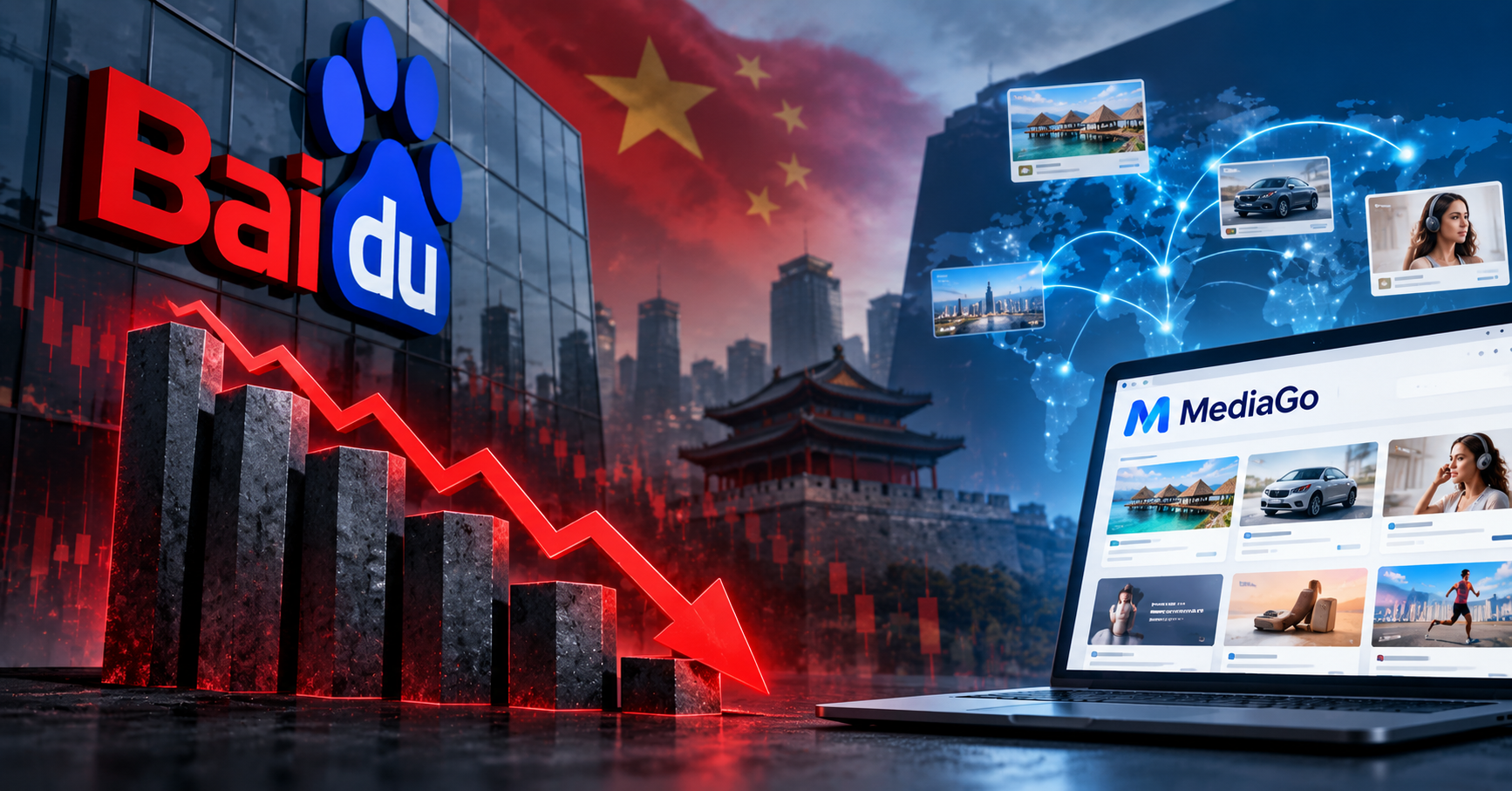
Baidu advertising revenue fell 19 percent in the second quarter of 2026. Online marketing services, the line that covers Baidu's search ads in China, brought in RMB 13.1 billion against RMB 16.2 billion a year earlier. The legacy portion of that business fell 23 percent.
If you buy ads on MediaGo, Baidu's international native platform, that number is worth understanding, because it explains a great deal about why MediaGo exists, how it is funded, and what Baidu needs it to become.
What the Baidu advertising numbers actually said
Baidu reported on 18 August for the quarter ended 30 June. Total revenue was RMB 31.325 billion, about $4.62 billion, down 4 percent year on year and 2 percent on the previous quarter. Analysts had expected RMB 31.96 billion, so it was a miss, and the stock fell 3.5 percent before the market opened.
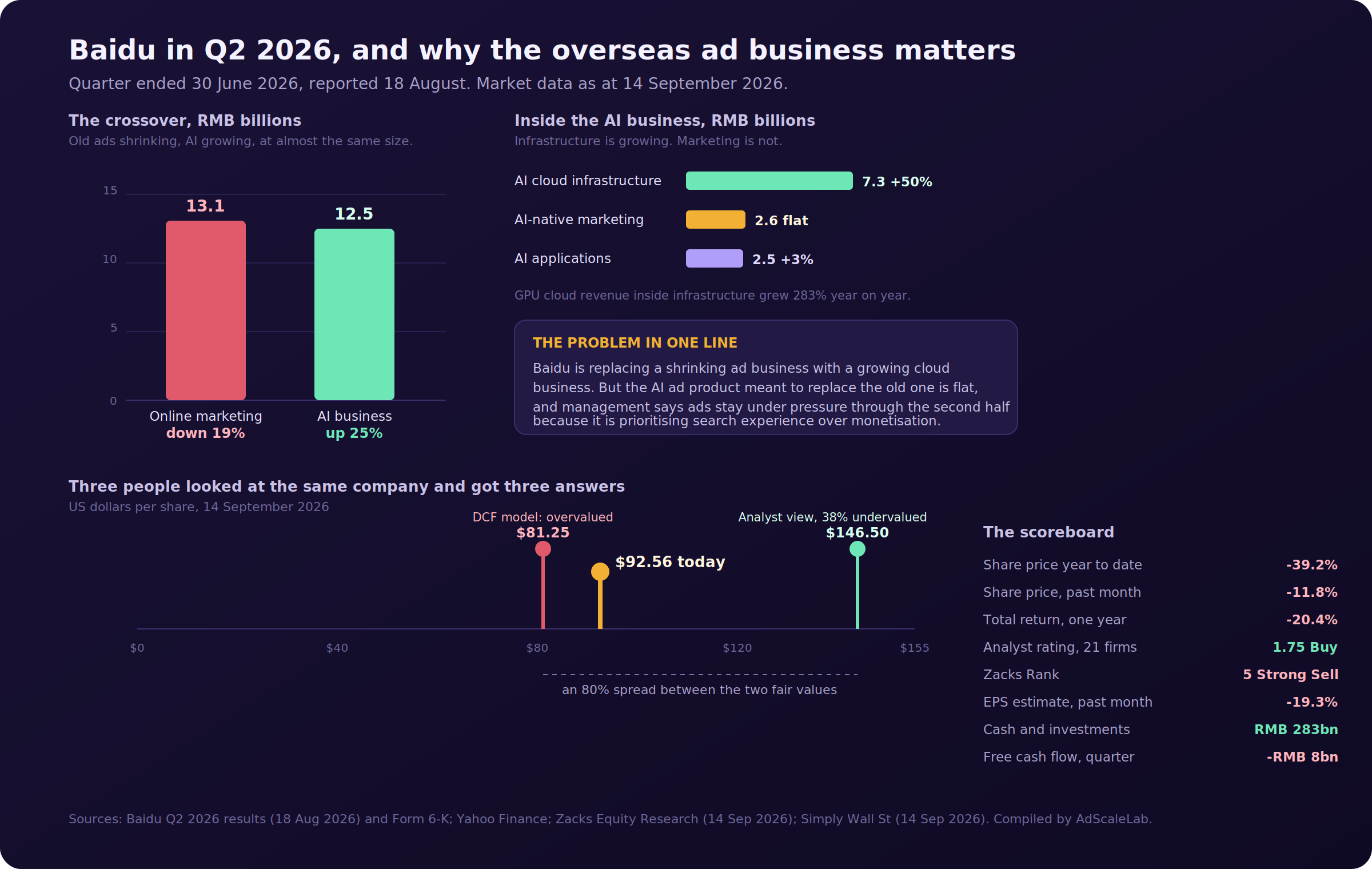
The split underneath is the story. Baidu Core revenue was RMB 25.183 billion, down 4 percent. iQIYI, the streaming business, was RMB 6.287 billion, down 5 percent. And online marketing, the traditional search advertising business, was RMB 13.1 billion, down 19 percent.
Against that, the AI business grew. Baidu's Core AI-powered Business reached RMB 12.5 billion, up 25 percent, and accounted for roughly half of Baidu Core revenue for the second quarter running. Inside it, AI cloud infrastructure was RMB 7.3 billion, up 50 percent, with GPU cloud revenue up 283 percent.
Net income attributable to Baidu was RMB 2.3 billion at a 7 percent net margin. Adjusted earnings per ADS were RMB 7.22, about 26 percent below what analysts expected, though adjusted operating profit and adjusted EBITDA both beat. Capital spending was RMB 11.4 billion and free cash flow was negative by about RMB 8 billion. Operating cash flow stayed positive at RMB 3.4 billion, the fourth consecutive quarter in the black. The company ended June with RMB 283.1 billion in cash and investments, roughly $40 billion.
Robin Li framed it as a transition from an internet-centric company to an AI-first company. The numbers support that framing. They also show the cost of it.
The detail almost nobody picked up
Look inside the AI business and one line does not behave like the others.
AI cloud infrastructure grew 50 percent. AI applications grew 3 percent to RMB 2.5 billion. And AI-native marketing services, which is the AI-powered advertising product meant to replace the old search ad business, came in at RMB 2.6 billion and was essentially flat year on year.
So the product designed to replace a business falling 19 percent is not growing. Baidu is replacing advertising revenue with cloud revenue, and cloud is a different business with different margins, different customers and different competitors. It has not yet replaced advertising revenue with better advertising.
Management was direct about the outlook. On the earnings call they said the advertising business is expected to remain under pressure in the second half, because the company is prioritising the AI search user experience over monetisation. The choice is deliberate and defensible. It also means the 19 percent decline is not a one-quarter event.
Two external causes sit underneath it. Reuters attributed the drop to China's prolonged property slump and weak consumer demand, which have pushed Chinese advertisers to cut budgets. And Baidu's own AI transformation removes ad slots from search results pages, which reduces inventory even where demand exists. Both pressures are domestic.
Why falling Baidu advertising makes MediaGo more important
Here is the connection that matters if you buy native ads.
MediaGo is Baidu's international advertising platform, operating under the Baidu Global brand since 2018. It sells programmatic and native advertising to more than 10,000 companies across North America, Europe, the Middle East, East Asia and Southeast Asia, and it runs 12 operational centres worldwide. Its inventory comes partly from Baidu's own overseas properties, including the Facemoji and Simeji keyboards, Simeji being the most popular keyboard app in Japan, plus preinstall deals with Xiaomi and Oppo, which together account for over 450 million users. Since 2022 it has also bought inventory through Microsoft's Xandr marketplace, and from January 2024 through Amazon Publisher Services, which is where its premium US publisher access comes from.
Baidu does not break out MediaGo's revenue. It is not large enough to appear separately in the results, and it sits within the international operations the company discusses only in risk-factor language.
But consider the position Baidu is in. Its domestic advertising business is shrinking by a fifth a year. Its replacement AI ad product is flat. It has $40 billion in cash. And it has an overseas advertising platform selling into US and European markets where ad spending is growing, not contracting.
A company in that position has every commercial reason to push hard on the one advertising business it owns that is not exposed to the Chinese property market. This is the strategic case for MediaGo, and it is stronger now than it was a year ago.
There is a second reason. MediaGo's marketing leans heavily on precision targeting without personal tracking, using page context and Baidu's machine learning models instead of following individuals around the internet. The domestic business is being rebuilt around the same technology, so the overseas platform benefits from AI investment Baidu would be making anyway. It won an artificial intelligence industry award for the approach in 2024.
The risk in the other direction
Be honest about the counter-argument, because it is real.
Baidu is spending enormous sums on AI infrastructure. Capital expenditure was RMB 11.4 billion in a single quarter and free cash flow was negative by roughly RMB 8 billion. In 2025 the company recorded RMB 16.2 billion of impairment on long-lived assets. A company under that kind of pressure reviews everything, and a small international advertising unit is not obviously protected.
The company's own risk disclosures are candid about the difficulty of overseas operations: forming local sales strategies for different cultures, finding and keeping local partners, depending on local platforms to market its products abroad, longer customer payment cycles, currency movements, and higher costs of doing business in foreign jurisdictions. Baidu is describing exactly the business MediaGo is in.
And Baidu's attention is visibly elsewhere. The earnings call spent more time on Apollo Go robotaxis in Dubai, London, Hong Kong and Shenzhen than on international advertising. The strategic priorities management named were AI cloud infrastructure, its Kunlunxin chips, Apollo Go, and the AI application portfolio. MediaGo did not make the list.
What the market cannot agree on
The valuation picture is worth a paragraph because it shows how unsettled the story is.
As of 14 September, Baidu trades around $92.56, having closed at $91.40 the day before. The shares are down 39.2 percent this year, down 11.8 percent in the past month, and the one-year total shareholder return is negative 20.4 percent.
Twenty-one brokerage firms cover the stock, and their average recommendation is 1.75 on a scale where 1 is Strong Buy. Fourteen of them rate it Strong Buy. The most followed valuation narrative puts fair value at $146.50, which would make the stock 38 percent undervalued.
At the same time, Simply Wall St's discounted cash flow model puts fair value at $81.25, which would make it 12.5 percent overvalued. And Zacks rates it Rank 5, Strong Sell, because the consensus earnings estimate for the current year has been cut 19.3 percent in a single month, to $5.66.
So the same company is simultaneously 38 percent undervalued on analyst targets and 12 percent overvalued on cash flow, with a Strong Buy average rating and a Strong Sell quantitative rank. An 80 percent spread between two fair value estimates is not normal. It reflects a business whose old engine is visibly failing and whose new engine has not yet proved it can carry the load.
One thing the company is doing about it: buying back stock. On 11 September Baidu repurchased 560,200 Class A shares on the Hong Kong exchange at between HKD 88.65 and HKD 90.00, for HKD 49.99 million. Under a mandate dated 26 August it can buy up to 273,356,149 shares and has so far bought 2,757,750, about 0.1 percent of issued shares.
What an advertiser should take from this
You are not buying the stock. You are deciding whether to run budget on a platform, and that is a different question with a simpler answer.
MediaGo is well funded and strategically useful to its parent. RMB 283 billion of cash and a domestic ad business in decline together make an overseas ad platform something Baidu wants to grow, not shut. The platform is not at risk in any near-term sense.
Its inventory does not depend on Baidu's Chinese business. MediaGo's US and European supply comes through Xandr and Amazon Publisher Services, plus its own app properties. None of that is affected by Chinese property developers cutting ad budgets.
The AI investment is real and it reaches the ad product. Whatever else is true about Baidu's spending, the machine learning work behind MediaGo's targeting is funded by a company pouring RMB 11.4 billion a quarter into AI.
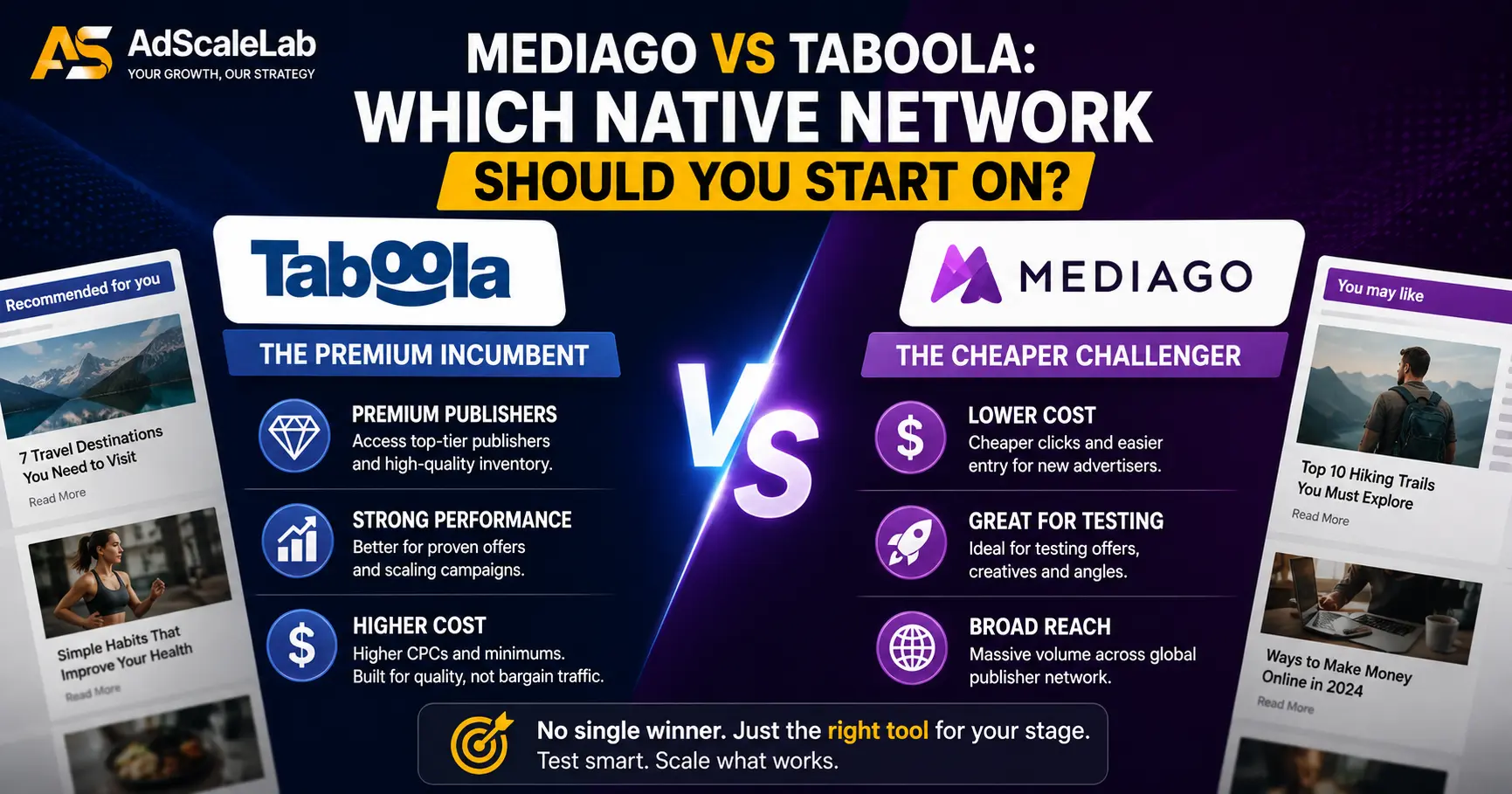
And the attention gap is still the opportunity. MediaGo claims more than a billion monthly users, roughly 70 percent of Taboola's reach, while attracting a tiny fraction of the search interest. Fewer advertisers bidding means the same budget buys more. We covered where it sits against the other platforms in our guide to the top native advertising networks.
The one thing to watch is whether Baidu's international unit gets caught in a cost review. Nothing suggests it is happening, but a company with negative free cash flow and RMB 16.2 billion of recent impairments is not a company with unlimited patience. If you are building a significant share of your media buying on MediaGo, keep a second native platform warm. Keeping a backup is sensible regardless of which network you favour, and this quarter is a reasonable reminder of why.
The short version
Baidu advertising revenue fell 19 percent to RMB 13.1 billion in Q2 2026, and management expects the pressure to continue through the second half because it is prioritising search experience over ad load. The AI business grew 25 percent, but the AI advertising product inside it was flat, so the replacement is coming from cloud, not from better ads.
For MediaGo, that makes the overseas platform more strategically valuable, not less. It is the one advertising business Baidu owns that is not exposed to the Chinese economy, it is funded by a company holding $40 billion in cash, and its inventory comes from Western marketplaces, not from Baidu's own declining domestic properties.
The market cannot decide whether the parent company is cheap or expensive. For an advertiser, the platform question is easier, and the answer for now is that MediaGo is safe, funded, and less crowded than the alternatives.
Agency ad accounts, without the wait.
Buy and top up Google, Meta, native, and more from one dashboard.
Get started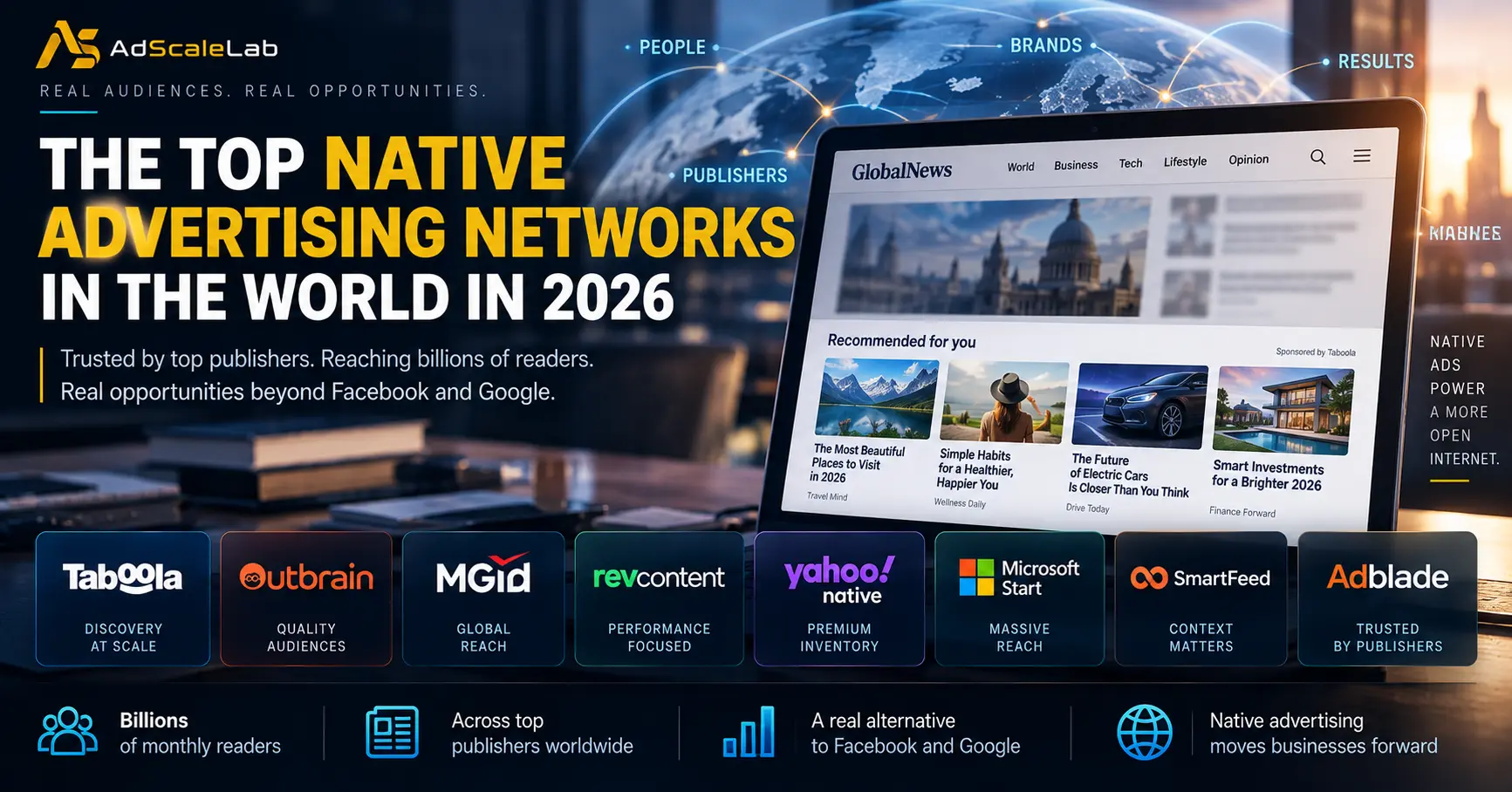
No comments yet. Be the first to comment.
Comments are open to registered AdScaleLab clients.
Sign in to comment