



How to Optimize Bing Ads AI Max for Better Search Performance
Search advertising is changing quickly, and Bing Ads AI Max is becoming part of that shift. People are no longer searching only with short keywords such as “running shoes” or “accounting software.” More searches now include longer questions, detailed descriptions and conversational language, especially as AI becomes part of the search experience.
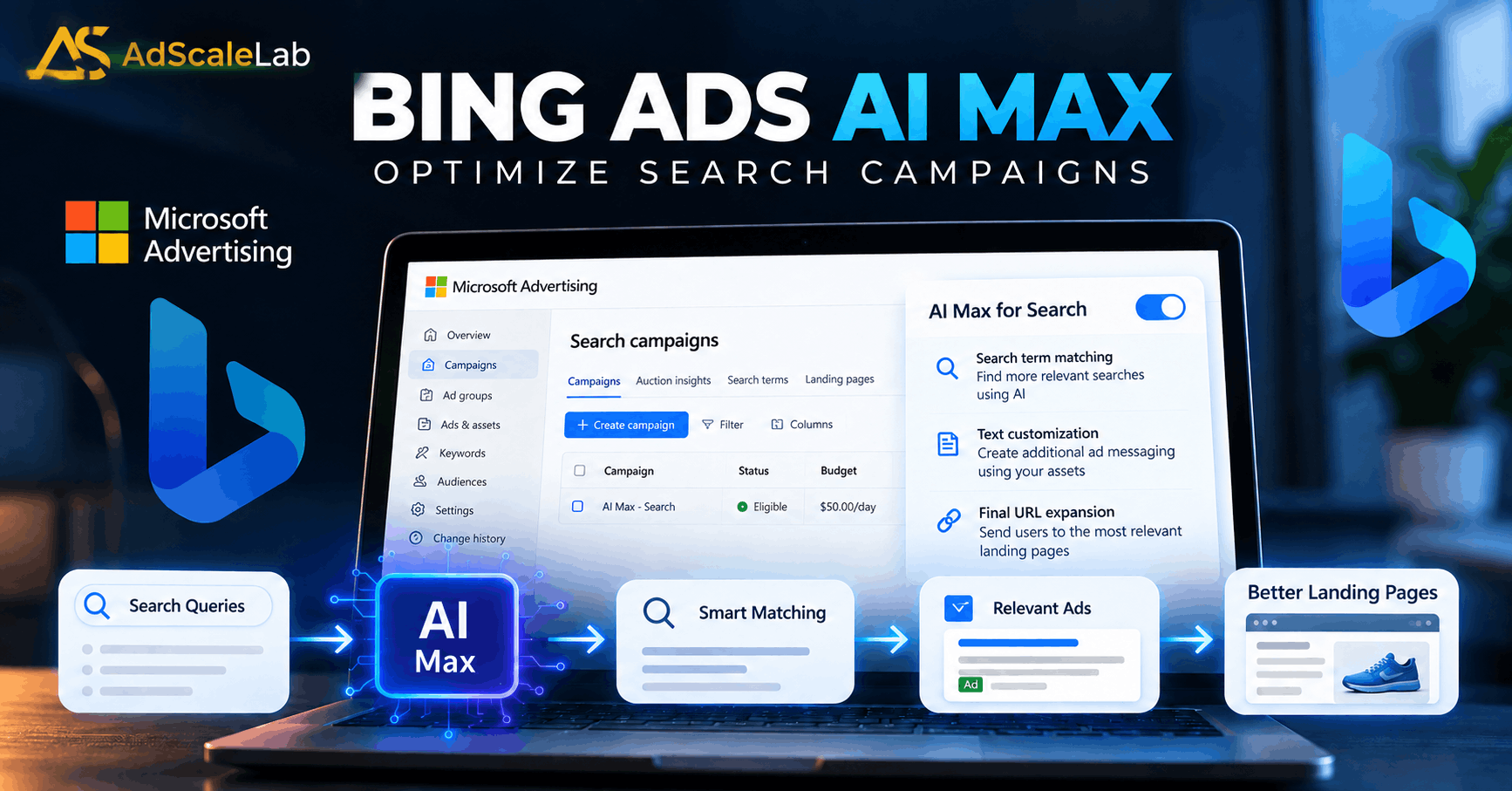
Microsoft Advertising is responding to this change with AI Max for Search campaigns. Microsoft made AI Max generally available in August 2026, bringing several AI-powered features into standard Search campaigns. These include search term matching, text customization and final URL expansion.
For advertisers, this creates a new way to manage Bing Ads campaigns. Instead of trying to manually predict every search a customer might make, advertisers can give Microsoft stronger signals and let AI help discover additional opportunities.
But that does not mean you can simply turn on AI Max and forget about the campaign. Your conversion tracking, website, campaign structure, ads and budget still matter. The real goal is to give AI Max good information and then use the available reports to understand what it is doing.
Here is how advertisers can approach Bing Ads AI Max and use it to improve search campaign performance.
What Is Bing Ads AI Max?
AI Max is not a completely separate advertising campaign. Microsoft describes it as an optional group of features that works inside Search campaigns. The system uses information from your keywords, ads, landing pages and other signals to understand search intent and find additional opportunities.
There are three main parts of AI Max. Search term matching helps expand reach beyond the keyword list. Text customization can create additional ad messaging using your existing assets and website content. Final URL expansion can send a user to a page that better matches what they were searching for instead of always sending everyone to one fixed landing page. These features are designed to work together. A broader search match can find a new query, text customization can create a more relevant message for that query, and final URL expansion can connect the visitor with a more suitable page.
This is important because the customer journey is becoming less predictable. A user may start with a general search, ask a more detailed question and then visit a specific product or service page. AI Max is designed to help advertisers respond to that type of changing search behavior.
How to Optimize Bing Ads With AI Max Step By Step
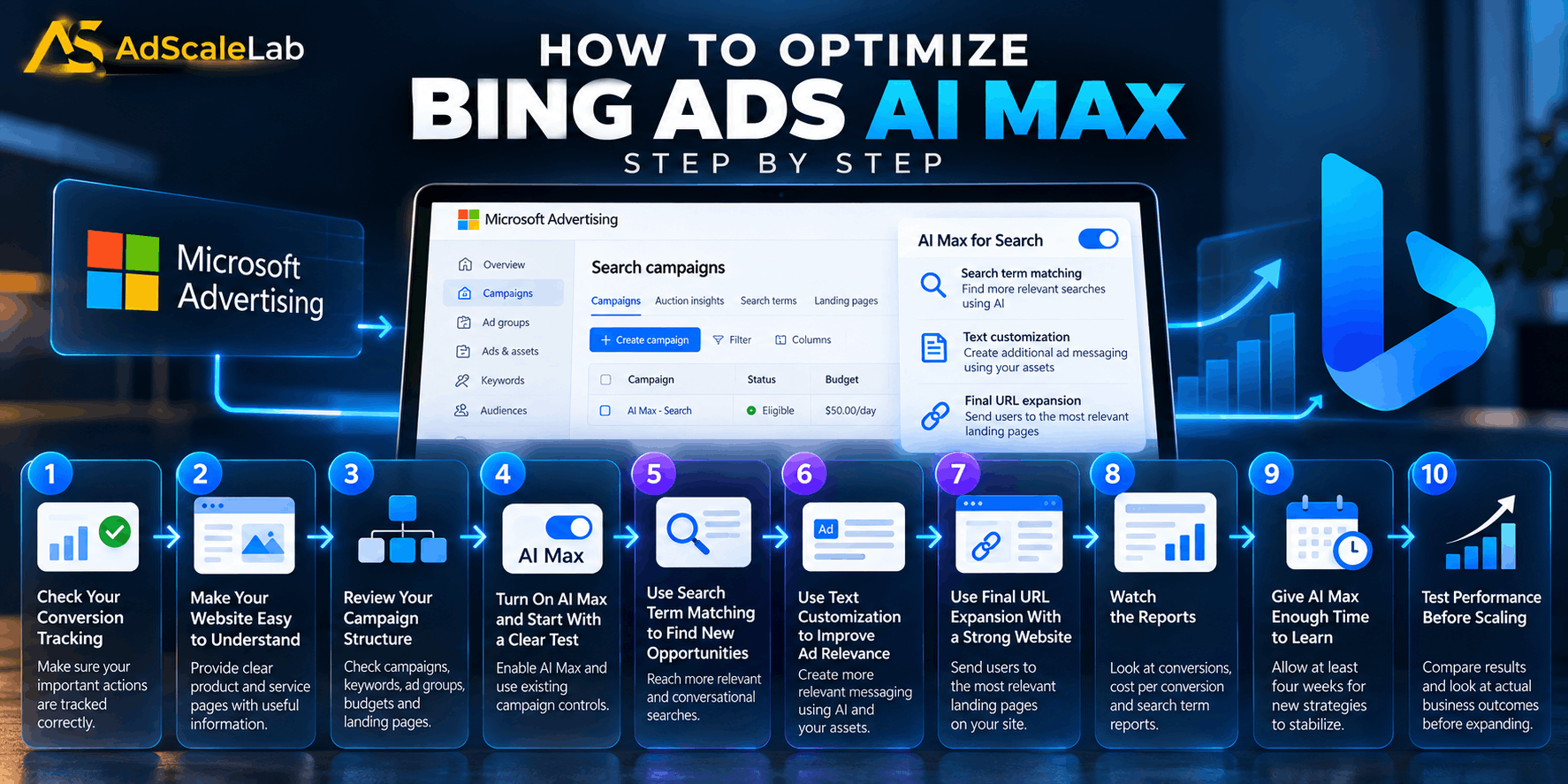
Step 1: Check Your Conversion Tracking Before Using AI Max
Before changing anything in your campaign, check your conversion tracking. This is one of the easiest things to overlook when testing a new advertising feature. AI-powered bidding and optimization need useful signals. If purchases, leads or other important actions are not being recorded correctly, you may make decisions based on incomplete information.
For an ecommerce business, the most important conversion may be a completed purchase. For a B2B company, it could be a completed form or a qualified lead. The right conversion depends on what the business is actually trying to achieve.
Microsoft's recent guidance also puts strong emphasis on measurement readiness. The company recommends connecting the signals that show which customer interactions create value before relying heavily on automated campaign optimization.
So, test your conversion goals before switching on AI Max. If the data is wrong, more automation will not solve the basic problem.
Step 2: Make Your Website Easy For AI Max To Understand
Your website plays a bigger role in AI-powered advertising than many advertisers realize. Microsoft says AI Max's search term matching can use keywords, ads, landing pages and contextual signals to uncover relevant searches. That means your website should clearly explain what your business sells and who it is for. Product and service pages should contain useful information instead of relying on vague marketing language.
For example, imagine a company selling running shoes. Its website could have separate pages for road running shoes, trail running shoes, beginner shoes and racing shoes. Each page gives Microsoft more useful information about the products and the type of customer they are designed for.
This can also help the customer. If someone searches for trail running shoes and reaches a relevant trail-running page instead of a general homepage, they have less work to do before finding what they need. Before using final URL expansion, therefore, check your website carefully. Make sure important pages load properly, contain accurate information and give visitors a clear next step.
Step 3: Review Your Existing Campaign Structure
AI Max works with your existing Search campaigns, so it is worth reviewing the campaign structure before making the change.
Look at your campaigns and ask whether each one has a clear purpose. Check the keywords, ad groups, conversion goals, budgets and landing pages. If you have many small campaigns targeting almost the same audience, you may also want to consider whether they are receiving enough data.
Microsoft's September 2026 guidance says campaigns with fewer than 30 conversions in 30 days may provide less data for bidding strategies and can experience more volatility. It recommends consolidating fragmented campaigns when appropriate so automated systems have stronger signals to work with. This does not mean every campaign should be combined. Different products, locations or business goals may need separate campaigns.
The important thing is to avoid creating unnecessary fragmentation. AI Max needs useful information to learn from, and spreading a small amount of data across too many campaigns can make optimization harder.
Step 4: Turn On AI Max And Start With A Clear Test
Once tracking and campaign structure are ready, you can begin testing AI Max.
Microsoft says AI Max is now generally available for Search campaigns and can be found in the Search campaign setup and settings. Microsoft also says the features can be used together and that advertisers can test and guide the system using existing campaign controls.
The important word here is test.
Do not assume that every new search or automatically generated ad will improve performance. Give the system room to find opportunities, but continue reviewing what happens after the feature is enabled. AI Max still works within campaign boundaries such as negative keywords, budgets, bidding strategies, conversion goals and targeting settings. Microsoft also provides additional controls such as brand inclusions, brand exclusions and term exclusions.
This gives advertisers a useful balance. You can allow AI to explore more opportunities while still maintaining control over what the campaign can do.
Step 5: Use Search Term Matching To Find New Opportunities
One of the most important parts of AI Max is search term matching. Traditional keyword planning depends heavily on the phrases an advertiser expects customers to search.
Real customers do not always use those exact phrases.
For example, a company selling accounting software might target “small business accounting software.” But a customer could search for something much longer, such as “what accounting software is easiest for a small company with five employees?”
Microsoft says AI Max can use campaign information and contextual signals to discover relevant searches, including more complex and conversational queries. This is particularly useful as people use AI-powered search experiences in addition to traditional search. However, broader matching should still be monitored. Once the campaign starts collecting data, look at the searches that are generating traffic and conversions.
Some new queries may reveal valuable demand that you had not considered before. Others may be unrelated to your business. If a search repeatedly produces poor-quality traffic, use the available exclusions and negative keyword controls rather than allowing the same problem to continue.
The goal is not simply to get more searches. It is to find more relevant searches.
Step 6: Use Text Customization To Improve Ad Relevance
The second major part of AI Max is text customization. Microsoft says its AI can use existing advertiser assets and website content to create additional messaging variations and select combinations at auction time.
This can be useful when different customers search for the same product in different ways. For example, one person may care about price while another may care about speed, quality or a specific feature. A single fixed message may not communicate the same value to every searcher.
Text customization gives the system more flexibility to adapt the messaging. But advertisers should still create strong original assets. Your headlines and descriptions should clearly explain the product, service, offer or benefit before AI starts generating additional variations.
It is also important to review what is being generated. Microsoft provides an asset report where advertisers can review AI-generated assets alongside their own creative. The platform also provides controls for excluding terms from generated text. This is useful because your brand should not depend entirely on automatic messaging. AI can create variations, but the advertiser remains responsible for making sure those messages are accurate and appropriate.
Step 7: Use Final URL Expansion With A Strong Website
Final URL expansion is the third major AI Max feature. Instead of always sending every visitor to the same landing page, Microsoft can select a page on your website that it believes better matches the user's intent.
This can be helpful when a business has many different products or services. Imagine someone searches for “business laptop under $1,000.” If your advertisement always sends that person to a general electronics homepage, they still need to find the right products themselves.
A website with a dedicated business laptop page gives AI Max a better destination to work with. But final URL expansion makes website quality even more important. Check that your important pages are up to date, mobile-friendly and closely connected to the products or services you advertise.
Microsoft has also introduced a search term landing page report that helps advertisers see how search queries are being connected to landing pages. The report can include information such as the search term, final URL, campaign, ad group, headline, match type and performance data.
This makes it easier to understand where your traffic is actually going.
Step 8: Watch The Reports Instead Of Looking Only At Clicks
After enabling AI Max, avoid judging the campaign only by impressions, clicks or CTR.
Those numbers can tell you whether people are interacting with your ads, but they do not necessarily tell you whether the campaign is creating business value.
Look at conversions, conversion rate, cost per conversion and conversion value as well. Then compare those numbers with the searches and landing pages that generated the traffic.
Microsoft has added specific reporting features for AI Max. Advertisers can see an “AI optimized” match type label in search term and keyword reports, review AI-generated assets and use the search term landing page report to understand URL routing. These reports are useful because automation can otherwise feel like a black box.
You want to know not just that performance changed, but also what kind of searches, ads and landing pages were involved.
Step 9: Give AI Max Enough Time To Learn
One common mistake with automated advertising is making too many changes too quickly.
An advertiser turns on AI Max, waits two days, sees a high CPA and immediately changes the budget, bidding strategy, keywords and landing page. After another few days, the campaign changes again.
That makes it difficult to understand what actually worked.
Microsoft's September 2026 guidance recommends allowing at least four weeks for new bidding strategies to stabilize. It also recommends keeping budget and target changes modest rather than making large changes repeatedly. This does not mean you should ignore the campaign for four weeks. You should still fix serious problems quickly, such as broken tracking, irrelevant traffic or a landing page that is not working.
But if everything is functioning correctly, give the campaign enough time to collect useful information before making major decisions.
Step 10: Test Performance Before Scaling
Once you have enough data, compare the results instead of relying on assumptions.
Microsoft has reported its own early AI Max testing results. Its internal analysis of 44 advertiser-run A/B experiments from June through August 2026 showed a spend-weighted conversion uplift of approximately 13.6% for the advertisers tested. Microsoft also reported that 10 experiments produced statistically significant positive results, with the lower confidence interval at 8.2%.
These numbers are useful context, but they should not be treated as a guarantee for every advertiser. They are Microsoft's internal results from the advertisers and experiments included in that analysis. Your own campaign can behave differently because every account has different products, audiences, budgets, conversion rates and website experiences.
That is why testing matters. If your account has enough traffic, use experiments or a controlled comparison where possible and look at the actual business results before expanding the approach across every campaign.
What Should You Check After Launch?
Once your Bing Ads AI Max campaign has been running for some time, create a simple review process.
Start with search quality. Look at the searches AI Max is finding and ask whether they represent the type of customer you actually want.
Then look at conversions. A search that generates hundreds of cheap clicks may still be less valuable than a smaller number of searches that bring customers who are ready to buy. Landing pages deserve attention too. If AI Max is sending traffic to different pages, check whether those pages actually match the searches that brought people there. You should also review the generated ad assets. If the system creates a message that does not match your brand or makes a claim you cannot support, use the available controls to prevent that type of messaging.
Finally, look at the overall campaign rather than one metric. Search term quality, conversions, cost per conversion, conversion value and landing-page performance together provide a much clearer picture than CTR alone.
Common Bing Ads AI Max Mistakes To Avoid
The first mistake is turning on AI Max before fixing conversion tracking. If your important actions are not recorded correctly, you will have a difficult time judging the campaign.
Another mistake is assuming that AI means no human involvement is required. AI Max can expand matching, create messaging and choose landing pages, but advertisers still need to review performance and maintain campaign controls. A weak website can also limit the value of the feature. AI Max has more useful information to work with when your website clearly explains your products, services and customer benefits. It is also a mistake to judge the campaign only by clicks. More traffic is not automatically better traffic. The important question is whether that traffic produces useful actions for the business.
Finally, avoid changing everything at once. If you change the budget, bidding strategy, keywords and landing pages at the same time, you may not know which change caused the performance difference.
The Bigger Picture For Bing Ads
AI Max is arriving at a time when search itself is becoming more conversational.
Microsoft says average query length in the U.S. increased by 14% between Q1 and Q2 2026 based on its first-party data. The company also says AI-powered experiences are changing how people research and make decisions.
This does not mean traditional search has disappeared. People still use normal search queries, keywords and websites. The bigger change is that advertisers now have to account for more ways in which people express their intent.
AI Max is Microsoft's attempt to bring those different types of searches into the existing Search campaign structure. Instead of requiring advertisers to manually predict every possible query, it gives the system more flexibility to interpret intent and connect the search with an ad and landing page.
For advertisers, this makes the quality of the information they provide even more important. Good conversion data, useful website content, strong advertising assets and clear campaign goals give AI Max better material to work with.
Final Thoughts
Bing Ads AI Max gives Microsoft Advertising users a new way to approach Search campaign optimization. Its three main features — search term matching, text customization and final URL expansion — are designed to help advertisers find additional relevant searches, create more suitable messaging and connect users with more relevant pages.
But AI Max should not be treated as a button that automatically fixes a campaign. Start by making sure your conversion tracking works. Then review your campaign structure and website before giving AI Max room to expand search matching and adapt your ads. Once the campaign is running, use Microsoft's reporting tools to understand which searches are being found, which assets are being generated and where visitors are being sent.
Most importantly, judge the results based on business outcomes rather than simply looking for more clicks.
The future of Bing Ads is likely to involve more automation, but advertisers still have an important job. The better the signals, website content and controls you provide, the easier it becomes to guide that automation toward useful results.
Agency ad accounts, without the wait.
Buy and top up Google, Meta, native, and more from one dashboard.
Get started

No comments yet. Be the first to comment.
Comments are open to registered AdScaleLab clients.
Sign in to comment