



Google Analytics Hostname Filters What Advertisers Need to Know
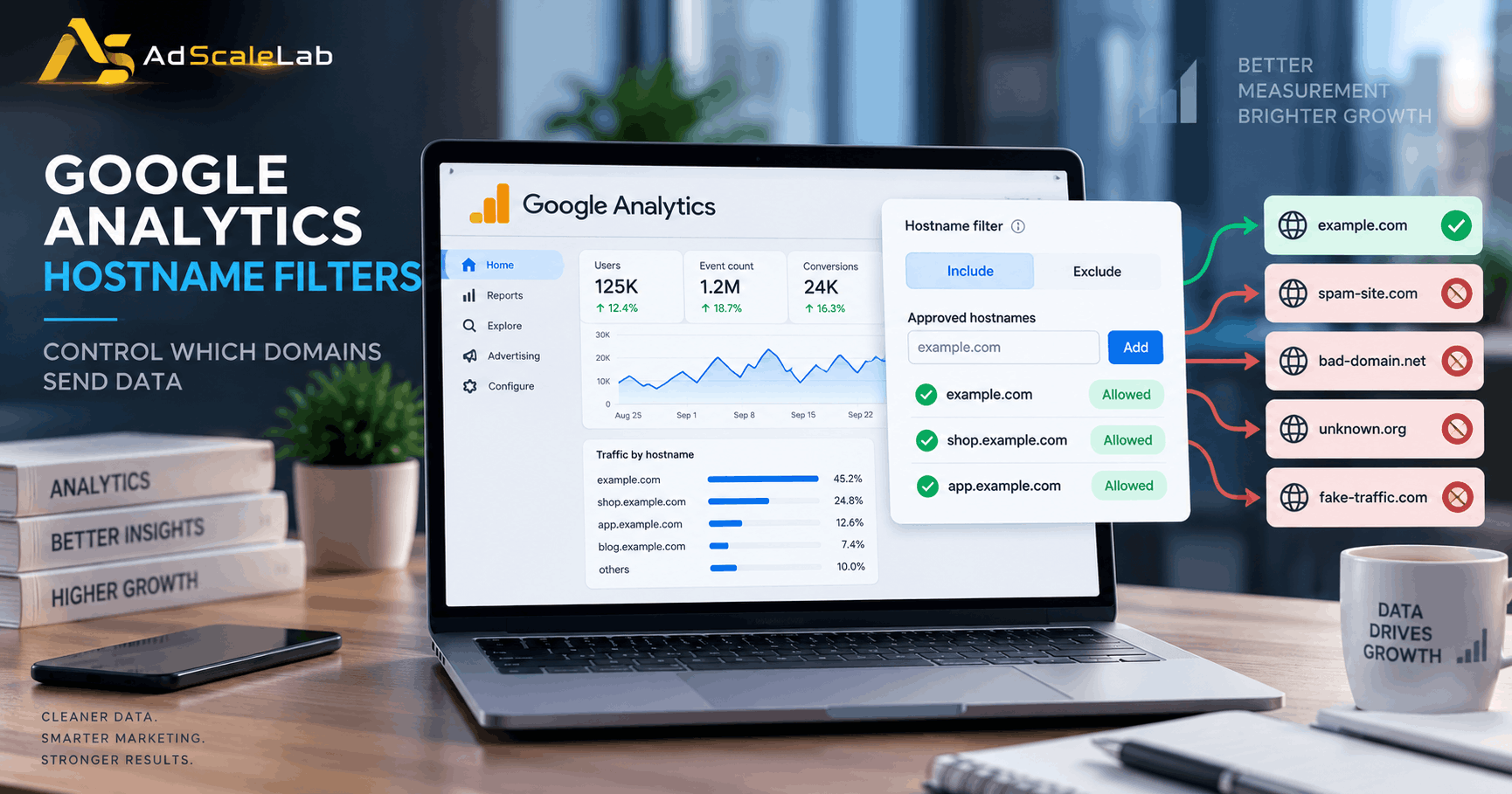
Google Analytics hostname filters are becoming more important for advertisers as websites collect data from more places and campaigns become harder to measure cleanly. Google has introduced an Include option for hostname data filters, giving Analytics users a way to allow approved domains instead of only trying to block unwanted domains one by one.
The change matters because advertising decisions depend on reliable measurement. If event data reaches a Google Analytics property from domains that should not be sending data, reports can become harder to understand. Advertisers may see activity that does not belong to the website they are actually measuring, which can make traffic and conversion analysis less clear.
Google announced the hostname filter update in its Google Analytics release notes on September 21, 2026. The new Include mode allows users to create a list of approved hostnames that are authorized to send event data to a Google Analytics property. This is different from the earlier Exclude approach, where users had to identify and block unwanted sources individually. For advertisers, the change is less about adding another technical setting and more about improving the quality of the data used to make marketing decisions.
What Are Google Analytics Hostname Filters?
A hostname is the domain or website address associated with a request that sends data to Google Analytics. For a normal website, this could be the main domain where visitors read pages, submit forms, or complete purchases. Google Analytics data filters are designed to control which incoming event data is processed. Google already provides filters for situations such as internal traffic and developer traffic. Hostname filtering adds another way to control the web sources that are allowed to contribute data.
The new Include option works like an allowlist. Instead of starting with every hostname and trying to remove unwanted ones, an advertiser can specify which hostnames are approved. Data from hostnames outside that approved list can then be excluded from processing. This can be useful when a business knows exactly which domains should be sending website event data to its Analytics property.
Why Google Added The Include Option
Before the new Include option, hostname filtering was mainly based on exclusion. That approach can work, but it can also require regular maintenance.
Imagine a business discovers that an unexpected hostname is sending event data into its Analytics property. The business can create an exclusion rule for that hostname. If another unwanted hostname appears later, another rule may be needed. Google's new Include option changes that approach. Rather than continually adding new unwanted hostnames to an exclusion list, an organization can define the hostnames it actually trusts.
Google's September 21 release notes explain that the new Include data filter lets Analytics users allowlist approved domains authorized to send event data. Google also noted that the earlier filtering approach required ongoing manual updates as new unwanted sources appeared. That makes the update particularly relevant to businesses that want tighter control over the data entering their Analytics properties.
Why This Matters For Advertisers
Advertisers use Analytics data to understand where users come from, what they do on a website, and whether campaigns are producing useful actions. If the underlying data contains activity from unexpected sources, the reports can become more difficult to interpret.
This does not automatically mean that every unexpected hostname represents fraud or malicious activity. There can be legitimate technical reasons why data appears from more than one hostname. A company may use several domains, subdomains, checkout systems, testing environments, or other web properties.
The important question is whether those hostnames belong in the Analytics property. For an advertiser, a clean data set makes it easier to connect campaign traffic with meaningful website behavior. It can also make reporting easier to review when teams compare paid traffic, organic traffic, referrals, conversions, and other acquisition sources.
The hostname filter therefore fits into a wider measurement process. It does not replace campaign tracking, conversion setup, attribution analysis, or regular data checks. Instead, it gives teams another control for deciding which web sources are allowed to contribute event data.
Include vs. Exclude: How The Two Approaches Differ
The difference between Include and Exclude is simple.
An Exclude filter removes data that matches a rule. If an advertiser knows that a certain hostname should not contribute data, the hostname can be excluded. An Include filter works in the opposite direction. It defines the hostnames that are allowed. This can be useful when a business has a clear list of trusted websites and wants to reject data from hostnames outside that list.
The right configuration depends on how a website is built and how its Analytics property is used. A company with several legitimate domains should not create an allowlist without checking those domains first. This is important because Google Analytics data filters are applied to incoming data from the point the filter is created. Google states that data filters do not change historical data. Google also explains that once data is excluded by a data filter, it is not available in Analytics or BigQuery.
That means hostname filtering should be treated as a data-quality configuration rather than something to switch on without checking the possible effect.
How Advertisers Should Approach Google Analytics Hostname Filters
Step 1: Identify The Hostnames That Should Send Data
The first step is to understand the website structure. Advertisers should identify the main website, relevant subdomains, checkout pages, landing-page domains, and any other legitimate hostnames that are intentionally connected to the Analytics property.
This is especially important for companies that operate several websites or use separate domains for different parts of the customer journey. The goal is to create an accurate picture of which hostnames are expected. The approved list should be based on the actual implementation rather than assumptions.
Step 2: Check Existing Analytics Data
Before changing a filter, advertisers should review their current Analytics data and look for unexpected hostnames.
This can help reveal whether a property is receiving data from domains that the business does not recognize. At the same time, an unfamiliar hostname should not immediately be treated as unwanted. It should be investigated first because some technical setups can create legitimate hostname variations. This review is also useful for finding configuration mistakes. A hostname that looks unusual may belong to a staging environment, payment flow, embedded experience, or another part of the website architecture.
Step 3: Decide Whether Include Or Exclude Fits The Setup
Once the hostname structure is understood, the advertiser can decide how to configure the filter.
An organization with a small and clearly defined group of approved hostnames may find the Include approach useful. A business with a more complex setup may need to review how its domains, subdomains, and third-party systems work before applying an allowlist. The key point is that the filter should reflect the actual website structure.
Step 4: Test The Configuration Carefully
Data filters can have permanent effects on the data they exclude. Because historical data is not changed by the filter, and excluded data is not available after processing, advertisers should review the configuration before activating it.
Teams should also remember that Measurement Protocol traffic has different behavior. Current reporting around the new hostname filter has noted that Measurement Protocol hits are exempt from the hostname filtering behavior. This makes it important to understand the technical source of incoming events instead of assuming that every event will behave exactly the same way.
Step 5: Keep Monitoring Data Quality
A hostname filter is not a complete Analytics maintenance strategy.
Advertisers should continue checking their data, conversion tracking, internal traffic settings, developer traffic settings, and other measurement controls. Google also recommends reviewing data quality and using appropriate controls for unwanted internal or developer traffic. The broader goal is to make sure that the data used for advertising decisions represents real customer activity as accurately as possible.

What Google Analytics Hostname Filters Do Not Do
Google Analytics hostname filters should not be treated as a universal solution for advertising fraud, spam, or poor campaign performance.
The filter controls whether event data from certain hostnames is processed. It does not determine whether a visitor is a real customer, whether a click came from a high-quality advertising placement, or whether a campaign is profitable. It also does not replace proper conversion tracking.
An advertiser can have perfectly clean hostname data and still have problems with campaign targeting, landing-page performance, creative quality, attribution, or conversion rates. Hostname filtering is one part of the measurement system. This distinction matters because data quality and advertising performance are related, but they are not the same thing.
How This Connects To Advertising Measurement
Digital advertising depends heavily on measurement. Advertisers need to know which campaigns generate visits, engagement, leads, purchases, or other valuable actions. That is why changes to analytics infrastructure can matter even when they are not directly related to an advertising platform.
For example, a business may use native advertising networks, paid search, social advertising, or other channels to bring visitors to its website. If the Analytics property is receiving unexpected event data, the reporting layer can become harder to interpret. Keeping the measurement system clean therefore supports the work advertisers already do across different channels.
For readers working with native advertising, AdScaleLab also covers broader advertising network topics in its guide to native advertising networks. For a comparison of two major native platforms, see MediaGo vs Taboola. And for a broader discussion of campaign performance, see why native ads don't work for most advertisers.
The Bigger Picture For Advertisers
Google Analytics hostname filters are a small technical change, but they fit into a larger shift toward better control over marketing data.
Advertisers are increasingly expected to understand not only how much traffic a campaign generates, but also whether the data behind that traffic can be trusted. As measurement systems become more complicated, small configuration choices can have a direct effect on how reports are interpreted. The new Include hostname filter gives Analytics users another way to control incoming web event data. For businesses with clearly defined domains, it can provide a more direct method of deciding which hostnames are authorized.
At the same time, the feature should be implemented carefully. Advertisers need to understand their website structure, review existing data, identify legitimate hostnames, and consider how the filter will affect future data before making changes. The main lesson is simple: better advertising decisions start with better measurement. Google Analytics hostname filters do not solve every data problem, but they give advertisers another tool for keeping their Analytics properties focused on the web sources that actually belong there.
Agency ad accounts, without the wait.
Buy and top up Google, Meta, native, and more from one dashboard.
Get started


No comments yet. Be the first to comment.
Comments are open to registered AdScaleLab clients.
Sign in to comment