



Taboola Returned to Profit in Q2 2026, So Why Did the Stock Drop 18%?
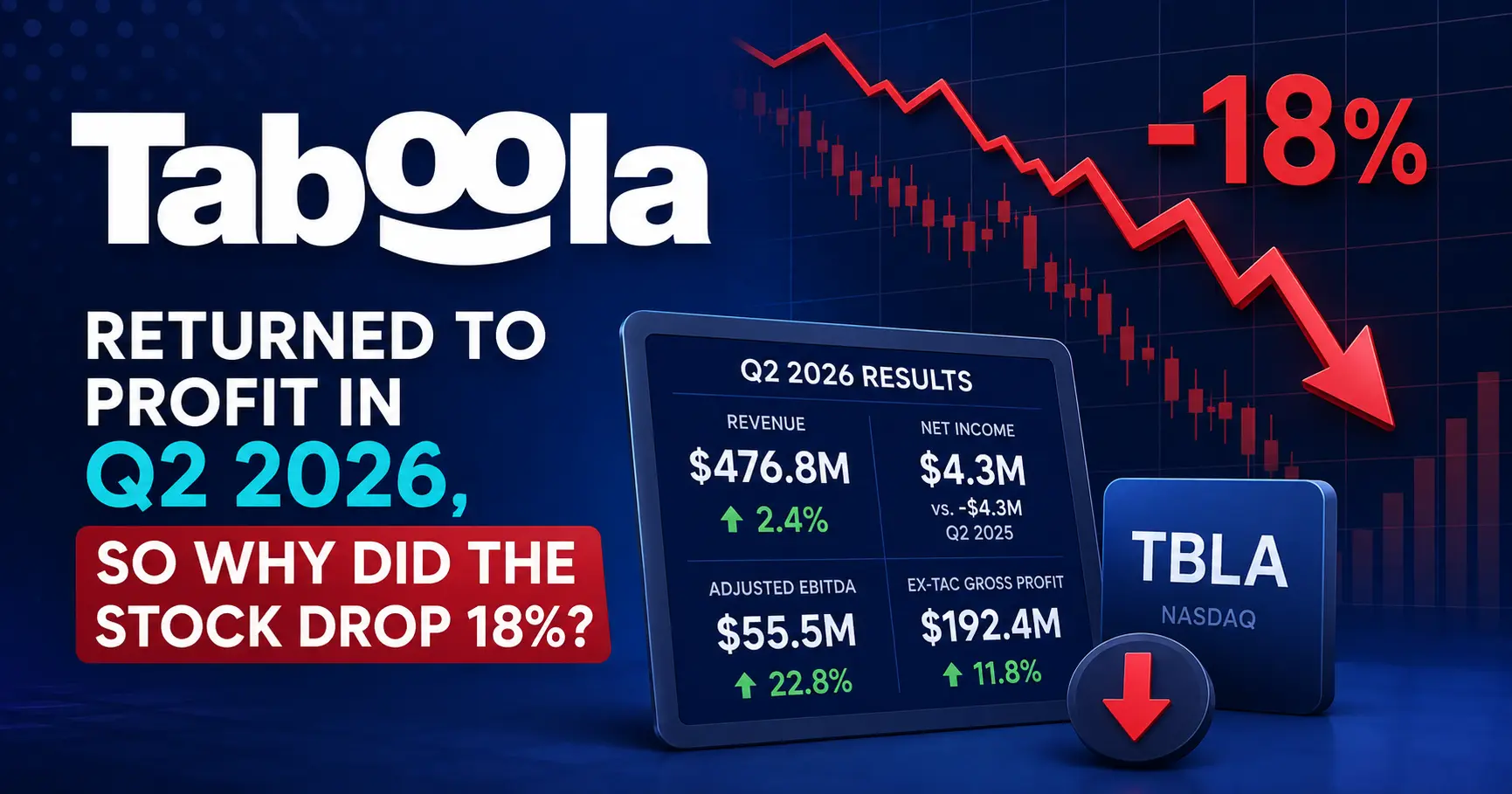
On August 5, 2026, Taboola reported its second quarter results and swung from a loss a year ago to a real profit. Normally that is good news. Yet the stock fell about 18% right after. Here is a plain look at what actually happened, and what it means if you run traffic on the platform, especially through Taboola agency accounts.
The headline numbers
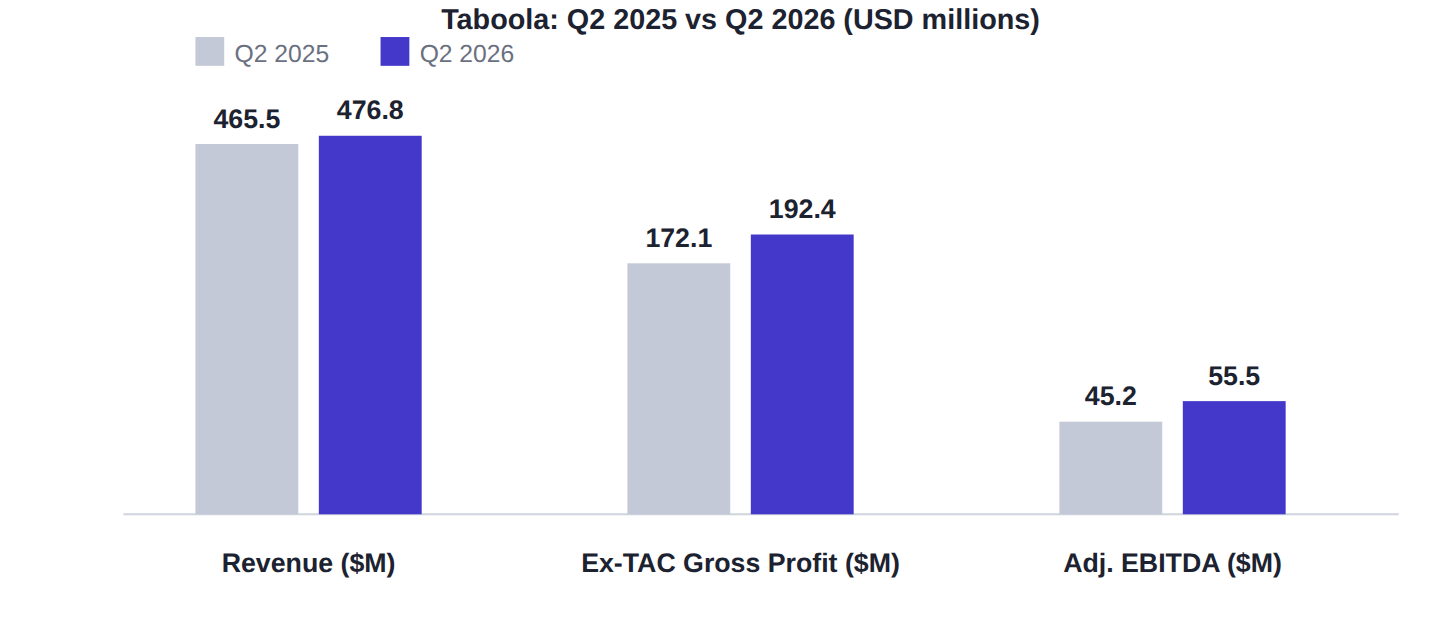
Taboola (Nasdaq: TBLA) posted revenue of $476.8 million for the quarter that ended June 30, 2026. That is up 2.4% from the same quarter a year earlier. The bigger story is the bottom line. The company reported net income of $4.3 million, a clear turn from a net loss of $4.3 million in the same quarter of 2025. Earnings per share came in at one cent, versus a one cent loss the year before.
Profit measures the market watches closely looked even better than revenue. Ex-TAC gross profit, which strips out what Taboola pays publishers for traffic, rose 11.8% to $192.4 million. Adjusted EBITDA jumped 22.8% to $55.5 million, and that margin widened to about 28.8%. So the business made more money on every dollar it kept, not just a little more revenue.
So why did the stock fall?
This is the part that confuses people. The company returned to profit and even raised its full year guidance for ex-TAC gross profit and adjusted EBITDA, and the stock still dropped about 18%. A few things explain it.
First, revenue growth was slow. A 2.4% rise is thin for a company that investors want to see re-accelerate. When a stock is priced for faster growth, a modest number disappoints even if profit improves.
Second, the cash picture softened. Operating cash flow fell to $31.3 million and free cash flow nearly halved to about $17.3 million for the quarter. Strong profit on paper matters less to some investors if the cash coming in the door slows down.
Third, the full year revenue guidance of $1.93 billion to $1.96 billion was steady rather than exciting. The most hopeful investors had been leaning on the Realize platform and AI tools to lift growth faster than that. Steady guidance against high hopes tends to bring a stock down.
What Realize and the Fox News win tell us
The bright spot in the report was momentum behind Realize, Taboola's AI powered advertising platform that opened up in early 2025. Management pointed to Realize as the engine meant to broaden how advertisers buy on the open web, beyond the classic native recommendation boxes. On the earnings call, CEO Adam Singolda highlighted the addition of Fox News, one of the largest publishers in the United States, as a strategic win. The company also mentioned a first of its kind deal with a premier publisher to monetize a full suite of ad placements, including display and vertical formats, which it said could be worth two to three times the revenue of traditional native placements.
Taboola says it now reaches over 600 million daily active users and works with major names like Yahoo, NBC News, and OEM partners such as Samsung and Xiaomi. Those relationships are the platform's real moat. They are also its risk, since losing a big partner or renewing on worse terms could squeeze profit.
What this means for advertisers
If you buy traffic on Taboola, the important takeaway is not the share price. It is the direction of the platform. A network that is now profitable, raising its profit guidance, and adding premium publishers like Fox News is a network that is investing in itself, not one in retreat. For media buyers, that usually means more premium inventory to reach, more ad formats to test, and steady development of the AI tools inside Realize.
It also means competition for that inventory stays serious. Premium supply and better targeting attract more advertisers, so the bar for creatives and landing pages keeps rising. This is where account structure matters. Running native at scale on Taboola is easier with a stable base to build on, which is exactly why many performance buyers work through Taboola agency accounts rather than a plain self serve setup.
Why Taboola agency accounts fit this moment
A self serve account is fine for a small test. Once you start scaling spend, though, you run into the same issues that show up on every large native platform: sudden reviews, tighter approval rules, and a support wall that is hard to get past when something breaks. Taboola agency accounts are built for that stage. They give you a more stable footing, higher limits room, and a real person to escalate to when the platform does something you cannot explain on your own.
Pair that with landing page pre-approval before you spend, and you remove a big chunk of wasted budget. Taboola, like every native platform, reviews your destination page, and getting rejected after you have already funded an account is the most common way buyers lose money here. Checking the page first, then scaling through a proper agency account, is simply the cleaner way to work on a platform that is now leaning into premium supply.
The bottom line
Taboola's Q2 2026 report was a genuine turnaround on profit, even if the stock did not reward it. Revenue grew slowly, cash flow softened, and guidance was steady rather than thrilling, which is why shares fell about 18%. Underneath that, the platform is healthier than it was a year ago, with real profit, rising margins, and premium wins like Fox News. For advertisers, a stronger, more profitable Taboola is good news, and the smart way to ride it is with a stable account setup, careful landing pages, and the room to scale that Taboola agency accounts are designed to give you.
This article is for general information only and is not financial advice. Figures are from Taboola's Q2 2026 earnings release (August 5, 2026) and related reporting.
Source: simplywall.st
Agency ad accounts, without the wait.
Buy and top up Google, Meta, native, and more from one dashboard.
Get started

No comments yet. Be the first to comment.
Comments are open to registered AdScaleLab clients.
Sign in to comment