





Why Native Ads Don't Work for Most People Who Try Them
Why Native Ads Don't Work for Most People Who Try Them
Ask about native advertising in any marketing community and you will get the same answer from a confident majority. Taboola is junk traffic. Outbrain is clicks from people who never buy. The whole channel is bottom-feeder inventory for scam supplements and celebrity clickbait.
Then, in the same thread, someone will mention they have been running native profitably for three years, and the confident majority will go quiet or accuse them of lying.
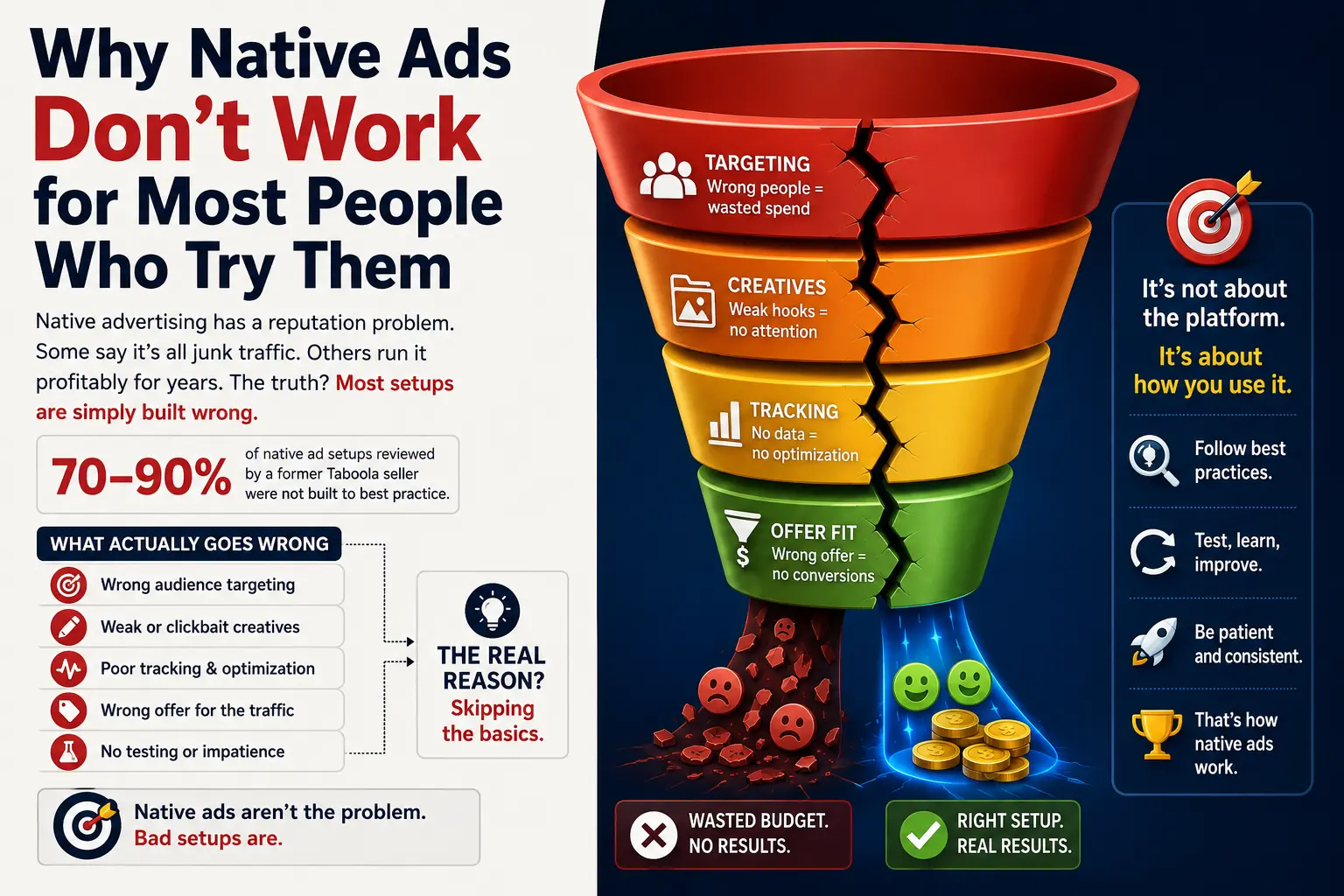
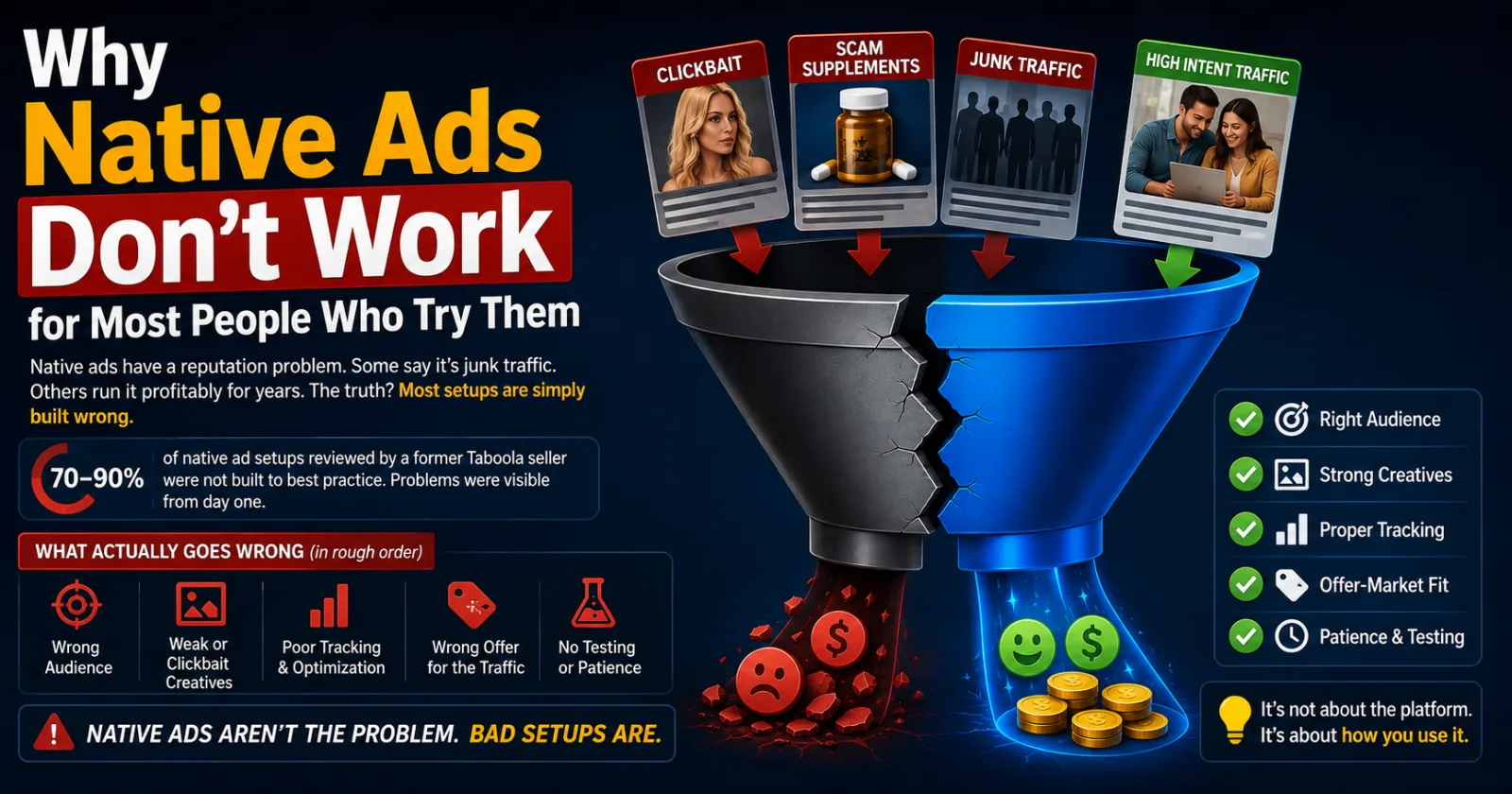
Both groups are describing something real. A person who spent four years selling native ads at Taboola put a rough number on it: of the setups he reviewed from advertisers who tested native and concluded it does not work, somewhere between seventy and ninety percent were not built to anything resembling best practice. The problems were visible from the first day.
So the channel is neither as bad as its reputation nor as easy as its defenders sometimes imply. Native ads not working is almost always one of a short list of problems, and most of them are on the advertiser's side. Here is what actually goes wrong, in rough order of how often it goes wrong, and then the one reason nobody wants to hear.
Reason One: You Bought It Through A DSP, Not The Platform
This is the first thing to establish, because it changes the entire diagnosis.
A lot of advertisers who complain about native never ran it through Taboola or Outbrain's own ad manager. They bought native placements programmatically through a demand-side platform, got served the remnant inventory those platforms push out to programmatic buyers, and concluded the channel was garbage. That conclusion is correct about what they bought. It says nothing about native run directly.
If you bought native programmatically and it failed, you have not tested native. Buy direct through the platform's own self-serve interface, then read the rest of this.
Reason Two: You Pasted Your Social Creatives Into A Native Account
Native ads look different from social ads because they are consumed differently. A social ad interrupts someone scrolling a feed. A native ad sits beside an article someone is reading, and it has to look like something that belongs there.
Polished brand creative with a logo, a product shot on white and a tagline tends to die on native. The audience skews older, they are reading rather than scrolling, and the ads that work look like headlines with a thumbnail rather than like ads. Taking a Facebook creative set and uploading it unchanged to Taboola is one of the most reliable ways to fail, and it is also one of the most common.
We cover what native creative actually needs to look like separately. The short version is that your social creative is not a starting point here, it is a liability.
Reason Three: You Sent The Click Straight To A Product Page
The same Taboola veteran estimated this fails in something like ninety-nine percent of cases, and nothing in any forum contradicts him.
A native click is cheap and cold. The person was reading about something else, saw a headline that caught them, and clicked. They know nothing about your brand and they were not looking for your product. Landing them on a product detail page with a price and a buy button asks them to make a purchase decision they were nowhere near making.
What works is a page that warms the click before it sees an offer. An advertorial, a listicle, or a hybrid of the two, that continues the story the ad started, builds the case, and only then hands off to the product page. This is the single largest structural difference between native and search, and skipping it produces exactly the result people complain about: plenty of clicks, no purchases, and a conclusion that the traffic was fake.
The traffic was not fake. It was cold, and you asked it to do something cold traffic does not do.
Reason four: you never looked at where your ads were served
Taboola runs on roughly eleven thousand sites. Some of those sites are premium publishers. Some are not. If you launch a campaign with no placement strategy, no block list and no rules, your budget flows to wherever the algorithm finds cheap clicks, which is often the worst inventory.
Then you look at the traffic, see it came from sites you have never heard of, and decide the channel is junk.
The platform shows you exactly which publishers served your ads. It lets you block sites at campaign level, upload block lists at account level, and build automatic rules that exclude publishers once they hit a threshold you define. A site producing an extreme click through rate on very few impressions, for instance, is usually a quality signal worth acting on automatically.
Advertisers who do this from day one report buying traffic from well-known publishers immediately, not after burning half a budget discovering which sites to block. Advertisers who skip it are, as one of them put it, leaving the front door open and complaining when someone walks in.
Reason Five: Your Tracking Was Too Thin, So The Algorithm Aearned Nothing
Native platforms optimise towards the conversion events you send them. Most advertisers send one: the purchase.
On a small budget that means the algorithm might see a fraction of a conversion per day. One or two a week is not enough for any optimisation system to learn from, on any platform. You are asking it to find buyers while giving it almost no examples of what a buyer looks like.
The fix is to pass soft conversions alongside the hard one. Add to cart. Checkout initiated. Individual funnel steps. A meaningful engagement event such as thirty seconds on the page. These give the system enough signal to optimise on while the purchase data accumulates, and they let you run a smaller test budget than a purchase-only setup would need.
This matters more on native than on social because the traffic is colder and the path to purchase is longer. Purchase-only tracking on native is close to running blind.
Reason Six: You Judged It In Three Days On Fifteen Euros
Native needs a genuine test budget and a genuine test period, and neither is what most first-time advertisers give it.
The budget question is covered in detail in our guide to native ads budget, but the shape of it is this. The platform's own guidance is a daily budget around ten times your target cost per acquisition. In a large market like the US, a few hundred dollars a day per campaign is the realistic floor. In a mid-sized European market, one to two hundred a day can work. And the test should run ten to fourteen days before any serious decision.
An advertiser who ran fifteen euros a day for three days and declared the channel dead did not test anything. That is not a criticism of them so much as a description of how most native tests actually happen.
Reason Seven: You Read The Wrong Number
This one hides the others, because it makes a working campaign look like a failure.
The conversion figures in a native ad manager have tracking and attribution gaps. Cookie consent in Europe means a large share of users opt out before the pixel fires. Attribution windows differ from what you are used to. And native frequently drives the first click in a purchase journey that gets credited elsewhere.
Advertisers who look at blended attribution tools rather than the platform dashboard often find a very different picture. One described nearly switching off Taboola because the native dashboard showed almost nothing, then checking first-click data in their analytics tool and finding a large share of customer journeys began on those advertorials. The channel was making money. The dashboard could not see it.
If you concluded native failed on the basis of platform-reported conversions alone, you may have killed a channel that was working. We have written this up properly in our piece on native ads attribution, and it is worth reading before you make a final call.
The Honest Reason Nobody Mentions
Everything above can be perfect and native can still fail, because the product does not fit the channel.
The same Taboola veteran put it at roughly half. Of ten products he looked at, about five were simply not native products. Average order value too high for a cold click to reach. No angle that gives an older reader an actual reason to buy. A break-even return on ad spend of four or five, which native does not produce and was never going to.
This is the part that vendors and agencies tend not to say, because it costs them the sale. It is also the part that a good account manager will tell you before you spend, and it is worth asking them directly. If someone experienced looks at your product and tells you it will not fly on native for a specific reason, take that seriously. If your friend ran his Meta setup on Taboola and it flopped, that tells you nothing.
Native Ads Not Working: Finding Which Reason Is Yours
Go through them in order.
If you bought programmatically, you have not tested native. If you used social creative, you tested the wrong ads. If you sent traffic to a product page, you tested the wrong funnel. If you never looked at placements, you tested the worst inventory. If you tracked purchases only, you starved the algorithm. If you ran for three days, you did not run long enough. If you read the ad manager alone, you may not have read the real result.
And if you did all of that right and it still failed, you have a real answer: your product is not a native product, and you can stop spending money finding out.
Most people never get to that last step, because one of the first seven caught them first. That is what native ads not working usually means. That is why the channel has the reputation it has, and it is also why the people running it profitably are not surprised by the reputation. They have seen the setups.
Agency ad accounts, without the wait.
Buy and top up Google, Meta, native, and more from one dashboard.
Get started

No comments yet. Be the first to comment.
Comments are open to registered AdScaleLab clients.
Sign in to comment